
Executive Takeaways
Test Our Free AI & Tech Utilities Suite
Calculate LLM API token costs, analyze article dwell-time, or simulate tech DCA returns.
- The Divergence Deepens: The upcoming midterm elections are poised to act as a financial wedge, splitting the technology sector into an upper-tier of capital-rich hyperscalers and a struggling lower-tier of margin-compressed application layers.
- Regulatory Moats as Competitive Armor: Shifting Congressional majorities and heightened federal oversight will paradoxically entrench incumbents capable of absorbing multi-billion-dollar compliance burdens while penalizing mid-market innovators.
- Infrastructure and Energy Bottlenecks: Legislative debates over grid expansion, Section 174 R&D tax amortization, and domestic semiconductor subsidies will dictate capital allocation efficiency, giving energy-secure tech giants an insurmountable operational lead.
- Valuation Multiples Realignment: Institutional asset managers are aggressively rotating out of high-multiple, generic software-as-a-service (SaaS) providers and concentrating liquidity into sovereign-aligned AI infrastructure leaders.
The Macro Bifurcation: Understanding the K-Shaped AI Trade
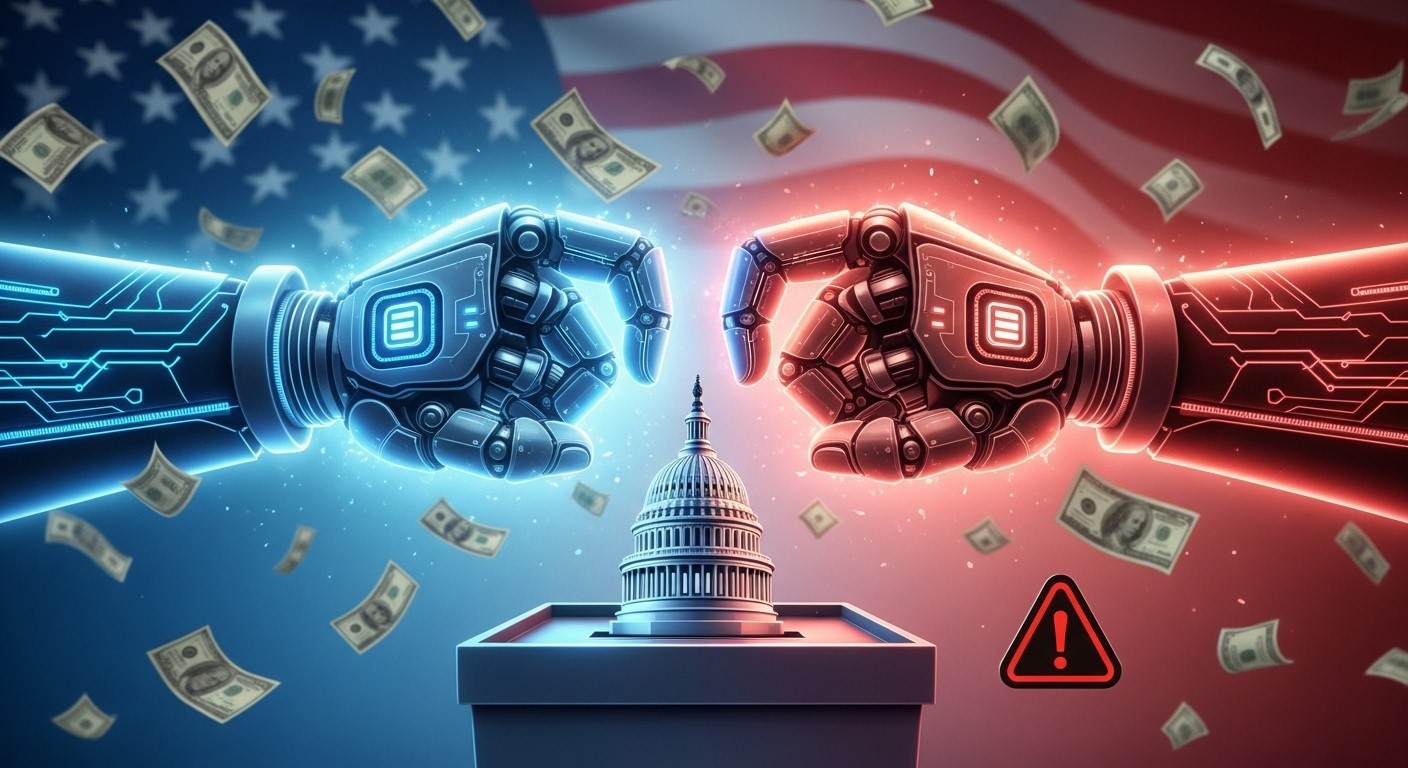
The global equity market is undergoing a structural realignment where the narrative of broad-based artificial intelligence monetization is giving way to a stark political and economic reality: the K-shaped divergence. At the top leg of the "K" sit the mega-cap hyperscalers, chip fabrication monopolists, and power infrastructure providers boasting fortress balance sheets and unassailable moat-building capabilities. At the bottom leg sit legacy IT vendors, mid-tier software application developers, and debt-laden AI startups struggling with accelerating cloud compute expenses, structural margin compression, and diminished access to late-stage venture capital.
As the United States approaches a high-stakes midterm election cycle, political volatility is set to act as the ultimate accelerant of this split. Far from treating the tech sector as a monolith, shifting policy priorities—spanning trade policy, domestic energy permitting, antitrust policy, and tax code revisions—are systematically rewarding scale while penalizing cash-burning competitors. Investors who previously traded AI as a rising tide lifting all boats must now navigate a macro environment where regulatory compliance overhead, sovereign strategic incentives, and capital allocation efficiencies strictly dictate enterprise survival.
The financial physics of the current market cycle are clear. With combined annual capital expenditures (CAPEX) among top-tier hyperscalers surpassing $200 billion to build out next-generation cloud compute architecture, smaller market entrants face an asymmetric game. Midterm election debates over national security mandates and cross-border data governance are raising the table stakes for entering the ecosystem, effectively turning political uncertainty into a strategic wedge that widens the spread between winners and losers.
Policy Drivers: How Congressional Shift Creates Regulatory Moats
The legislative agenda surrounding the midterm elections presents a complex matrix of tailwinds and headwinds. Rather than suppressing technology investment wholesale, political friction inevitably creates regulatory moats. These legal and administrative hurdles are easily cleared by balance-sheet giants, but often prove fatal to cash-poor market challengers.
1. Antitrust Enforcement vs. Sovereign Capability
While the Federal Trade Commission (FTC) and the Department of Justice (DOJ) maintain aggressive posture against monopolistic horizontal integration, the geopolitical imperative to maintain national dominance in artificial intelligence limits radical structural breakups. Legislative posturing ahead of the midterms will emphasize sovereign capability. Mega-caps with defense partnerships and deep integration into domestic intelligence frameworks will gain unspoken regulatory insulation, whereas mid-tier platforms face heightened operational friction and protracted acquisition reviews that stifle exit liquidity.
2. Tax Policy and Section 174 Capitalization
The resolution—or continuation���of the amortization rules under Internal Revenue Code Section 174 remains a vital catalyst for the K-shaped trade. The requirement to amortize research and experimentation costs over five years (or fifteen years for foreign R&D) rather than deducting them immediately has severely eroded cash flows for mid-sized technology firms. If a divided Congress fails to enact retroactive relief following the midterms, smaller, software-intensive companies will see net margins drop further, while enterprise giants leverage existing tax assets and foreign treasury strategies to mitigate the impact.
3. Energy Permitting and Grid Infrastructure Reform
Compute capacity is fundamentally constrained by electron availability. Midterm campaign discourse focused on energy transition policies, FERC regulatory authority, and clean-energy tax credits directly impacts the timeline for grid-interconnection approvals. Big tech firms with the liquidity to execute direct power purchase agreements (PPAs), invest in small modular reactors (SMRs), or co-locate data centers near nuclear facilities will secure uninterrupted compute capabilities. Conversely, smaller players relying on public cloud spot rates will face soaring passed-through electricity costs.
Verified Data & Financial Metrics Breakdown
The structural divergence between the upper and lower arms of the K-shaped AI trade is clearly visible across fundamental financial metrics, valuation multiples, and capital deployment profiles:
| Financial Metric / Dynamic | Upper-Arm: Infrastructure & Hyperscalers | Lower-Arm: Mid-Tier SaaS & Wrapper Apps | Midterm Policy Impact & Sensitivity |
|---|---|---|---|
| Forward EV/EBITDA Multiples | 24.0x – 35.0x (Supported by direct cash generation) | 8.0x – 14.0x (Compressed due to lack of moat) | High: Tax policy & regulatory cost changes alter cash flow discount rates. |
| Annual CAPEX Intensity | $30B – $65B per enterprise (Hard infrastructure focus) | < $500M (Relies heavily on third-party public clouds) | Extreme: Grid permitting and chip export restrictions dictate capacity costs. |
| Regulatory Compliance Cost / Revenue | < 1.5% of net revenues (Scalable operations) | 4.5% – 8.0% of net revenues (High fixed burden) | Direct: FTC/DOJ oversight and data security mandates favor broad scale. |
| R&D Expense Tax Deductibility Impact | Absorbed via global tax optimization models | Directly erodes operating margins under Sec. 174 | High: Congressional tax relief packages will directly alter bottom-line stability. |
| Enterprise Cash Reserves | $40B – $110B+ in cash and liquid securities | < $1.5B (Dependence on high-cost debt/dilution) | Moderate: Market liquidity and interest rate expectations dictate refinancing capability. |
Sectoral Breakdown: Institutional Capital Flows and Disparity
Institutional asset managers, sovereign wealth funds, and private equity firms are executing distinct playbooks in response to this political and economic dynamic. The flow of funds reveals a systematic flight to operational quality and defensible infrastructure.
The Winners: Hyperscalers, Semiconductors, and Utilities
The top tier of the K-trade consists of companies providing foundational compute infrastructure, semiconductor manufacturing equipment, and direct energy solutions. Wall Street analysts are consistently revising upward the multi-year revenue projections for companies operating in these categories:
- Semiconductor Monopolists & Foundry Partners: High-bandwidth memory (HBM) suppliers and specialized chipmakers remain insulated due to strict export controls and defense contracts that receive bipartisan support regardless of congressional control.
- Hyperscale Cloud Providers: Built-in structural advantages allow these firms to bundle native AI models with existing enterprise software suites, driving up net dollar retention without incurring proportional customer acquisition costs.
- Base-Load Energy & Power Infrastructure: Independent power producers (IPPs), nuclear utility operators, and electrical grid component manufacturers are capturing a growing premium as data center power demand outpaces localized generation capacity.
The Strugglers: Generic SaaS, Consumer Wrappers, and Legacy IT Services
In contrast, companies occupying the lower tier face a compounding crisis of revenue deceleration, high churn rates, and margin compression:
- Application Layer "Wrappers": Companies whose core product consists of a thin interface layer over third-party foundation models face rapid feature obsolescence as platform providers integrate identical tools natively.
- Legacy Enterprise Software Vendors: Outdated licensing models and slow cloud-native migrations leave these firms vulnerable to vendor consolidation as corporate CIOs trim software stacks to fund AI implementation initiatives.
- Capital-Constrained AI Startups: Lacking sovereign funding backing or multi-year compute reservations, late-stage venture-backed firms face down-rounds or fire-sale acquisitions under heightened antitrust scrutiny.
People Also Ask (Frequently Asked Questions)
What is the K-shaped AI trade, and how do the midterms affect it?
The K-shaped AI trade describes an economic environment where mega-cap infrastructure leaders and energy suppliers experience accelerated earnings growth and valuation expansion (the upper arm), while mid-tier software and application-layer firms suffer margin compression and declining multiples (the lower arm). The midterms amplify this split because legislative action—or gridlock—on tax policy, grid infrastructure permitting, and antitrust enforcement reinforces the competitive advantages of well-capitalized incumbents while increasing operational costs for smaller competitors.
How does Section 174 taxation impact mid-tier software and AI companies?
Section 174 of the U.S. Internal Revenue Code requires companies to amortize software development and R&D costs over five years for domestic work (and fifteen years for international work) rather than deducting these expenses in the year they were incurred. For mid-tier AI and software firms with high R&D expenditures relative to revenue, this creates phantom taxable income, significantly reducing net cash flow and forcing companies to cut operational capacity or seek expensive bridge financing.
Why are energy and utility stocks included in the top-tier of the AI trade?
Modern AI model training and real-time inference workloads require unprecedented volumes of electric power. Hyperscale data centers require gigawatt-scale power commitments, creating severe supply constraints on regional electrical grids. Utility providers, nuclear operators, and energy infrastructure firms that hold grid-interconnection rights or possess base-load power generation capabilities can charge premium prices through long-term Power Purchase Agreements (PPAs), making them vital, cash-generative winners in the AI value chain.
Will antitrust enforcement drop if control of Congress changes after the midterms?
While the focus of antitrust enforcement may shift depending on political control, overall scrutiny over the tech sector is expected to remain high under a bipartisan populism model. A change in congressional majorities may alter the specific enforcement vectors—shifting focus from platform neutrality to censorship, national security, or foreign supply chain dependencies—but it is unlikely to roll back existing compliance requirements. Crucially, larger incumbents have the balance sheet capacity to handle protracted legal battles, whereas mid-market companies face structural deal-cancellation risks when attempting strategic M&A.
Future Outlook: Strategic Milestones to Watch (12 to 24-Month Horizon)
Navigating the K-shaped AI trade through and beyond the midterm elections requires closely monitoring specific macro events, regulatory deadlines, and corporate indicators. Institutional allocators must track the following key catalysts to optimize portfolio risk mitigation and capital allocation strategies:
- Post-Election Congressional Lame-Duck Session: Watch for last-minute legislative packages addressing the extension of business tax incentives, specifically Section 174 R&D amortization relief and accelerated bonus depreciation under Section 168(k). Failure to pass relief will trigger instant downside guidance revisions across unprofitable tech components.
- FERC and Regional Grid Interconnection Rulings: The Federal Energy Regulatory Commission’s policy decisions regarding co-located data center power configurations will dictate whether hyperscalers can secure private nuclear power sources directly or face delays from regional utility opposition.
- Hyperscaler CAPEX-to-Free-Cash-Flow Ratios: Institutional markets will monitor whether multi-billion-dollar infrastructure outlays convert into software revenue expansion. Any signal of decelerating enterprise cloud spending could trigger brief market pullbacks, though structural advantages will keep the underlying market split intact.
- Sovereign AI Mandates & Export Control Updates: Further restrictions on high-performance compute export licenses to foreign markets will lock down global supply chains, benefiting onshore chipmakers while squeezing mid-market global software providers.
As the political landscape evolves, the market will continue to penalize execution risk, high leverage, and weak capital positions. The midterms will not erase the underlying disruption of artificial intelligence; instead, they will clarify which institutional titans have the structural leverage, political influence, and balance sheet strength to capitalize on the next era of technological deployment.