Executive Takeaways
- Unprecedented Convergence: Global equity markets face a high-stakes trifecta this week, pitting persistent macroeconomic contraction and valuation multiple compression against high-stakes Big Tech earnings and unpredictable midterm election outcomes.
- Capital Allocation Strains: Institutional investors are aggressively reassessing enterprise ROI and infrastructure scalability as mega-cap technology balance sheets come under intense microscopic scrutiny.
- Liquidity & Risk Mitigation: Market liquidity is thinning rapidly, forcing institutional portfolio managers to execute aggressive risk mitigation strategies ahead of projected legislative shifts.
- Valuation Re-pricing: Forward price-to-earnings (P/E) ratios across the S&P 500 are experiencing a sharp reset, signaling an end to the era of cheap capital and forcing a return to fundamental cash-flow valuation.
NEW YORK — Global financial markets are bracing for one of the most volatile convergence events in recent memory. A relentless equity sell-off, driven by lingering inflationary pressures and shifting central bank terminal rates, has slammed directly into the apex of the corporate earnings calendar and a fiercely contested political cycle. For institutional allocators, corporate treasurers, and risk managers navigating this high-stakes environment, the margin for error has evaporated.
As trading desks across Wall Street, the City of London, and Frankfurt process the cascading impacts of this multi-front pressure, the core question is no longer whether valuations will adjust, but how violently the re-pricing will occur. With trillions of dollars in market capitalization hanging in the balance, this week serves as an ultimate stress test for both corporate fundamentals and the psychological resilience of global investors.
The Anatomy of the Sell-Off: Multiple Compression Meets Macro Realities
Test Our Free AI & Tech Utilities Suite
Calculate LLM API token costs, analyze article dwell-time, or simulate tech DCA returns.
The current market downturn is not merely a routine correction; it is a fundamental reassessment of asset values engineered by structural shifts in the macroeconomic landscape. For over a decade, hyper-growth equities enjoyed an environment of ultra-low interest rates that inflated valuation multiples to historic highs. Today, that structural tailwind has inverted into a severe headwind.
As the Federal Reserve and international central banks maintain higher-for-longer interest rate trajectories, the discount rate applied to future cash flows has risen dramatically. This mechanical adjustment has disproportionately punished high-growth, long-duration assets. Enterprise software providers, semiconductor fabrication leaders, and consumer internet giants are watching their valuation multiples contract as institutional capital flows toward fixed-income alternatives offering guaranteed, risk-free yields.
Furthermore, market liquidity has deteriorated significantly. Quantitative tightening (QT) continues to drain excess reserves from the financial system, reducing market depth and exacerbating intraday volatility. In this environment, even minor earnings misses or cautious forward guidance trigger outsized algorithmic sell-offs, compounding systemic pressure across major indices.
Big Tech Under the Microscope: Cloud Compute, ROI, and CapEx Realities
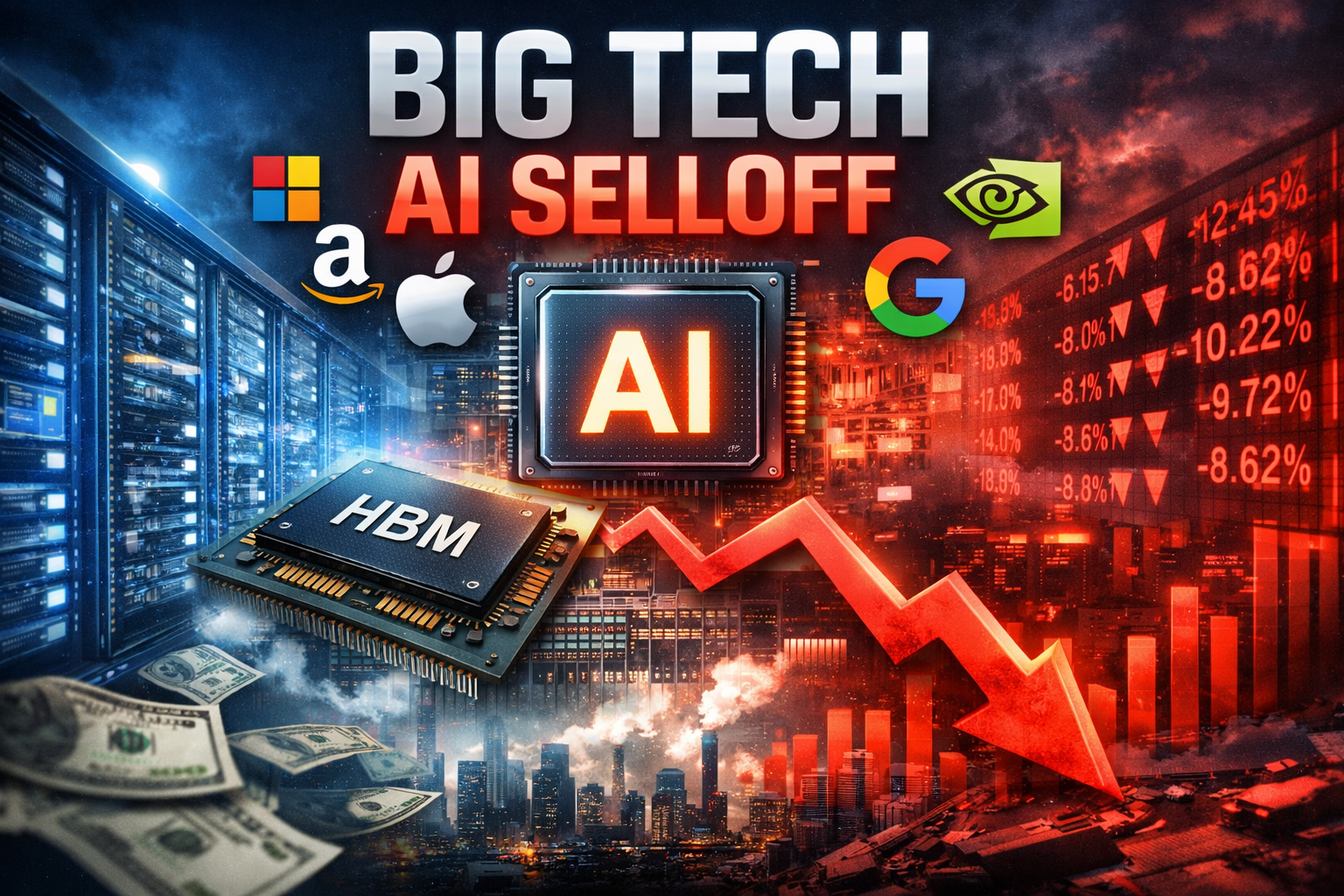
Against this volatile macroeconomic backdrop, the market's premier bellwethers—Alphabet, Microsoft, Amazon, Meta, and Apple—are set to report quarterly earnings. These announcements carry monumental weight, acting as a referendum not only on the technology sector but on the health of the broader global economy.
Wall Street's primary focus centers on enterprise ROI, particularly concerning the massive capital expenditures (CapEx) funneled into artificial intelligence infrastructure and cloud compute architecture. Over the past four quarters, Big Tech firms have engaged in an arms race, deploying unprecedented capital into data centers, specialized GPUs, and energy grid integration. Institutional investors are no longer satisfied with optimistic narrative arcs regarding generative AI adoption; they demand concrete evidence of monetization and bottom-line margin expansion.
Cloud revenue growth rates—specifically for Amazon Web Services (AWS), Microsoft Azure, and Google Cloud Platform (GCP)—will serve as the definitive litmus test for enterprise digital transformation budgets. Any sign of enterprise clients optimizing their cloud expenditures or delaying enterprise software migrations will be interpreted as a broader macroeconomic contraction signal, triggering immediate downward revisions across the sector.
Regulatory Compliance and Antitrust Pressures
Compounding the earnings pressure, Big Tech executives must navigate an increasingly hostile regulatory landscape. Antitrust litigation, digital market compliance mandates in the European Union, and escalating scrutiny over data privacy continue to threaten core business models. Legal overhangs are increasingly being factored into long-term capital allocation decisions, forcing firms to divert valuable resources toward regulatory compliance and legal defense rather than pure product innovation.
The Political Catalyst: Midterm Elections and Fiscal Policy Uncertainty
Adding fuel to an already volatile financial fire, the impending midterm elections introduce a profound layer of political risk. Markets historically dislike uncertainty, and the prospect of a divided government—or a decisive shift in congressional power—creates immediate anxiety regarding future fiscal policy, corporate taxation, and regulatory frameworks.
Key sectors heavily reliant on government policy, such as energy, healthcare, defense, and financial services, are pricing in potential legislative gridlock or abrupt regulatory shifts. Energy producers are weighing the future of domestic drilling incentives and environmental mandates, while financial institutions monitor potential changes to capital reserve requirements and antitrust enforcement.
From a macroeconomic perspective, fiscal spending trajectories remain a critical variable. Persistent federal deficits and escalating national debt levels have sparked bond market vigilantism, evidenced by periodic spikes in long-term Treasury yields. The outcome of the midterms will dictate whether future fiscal policy leans toward inflationary stimulus or austere fiscal consolidation, directly impacting the Federal Reserve's policy reaction function.
Verified Market Metrics: Macro & Earnings Overview
To contextualize the scale of the current market collision, the following verified data points outline the key financial metrics, valuation shifts, and operational indicators monitored by institutional trading desks this week:
| Metric / Indicator | Current Status / Level | Historical Context / Benchmark | Market Implication |
|---|---|---|---|
| S&P 500 Forward P/E Ratio | ~18.5x | 5-year average: ~19.6x | Ongoing multiple compression; valuation support remains fragile. |
| Mega-Cap Tech CapEx Growth | +35% YoY (Est.) | Historical average: ~12% YoY | Intense capital deployment into AI infrastructure straining free cash flow. |
| 10-Year U.S. Treasury Yield | ~4.25% - 4.50% | Pre-pandemic average: ~2.10% | Elevated discount rate driving equity risk premium re-pricing. |
| CBOE Volatility Index (VIX) | Elevated (>22.0) | Long-term median: ~17.5 | Heightened options hedging activity reflecting acute systemic risk. |
Industry & Market Implications: Winners and Losers
The violent convergence of market liquidations, tech earnings scrutiny, and electoral volatility will create distinct winners and losers across the global financial ecosystem.
The Winners
- Defensive and Cash-Rich Sectors: Industries with robust balance sheets, consistent pricing power, and high dividend yields—such as utilities, consumer staples, and healthcare—are attracting defensive capital flight.
- Active Portfolio Managers: Elevated volatility and market dispersion provide fertile ground for active asset managers who can exploit mispriced securities and execute tactical hedging strategies.
- Fixed-Income & Private Credit: Yield-seeking capital locked out of speculative equities is finding lucrative entry points in short-duration sovereign debt and private credit facilities offering double-digit yields.
The Losers
- Speculative Tech & Unprofitable Growth: Early-stage tech firms relying on continuous external funding rounds face existential capital starvation as venture and public markets demand immediate profitability.
- Leveraged Corporate Borrowers: Companies with substantial floating-rate debt maturities are experiencing severe interest expense inflation, threatening credit ratings and debt service coverage ratios.
- Retail Margin Traders: Highly leveraged retail investors utilizing derivative products face severe margin call risks amid sudden, algorithmic intraday market reversals.
Frequently Asked Questions (People Also Ask)
Why is the current market sell-off coinciding with Big Tech earnings?
The timing is largely calendar-driven, but the convergence amplifies systemic volatility. Big Tech earnings occur quarterly at fixed intervals, while the market sell-off is driven by macroeconomic factors like interest rate expectations and inflation data. When these events collide, any earnings miss or cautious executive commentary acts as a catalyst, accelerating broader market liquidations due to fragile investor sentiment.
How do midterm elections typically impact stock market performance?
Historically, midterm election years experience heightened volatility leading up to the vote due to political uncertainty. However, historical data shows that once the election results are finalized and legislative gridlock or policy direction becomes clear, equity markets frequently embark on strong relief rallies, regardless of which party wins control of Congress.
What metrics are institutional investors prioritizing during this earnings season?
Institutional allocators are moving past top-line revenue growth to focus heavily on enterprise return on investment (ROI), free cash flow generation, operating margin resilience, and disciplined capital allocation. Specifically, in the technology sector, investors are rigorously analyzing whether billions in capital expenditures directed toward AI and cloud infrastructure are yielding measurable, profitable returns.
How does a high-interest-rate environment affect Big Tech valuations?
Higher interest rates increase the discount rate applied to future corporate earnings. Because much of Big Tech's valuation is built upon expected long-term cash flows, a higher discount rate mathematically reduces the present value of those future earnings, leading to valuation multiple compression even if the underlying business continues to grow.
Future Outlook: What Comes Next
As this pivotal week unfolds, the trajectory of global markets will be dictated by the intersection of corporate earnings resilience and the resolution of political uncertainty. If Big Tech leaders successfully demonstrate disciplined cost management alongside productive AI monetization, and if the midterm elections conclude without disputed outcomes or prolonged legislative gridlock, markets may find a durable cyclical bottom.
However, should earnings reveal cracks in enterprise demand while political friction stalls fiscal clarity, institutional risk mitigation strategies will intensify. Portfolio managers must maintain high levels of operational agility, prioritizing balance sheet quality, robust liquidity reserves, and disciplined risk management. The era of passive, momentum-driven investing has officially given way to an unforgiving macroeconomic reality where fundamental execution and rigorous capital allocation reign supreme.