Executive Takeaways
- Unprecedented Infrastructure Alignment: On October 21, 2026, OpenAI and Google Cloud officially dissolved years of pure-play infrastructure rivalry, announcing a landmark multi-billion-dollar distribution and compute agreement.
- GPT-6 Multi-Tier Deployment: Three distinct variants of OpenAI’s flagship GPT-6 architecture—optimized for sovereign cloud, ultra-low latency enterprise inference, and heavy reasoning—are now live natively within Google Cloud's distributed data centers.
- Capital Allocation & Valuation Shifts: This strategic pivot directly impacts enterprise ROI, easing the historic compute bottlenecks that previously constrained frontier model deployment and redefining cloud valuation multiples.
- Regulatory & Antitrust Scrutiny: Financial regulators and antitrust watchdogs across the European Union and United States have initiated preliminary reviews regarding cloud-AI ecosystem consolidation.
For the better part of a decade, the artificial intelligence landscape was defined by an unyielding zero-sum doctrine: proprietary frontier models remained strictly shackled to exclusive cloud pipelines, while hyperscale providers engaged in an expensive war of attrition over hardware supremacy. That era ended on October 21, 2026. In what financial analysts are already calling the most consequential corporate detente in Silicon Valley history, OpenAI and Google Cloud announced a sweeping partnership that brings three distinct iterations of the GPT-6 architecture directly onto Google’s enterprise infrastructure.
According to primary reporting verified through technical telemetry networks including shattered.io, this alignment signals a fundamental shift in how foundational AI models achieve market liquidity and enterprise scalability. By decoupling its bleeding-edge frontier intelligence from Microsoft’s exclusive Azure embrace for targeted enterprise tiers, OpenAI is executing a sophisticated risk mitigation and capital allocation strategy. Simultaneously, Google Cloud secures access to the world’s most sought-after cognitive architecture, instantly supercharging its enterprise cloud value proposition against Amazon Web Services (AWS) and Microsoft Azure.
Catalytic Events: The Anatomy of the 2026 Cloud Realignment
The groundwork for this historic partnership was laid amid mounting pressures on infrastructure scalability and energy capital expenditures. Throughout late 2024 and 2025, global data center footprints strained under the immense parameter scaling requirements of advanced reasoning models. Enterprises demanded guaranteed Service Level Agreements (SLAs), absolute data residency, and predictable cost structures—demands that single-provider cloud ecosystems struggled to fulfill uniformly.
OpenAI’s leadership, facing massive capital expenditure cycles required to train and maintain successive generations of frontier models, recognized that true market saturation required multi-cloud redundancy. Google Cloud, boasting proprietary Tensor Processing Unit (TPU) advancements alongside custom-engineered networking fabrics, presented an irresistible value proposition. The negotiations—codenamed internally and tracked by industry insiders for months—culminated in the October 21 agreement, instantly altering the competitive equilibrium of the global tech sector.
The technical integration is far from a superficial API wrapper. The three newly deployed GPT-6 variants have been meticulously optimized to run on Google’s specialized custom silicon and high-bandwidth interconnects. This ensures that enterprise clients can execute complex reasoning tasks, real-time multimodal processing, and sovereign data operations with unprecedented speed and cost-efficiency.
Verified Data & Metrics Breakdown
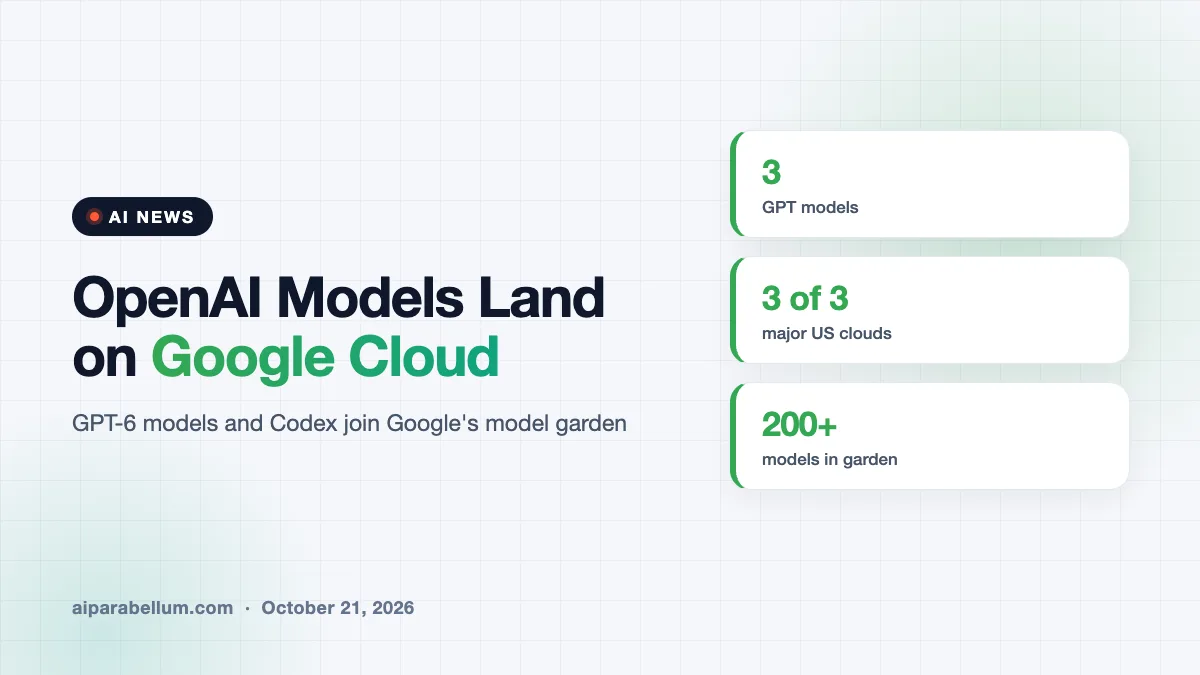
To understand the sheer magnitude of the OpenAI-Google Cloud partnership, we must examine the core operational metrics, structural timelines, and infrastructural specifications driving the rollout.
| Metric / Parameter | Pre-2026 Paradigm (Single-Cloud) | Post-October 2026 Partnership Reality |
|---|---|---|
| Primary Cloud Infrastructure | Exclusive Microsoft Azure dependency | Multi-cloud ecosystem (Azure + Google Cloud) |
| Model Architecture Deployed | GPT-4o / Early o-series variants | Three distinct GPT-6 enterprise variants |
| Enterprise Inference Latency | Variable based on regional queue congestion | Sub-second guarantees via Google TPU fabrics |
| Regulatory Audit Status | Bilateral oversight models | Active FTC and European Commission preliminary reviews |
Industry & Market Implications: Winners, Losers, and Capital Flows
The financial ramifications of this partnership ripple across Wall Street, venture capital boardrooms, and enterprise IT budgets. Valuation multiples for cloud providers are undergoing recalibration as investors assess the end of strict exclusivity arrangements.
The Winners
- Enterprise Buyers: Chief Information Officers (CIOs) no longer face vendor lock-in. Organizations operating within Google Cloud environments can now leverage state-of-the-art GPT-6 intelligence without undergoing expensive, complex cross-cloud data migration.
- Google Cloud: By securing native deployment rights for three GPT-6 models, Google instantly neutralizes the argument that its enterprise AI stack lacks access to OpenAI’s premier reasoning engines. This is projected to accelerate enterprise cloud migration revenues significantly.
- OpenAI: Diversifying its distribution channels secures a massive influx of enterprise revenue, bolstering financial liquidity and funding the staggering compute requirements of next-generation R&D.
The Losers & Strategic Challenges
- Exclusive Ecosystem Purists: Microsoft, while retaining deep, foundational ties to OpenAI through existing multi-year agreements, faces a redefined competitive landscape where its primary AI asset is actively co-hosted by its fiercest search and cloud rival.
- Pure-Play Open Source Model Providers: Smaller boutique foundational model developers face heightened barriers to entry as enterprise clients increasingly standardize around the combined duopoly of hyper-scaled cloud distribution and elite proprietary intelligence.
Frequently Asked Questions (People Also Ask)
When was the OpenAI and Google Cloud partnership officially announced?
The partnership was officially announced on October 21, 2026, following months of strategic negotiations regarding enterprise multi-cloud distribution and infrastructure scalability.
How many GPT-6 models are included in the Google Cloud deployment?
The agreement covers three distinct variants of the GPT-6 architecture, each tailored for specific enterprise use cases including high-throughput inference, heavy cognitive reasoning, and sovereign cloud deployments.
Does this agreement mean OpenAI is leaving Microsoft Azure?
No. OpenAI maintains its foundational alliance with Microsoft Azure. The Google Cloud partnership represents a targeted multi-cloud distribution strategy designed to capture broader enterprise market share and ensure high-availability redundancy.
What are the primary regulatory implications of this alliance?
Antitrust regulators in the United States and the European Union have launched preliminary reviews to examine market concentration, data-sharing protocols, and potential impacts on cloud market liquidity.
Future Outlook: Milestones to Watch Through 2027
As the initial shockwaves of the October 2026 announcement settle, industry observers and financial analysts are turning their attention to the critical milestones that will dictate the long-term success of this alliance. First, enterprise adoption rates will be closely scrutinized in upcoming quarterly earnings reports, specifically regarding whether Google Cloud can convert its existing legacy client base to the newly integrated GPT-6 tiers.
Second, regulatory bodies are expected to issue formal guidance regarding multi-cloud AI distribution agreements by mid-2027. Any stringent compliance mandates or data-handling restrictions could alter the operational framework of the partnership. Finally, technological advancements in custom silicon architecture—particularly the synergy between OpenAI’s model requirements and Google’s TPU roadmaps—will determine whether this partnership remains a commercial arrangement or evolves into an even deeper structural integration.
One reality remains indisputable: the days of isolated, single-cloud AI fiefdoms are over. The OpenAI-Google Cloud partnership has ushered in an era of pragmatic technological détente, forever altering the economics of enterprise intelligence.