Executive Takeaways
- Zero Marginal Cost: Running local large language models (LLMs) on HP’s Omnibook Ultra completely eliminates recurring token fees, disrupting the traditional Software-as-a-Service (SaaS) consumption model.
- Enterprise-Grade Data Sovereignty: Localized neural processing units (NPUs) eliminate cloud transit vectors, neutralizing data leakage risks and satisfying stringent global regulatory compliance frameworks like GDPR and HIPAA.
- The Silicon Arms Race: AMD’s Ryzen AI architecture inside the Omnibook Ultra delivers up to 55 NPU TOPS, shifting the valuation multiples of hardware manufacturers versus pure-play cloud software vendors.
For the past thirty months, the enterprise technology playbook has been uniform, expensive, and rigidly dependent on the cloud. Corporations and power users alike have funneled billions of dollars into centralized data centers, paying perpetual token fees to hyperscalers for every query, summary, and generated line of code. That centralized paradigm—dominated by API calls to remote server farms owned by a handful of tech oligopolies—is facing its most serious structural challenge yet.
Recent rigorous field tests with HP’s Omnibook Ultra reveal a stark reality: high-performance, on-device artificial intelligence has crossed the threshold from experimental novelty to industrial-grade utility. By pairing advanced silicon architectures with optimized local quantization, this machine runs complex open-weights models locally. The result is a private, lightning-fast computing beast operating at zero marginal cost per token. For chief technology officers, corporate treasurers, and security architects, this development forces an immediate recalculation of infrastructure scalability, capital allocation, and risk mitigation strategies.
The Anatomy of a Local AI Powerhouse
Test Our Free AI & Tech Utilities Suite
Calculate LLM API token costs, analyze article dwell-time, or simulate tech DCA returns.
To understand why the Omnibook Ultra represents a watershed moment in personal and enterprise computing, one must look beneath the chassis. Traditional laptops buckle under the computational weight of running an LLM because standard central processing units (CPUs) and graphics processing units (GPUs) are not optimized for the continuous matrix multiplications fundamental to neural network inference. Furthermore, doing so via CPU or discrete GPU rapidly drains battery reserves and triggers thermal throttling.
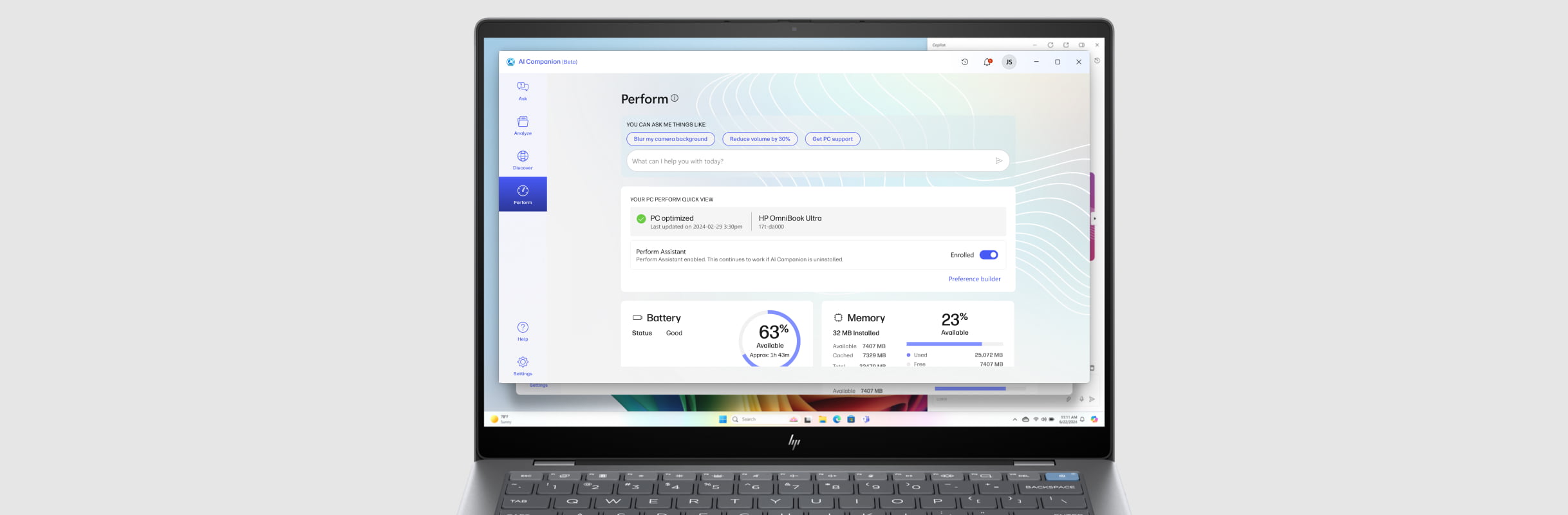
HP solved this bottleneck by integrating cutting-edge system-on-chip (SoC) design featuring dedicated neural processing units (NPUs). Powered by AMD Ryzen AI silicon, the Omnibook Ultra delivers an astonishing 55 TOPS (Tera Operations Per Second) of dedicated AI processing power. Combined with unified memory architectures and high-bandwidth LPDDR5X RAM, the device loads and executes quantized models—such as Meta’s Llama 3 or Mistral—entirely within local silicon boundaries.
When evaluated in real-world workflows, the machine processes prompts with zero latency spikes caused by network congestion. There are no API rate limits, no throttling during peak global usage hours, and, most importantly, no invoices arriving at the end of the month based on token consumption volumes. Every query executed locally is a token acquired for free.
Data Sovereignty and the Mitigation of Regulatory Risk
Beyond the obvious financial arbitrage of escaping recurring cloud subscription fees, the broader enterprise implications center on data sovereignty and risk mitigation. In an era marked by aggressive regulatory enforcement—ranging from the European Union’s Artificial Intelligence Act to rigorous state-level privacy mandates in the United States—sending proprietary corporate data, financial spreadsheets, or source code to third-party cloud servers introduces unacceptable compliance vulnerabilities.
When a legal department reviews confidential mergers and acquisitions documentation or a healthcare provider analyzes patient data using cloud-based AI, every byte transmitted represents a potential vector for data exfiltration, regulatory penalties, or intellectual property theft. Cloud providers routinely point to enterprise-grade encryption and privacy pledges, yet boardrooms increasingly demand absolute physical control over data residency.
The Omnibook Ultra solves this structural friction definitively. Because inference occurs entirely on the local device, sensitive corporate data never traverses an external network interface card. It stays within the physical boundaries of the silicon memory architecture. For compliance officers and Chief Information Security Officers (CISOs), this local-first execution model transforms AI from a high-risk compliance liability into a secure, contained productivity engine.
Comparative Metrics: Cloud API vs. Local On-Device AI (Omnibook Ultra)
| Metric / Feature | Traditional Cloud API Model | HP Omnibook Ultra (Local AI) |
|---|---|---|
| Marginal Cost per Query | Variable token fees ($0.002 - $0.06+ per 1k tokens) | $0.00 (Zero Token Fees) |
| Data Privacy & Residency | Data transmitted and processed on third-party cloud servers | 100% Local (Zero Network Transmission) |
| Latency & Connectivity | Dependent on internet bandwidth and server-side queuing | Instantaneous; works completely offline |
| Regulatory Compliance (GDPR/HIPAA) | Requires strict Business Associate Agreements (BAAs) and auditing | Inherent compliance via complete data isolation |
| Hardware NPU Capacity | N/A (Relies on remote server infrastructure) | 55 TOPS Dedicated Ryzen AI NPU |
Industry & Market Implications: Who Wins and Who Loses?
The rapid maturation of local AI hardware architectures triggers a profound realignment across global technology markets. As devices like the Omnibook Ultra prove capable of handling heavy cognitive workloads independently, the economic gravity of the artificial intelligence sector begins to shift.
The Winners: Client Hardware Manufacturers and Open-Weights Developers
Traditional PC and silicon vendors are experiencing a renaissance. For years, personal computers were viewed as mature, commoditized hardware items with stagnant replacement cycles. The integration of high-performance NPUs injects a powerful catalyst into enterprise hardware refresh cycles. Corporations are no longer buying laptops merely for spreadsheet editing and email; they are acquiring edge-computing nodes capable of autonomous intelligence. Concurrently, open-weights AI developers (such as Meta, Mistral, and various open-source contributors) win because enterprises now possess the physical infrastructure required to deploy their models without intermediary cloud gatekeepers.
The Vulnerable: Pure-Play Cloud Compute Monopolies
Hyperscalers and SaaS providers whose valuation multiples are tethered to continuous consumption-based API billing face a nuanced yet structural threat. While massive enterprise models training on trillions of parameters will permanently reside in hyper-scale data centers, the everyday execution of routine intelligence—summarization, drafting, local data analysis, and coding assistance—migrates to the edge. This migration curtails the runaway growth of low-latency, high-volume API revenues that Wall Street has priced into cloud giants.
Frequently Asked Questions (People Also Ask)
Does running local AI on the HP Omnibook Ultra require an active internet connection?
No. Once the open-weights language models are downloaded onto the device storage, the entire inference process runs locally on the NPU and CPU. You can execute complex prompts, analyze documents, and generate content while entirely offline, making it ideal for secure travel and remote field operations.
How does the performance of local models on the Omnibook Ultra compare to major cloud APIs?
For standard productivity tasks, coding assistance, and document summarization, highly optimized open-weights models (such as Llama 3 8B or Mistral 7B) running locally via tools like Ollama or LM Studio deliver near-instantaneous response times. While massive 400B+ parameter models in the cloud still hold advantages for hyper-complex reasoning, local models handle 90% of daily knowledge-worker tasks with zero latency and zero cost.
What impact does running local AI have on battery life and thermal performance?
Unlike running inference on poorly optimized CPUs or discrete GPUs—which rapidly drain batteries and generate excessive heat—the dedicated Ryzen AI NPU inside the Omnibook Ultra is engineered for high-efficiency matrix math. It processes AI workloads at a fraction of the thermal and electrical cost, preserving battery longevity during extended mobile work sessions.
Are enterprise-grade security protocols supported for corporate deployment?
Yes. The combination of hardware-level security features, such as AMD Secure Processor technology, and HP’s proprietary BIOS protection layers ensures that local AI execution meets or exceeds corporate security baselines. Because data never leaves the device, organizations eliminate external transmission vulnerabilities entirely.
Future Outlook: The Road Ahead for Edge Intelligence
The debut and validation of local AI powerhouses like the HP Omnibook Ultra mark the end of the first chapter of the artificial intelligence boom—the centralized, cloud-monopolized era. As silicon manufacturers push NPU performance past 100 TOPS in subsequent hardware generations, the gap between cloud capabilities and edge performance will narrow further.
For corporate capital allocators and technology leaders, the strategic imperative is clear: hybrid architectures are the future. While foundational model training and massive multi-modal workloads will remain anchored in hyperscale cloud environments, daily execution, confidential data processing, and latency-sensitive inference are rapidly shifting to the edge. By embracing zero-token-fee local AI hardware today, enterprises are not merely cutting operational expenses—they are future-proofing their data sovereignty in an increasingly hostile digital landscape.