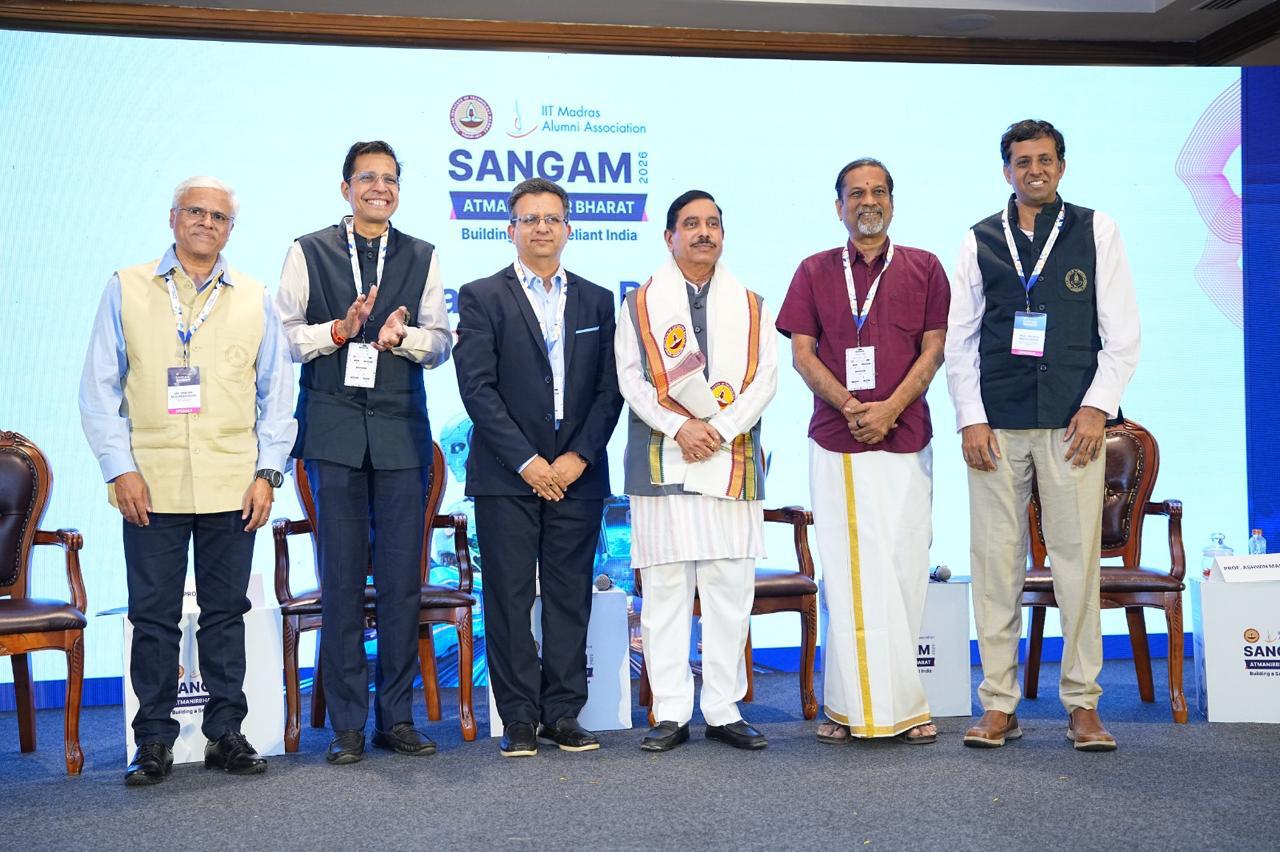
NEW DELHI — In an era defined by geopolitical supply chain fragmentation and relentless technological disruption, India’s premier technical diaspora is charting a bold new course. At the center of this movement is the recently concluded IITMAA Sangam 2026, a landmark summit that brought together top-tier innovators, industry titans, and policy visionaries to accelerate India’s journey toward technological self-reliance.
Led by Mr. Sridhar Boovaraghavan, President of the IIT Madras Alumni Association (IITMAA), the event served as a high-stakes convergence of minds focused on three pillars of modern economic power: Artificial Intelligence (AI), Semiconductors, and Deep Tech. As global superpowers race for dominance in silicon manufacturing and algorithmic intelligence, Sangam 2026 underscored how India’s engineering powerhouse is transitioning from a service-oriented IT hub into a global product and R&D capital.
The Strategic Imperative: Beyond Software to Silicon
For decades, India’s narrative in the global technology arena was anchored in software development and IT services. However, the macro-environment has shifted dramatically. Supply chain vulnerabilities exposed during the pandemic, coupled with rising national security concerns over hardware provenance, have made self-reliance—or Atmanirbhar Bharat—an absolute economic necessity.
Speaking to a packed auditorium of alumni, venture capitalists, and deep-tech founders, leadership at the summit emphasized that India can no longer afford to be a mere consumer of frontier technologies. The focus must pivot aggressively toward indigenous semiconductor fabrication, advanced RF and Electromagnetic Compatibility (EMC) testing in real environments, and sovereign AI architectures tailored to the Global South.
"We are no longer discussing the future of technology in abstract terms; we are building the foundational infrastructure that will power India’s next century of growth," noted senior delegates at the conference. "From silicon wafers to neural networks, the mandate of IITMAA Sangam 2026 is clear: translate academic brilliance into commercial sovereignty."
Key Focus Areas Driving the 2026 Agenda
- Semiconductor Ecosystems: Accelerating domestic fab design, packaging, and testing facilities to capture high-value segments of the global chip market.
- Advanced AI Deployment: Scaling localized large language models and computing clusters to solve critical challenges in agriculture, healthcare, and governance.
- Deep Tech Commercialization: Bridging the "valley of death" between laboratory research and venture-backed industrialization.
- Real-World RF & EMC Testing: Enhancing domestic testing capabilities for complex electronics to meet stringent global compliance standards.
Decoding the Numbers: India's Tech Horizon

To understand the gravity of the discussions at IITMAA Sangam 2026, one must examine the macroeconomic trajectory of India's semiconductor and deep tech landscape.
| Technology Sector | Current Milestone (2026) | Projected Impact / Outlook |
|---|---|---|
| Semiconductors & OSAT | Multiple fabrication & assembly units breaking ground | Targeting $100B+ market valuation by 2030 |
| Artificial Intelligence | Rapid scaling of sovereign compute infrastructure | Integration across public digital goods (India Stack) |
| Deep Tech Startups | Surge in specialized venture capital funding | Over 3,000 active hardware and biotech startups |
| RF & EMC Testing | Expansion of certified domestic testing labs | Reduction of time-to-market for hardware exporters |
Bridging the Gap: Academia, Industry, and Capital
A recurring theme throughout the summit under Mr. Sridhar Boovaraghavan’s leadership was the critical need to break down institutional silos. Historically, India’s elite institutions like the Indian Institutes of Technology (IITs) produced world-class engineering talent, much of which migrated abroad or remained confined to theoretical research.
Sangam 2026 acted as a catalyst to reverse this trend. By fostering direct syndication between deep tech founders and seasoned venture capitalists who understand the long gestation periods of hardware and semiconductor startups, the event created a viable roadmap for domestic commercialization.
Industry leaders highlighted breakthroughs in RF and EMC testing in real environments as a major competitive advantage currently being unlocked within India’s R&D corridors. As electronic devices become denser and wireless communication standards evolve toward 6G and satellite-based connectivity, rigorous environmental testing becomes non-negotiable. Indian startups are now stepping up to provide localized, cost-effective testing infrastructure that rivals traditional Western facilities.
The Road Ahead: What’s Next for India Inc.?
As the curtains close on IITMAA Sangam 2026, the real work begins. The commitments made on stage must now translate into policy advocacy, patent filings, and factory floor execution. The confluence of a favorable geopolitical climate, aggressive government incentives like the Semicon India program, and a mobilized diaspora network gives India its best window yet to secure its technological destiny.
For global investors and domestic stakeholders alike, the message from New Delhi is unmistakable: India is moving up the value chain. The transformation from code writers to chip makers is no longer an ambitious talking point—it is an unfolding economic reality.
Frequently Asked Questions
What is the core objective of IITMAA Sangam 2026?
The primary objective is to drive India's technological self-reliance by uniting alumni, industry leaders, and policymakers to accelerate growth in AI, semiconductor manufacturing, and deep tech commercialization.
Why are semiconductors and deep tech central to India’s current economic strategy?
With global supply chains facing persistent vulnerabilities, building domestic capabilities in hardware, silicon design, and advanced testing ensures national security, reduces import dependency, and captures high-value segments of the global digital economy.