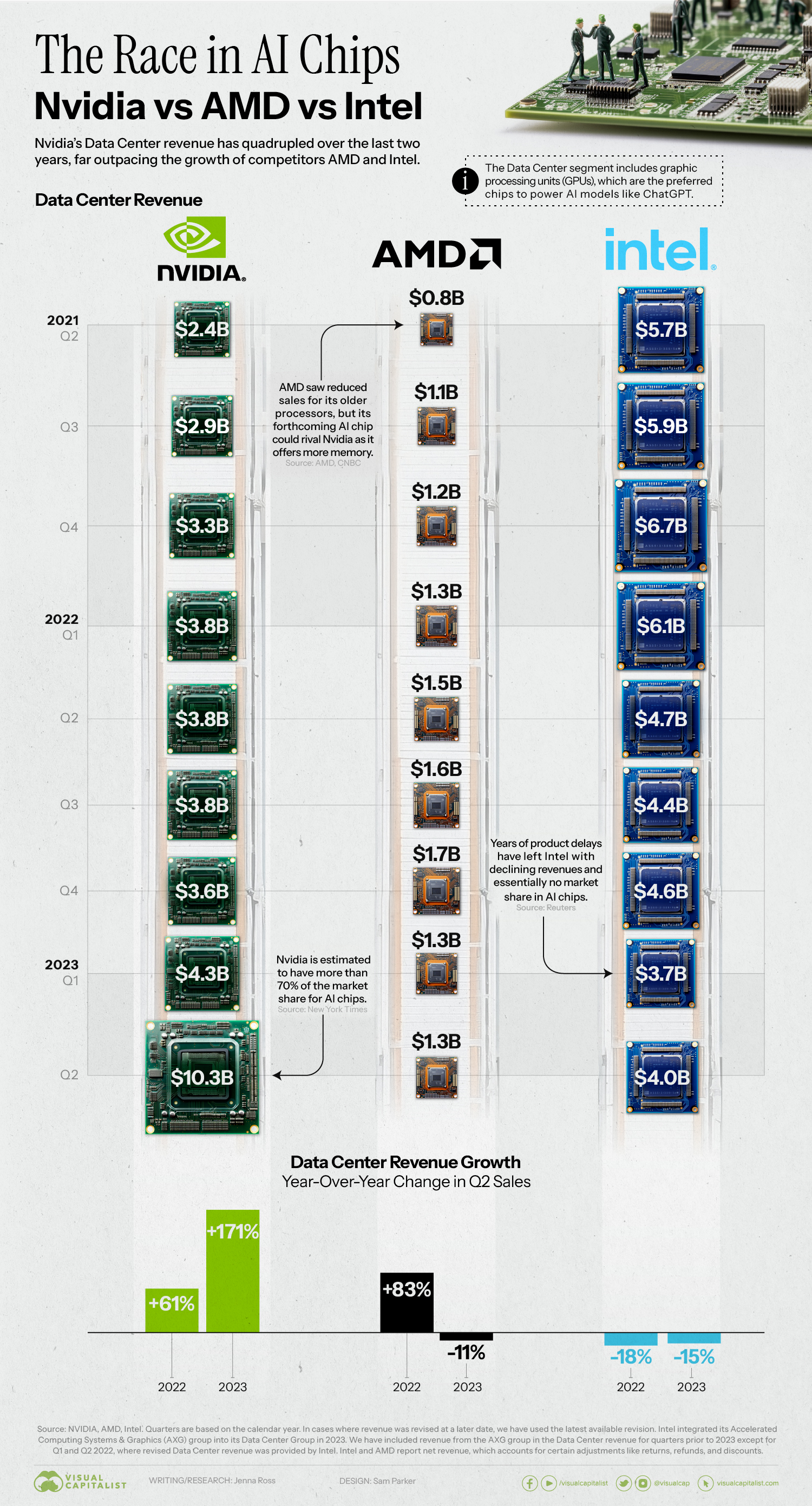
The global race for artificial intelligence supremacy is no longer a futuristic vision; it is a present-day battle waged across silicon foundries, data centers, and advanced research labs worldwide. At its epicenter lies the AI chip, the fundamental hardware enabling the parallel computing capabilities essential for training and deploying increasingly sophisticated AI models. While NVIDIA Corporation has long held an seemingly unassailable lead, fueled by its dominant GPU architectures and the ubiquitous CUDA software ecosystem, a formidable coalition of traditional semiconductor giants, hyperscale cloud providers, and innovative startups is now challenging its reign, investing unprecedented capital and engineering talent to carve out their share of this multi-trillion-dollar market opportunity.
Executive Takeaways
- NVIDIA's Enduring Hegemony: NVIDIA maintains a commanding lead in the AI chip market, anchored by its powerful H100 and upcoming Blackwell GPU architectures, and critically, its deeply embedded CUDA software platform, which presents a significant barrier to entry for competitors.
- Accelerated Competition: A diverse array of challengers, including AMD, Intel, Google, Amazon, Microsoft, and a cohort of specialized AI startups, are aggressively deploying proprietary silicon and alternative software stacks, fueling intense innovation and driving down the total cost of ownership (TCO) for AI infrastructure.
- Strategic Capital & Infrastructure Scaling: The insatiable demand for high-performance AI compute across enterprise, cloud, and edge applications is catalyzing massive capital allocation into advanced fabrication, data center expansion, and next-generation cloud compute architectures, directly impacting global market liquidity and investment strategies.
- Geopolitical & Supply Chain Imperatives: Beyond performance metrics, geopolitical tensions, the critical need for supply chain diversification, and the relentless pursuit of energy efficiency are becoming paramount strategic considerations, reshaping risk mitigation strategies and influencing national competitiveness in AI.
The Genesis of Parallel Power: How AI Chips Remade Computing
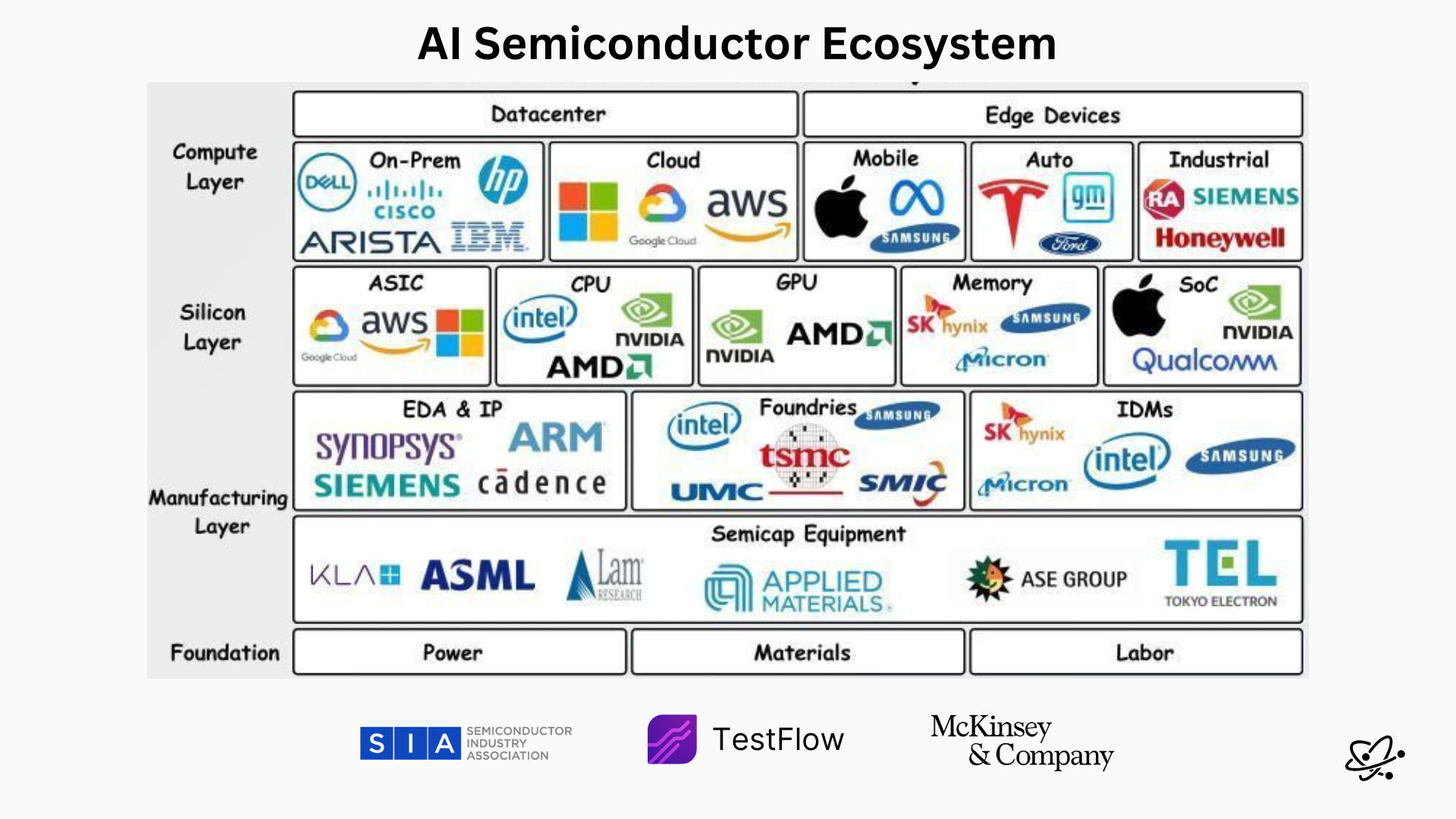
For decades, the semiconductor industry focused on increasing the clock speed of general-purpose CPUs. However, the dawn of deep learning and neural networks exposed the limitations of serial processing. AI workloads, characterized by vast matrix multiplications and parallelizable operations, demanded a fundamentally different compute paradigm. This necessity elevated the Graphics Processing Unit (GPU), originally designed for rendering complex 3D graphics, to an indispensable role. NVIDIA, a pioneer in GPU technology, found itself perfectly positioned for this revolution.
The catalytic event was arguably the widespread adoption of deep learning frameworks like TensorFlow and PyTorch, coupled with the success of large language models (LLMs) and generative AI applications. These advancements required not just faster processing, but massive parallel throughput and high-bandwidth memory. NVIDIA’s strategic investment in its CUDA (Compute Unified Device Architecture) platform, a parallel computing platform and programming model, proved prescient. CUDA became the de facto operating system for AI development, locking developers into NVIDIA's ecosystem and establishing a powerful moat against competitors. This software-hardware synergy cemented NVIDIA’s dominance, turning its GPUs – from the A100 to the cutting-edge H100 and the forthcoming Blackwell platform – into the gold standard for AI training and inference.
NVIDIA and the Vanguard: A Deep Dive into the Top AI Chip Makers
While NVIDIA commands an estimated 80-90% market share in high-end AI accelerators, the competitive landscape is far from static. A global array of innovators is investing heavily to chip away at this lead, offering diverse solutions tailored for specific AI workloads, cost points, and deployment environments.
NVIDIA: The Architects of AI Dominance
NVIDIA's strategy extends beyond raw silicon. Its full-stack approach, encompassing GPUs (e.g., H100, GH200 Grace Hopper Superchip), networking (Infiniband, NVLink), and software (CUDA, cuDNN, TensorRT), creates a formidable, optimized ecosystem. This vertical integration provides superior performance, easier development, and infrastructure scalability, offering compelling enterprise ROI for data centers and cloud providers building AI foundations. Their next-generation Blackwell architecture, with its enhanced transformer engine and massive memory bandwidth, aims to extend this lead further, promising unprecedented compute density and energy efficiency.
The Traditional Semiconductor Titans
- AMD (Advanced Micro Devices): AMD has emerged as NVIDIA’s most potent traditional rival. With its Instinct series (e.g., MI300X, MI300A APU), AMD offers competitive hardware performance, particularly in memory capacity and bandwidth. A critical component of their challenge is ROCm (Radeon Open Compute platform), an open-source software stack designed to rival CUDA. AMD’s strategy involves leveraging its CPU-GPU integration expertise and fostering a more open ecosystem to attract developers seeking alternatives, aiming to disrupt NVIDIA's valuation multiples and market liquidity.
- Intel Corporation: Intel, a foundational player in computing, is aggressively re-entering the high-performance AI accelerator market. Their strategy includes the Gaudi series (Habana Labs, now Intel) – with the Gaudi2 and the recently announced Gaudi3 – designed specifically for AI training and inference. Intel is also developing its Falcon Shores architecture and pushing its oneAPI software initiative to provide a unified programming model across its diverse hardware portfolio (CPUs, GPUs, FPGAs, NPUs). The sheer scale of Intel's manufacturing and research capabilities presents a long-term threat, aiming to capture significant market share in cloud compute architecture.
Hyperscale Cloud Providers: Building In-House Innovation
A significant trend is the rise of proprietary AI silicon developed by major cloud providers. This vertical integration allows them to optimize chips for their specific infrastructure, reduce dependency on external vendors, and potentially lower operational costs, thereby enhancing their enterprise ROI and infrastructure scalability.
- Google: Google's Tensor Processing Units (TPUs) have been a cornerstone of its internal AI development for years. The latest iterations, like the TPU v5p, offer massive performance for specific AI workloads and are available to Google Cloud customers, providing a highly optimized alternative to GPUs.
- Amazon Web Services (AWS): AWS offers its Inferentia (for inference) and Trainium (for training) chips. Inferentia2 and Trainium2 are designed to deliver high performance at a lower cost for AWS customers, representing a key strategic investment in its cloud compute architecture.
- Microsoft: Microsoft recently unveiled its own custom AI chips, Maia 100 (for inference) and Athena (for training). These chips are designed to power Microsoft's massive internal AI workloads and Azure cloud services, signaling a strong commitment to controlling its AI infrastructure costs and performance.
Innovative Startups and Specialized Accelerators
Beyond the giants, a vibrant ecosystem of startups is pioneering novel architectures to solve specific AI challenges, often focusing on efficiency, specific data types, or entirely new computing paradigms. These companies attract significant venture capital, influencing future capital allocation in the sector.
- Cerebras Systems: Known for its Wafer-Scale Engine (WSE), the largest chip ever built. The WSE-2 powers Cerebras's CS-2 system, offering unprecedented compute density for large models and specialized AI applications, aiming to reduce the physical footprint and complexity of AI data centers.
- Groq Inc.: With its Language Processing Unit (LPU) architecture, Groq focuses on ultra-low-latency inference, particularly for LLMs. Its deterministic execution model provides predictable performance, addressing critical concerns for real-time AI applications.
- Graphcore: Based in the UK, Graphcore develops Intelligence Processing Units (IPUs) with a focus on graph neural networks and sparse model execution, offering a different approach to parallel processing.
- Tenstorrent: Led by AI chip veteran Jim Keller, Tenstorrent is developing RISC-V-based AI accelerators with a focus on leveraging open standards for greater flexibility and customizability.
- SambaNova Systems: Offers a full-stack AI platform powered by its Dataflow-as-a-Service architecture, utilizing its SN30 reconfigurable dataflow unit for specialized AI processing.
- Untether AI, Blaize, Hailo: These companies specialize in edge AI and energy-efficient inference, targeting applications where power consumption and size are critical, extending AI compute beyond the data center.
The Rise of National Champions: Chinese AI Chip Contenders
Geopolitical considerations and the pursuit of technological sovereignty are driving significant investments in AI chip development, particularly in China. These efforts are crucial for national regulatory compliance and long-term economic strategy.
- Huawei (Ascend Series): Huawei's Ascend 910B (part of the Ascend series) is a powerful AI processor, a critical component of China's domestic AI infrastructure development, aiming to reduce reliance on foreign technology.
- Biren Technology: Biren has developed its BR100 series GPUs, aiming to compete with high-end global AI accelerators for general-purpose AI and HPC workloads.
- Cambricon: A pioneer in AI instruction sets, Cambricon produces specialized AI processors for cloud, edge, and device-side inference.
Verified Data / Metrics Breakdown: Key AI Chip Players
The following table provides a snapshot of key players, their flagship offerings, and strategic positioning in the dynamic AI chip market. *Market share figures are estimates based on recent industry reports focusing on high-end accelerators.*
| Company | Flagship AI Product(s) | Core Technology/Strategy | Estimated High-End Market Share | Notable Partners/Customers |
|---|---|---|---|---|
| NVIDIA | H100, GH200 Grace Hopper, Blackwell | CUDA ecosystem, GPU dominance, full-stack integration, NVLink | ~80-90% | AWS, Google Cloud, Microsoft Azure, Oracle Cloud, Tesla |
| AMD | Instinct MI300X, MI300A APU | ROCm open software, CPU-GPU integration, chiplet design | ~5-10% (growing) | Microsoft, Oracle, HPE, Dell |
| Intel | Gaudi3, Falcon Shores (upcoming) | Specific AI accelerators, Ethernet fabric, oneAPI software | ~2-3% | CSC, Stability AI, NAVER |
| TPU v5p | Custom ASIC for internal AI, optimized for specific workloads | Internal/Google Cloud exclusive | DeepMind, Google Research, Google Cloud customers | |
| AWS | Inferentia2, Trainium2 | Proprietary cloud silicon, cost-performance optimization for AWS | Internal/AWS exclusive | Amazon.com, AWS Cloud customers |
| Microsoft | Maia 100, Athena | Custom chips for Azure and internal AI, cloud optimization | Internal/Azure exclusive | Microsoft Azure, OpenAI |
Industry & Market Implications: Who Wins, Who Loses, and Broader Economic Impact
The intensifying competition in AI chips carries profound implications across multiple economic sectors. For enterprises, the diversification of AI compute options translates into greater flexibility, potentially lower costs, and enhanced risk mitigation against single-vendor reliance. The relentless pursuit of performance per watt and price/performance ratios by competitors is driving down the TCO for AI infrastructure, making advanced AI capabilities more accessible.
Hyperscalers investing in proprietary silicon aim to reduce their capital allocation to external vendors, improve their cloud compute architecture efficiency, and offer differentiated services. This move can put pressure on NVIDIA’s profit margins in the long run but also expands the overall market for AI services. For traditional chipmakers like AMD and Intel, gaining even a few percentage points of market share represents billions in revenue and significantly impacts their valuation multiples. Their success hinges on breaking the CUDA hegemony through open-source initiatives like ROCm and oneAPI, fostering developer adoption.
The broader economic impact is colossal. This chip war is fueling an unprecedented build-out of data centers globally, driving demand for power infrastructure, cooling technologies, and network components. It affects national competitiveness, with countries investing heavily in domestic AI chip capabilities to ensure technological sovereignty and regulatory compliance. Supply chain resilience has become a paramount concern, prompting diversification strategies and investments in advanced packaging and fabrication within different geopolitical spheres. The future of AI, from drug discovery to autonomous systems, is directly tied to the innovation and accessibility of these fundamental computing engines.
People Also Ask (FAQ)
What are the primary investment risks in the AI chip sector beyond NVIDIA?
Investing beyond NVIDIA, while offering significant upside, carries distinct risks. These include the challenge of overcoming the entrenched CUDA ecosystem, which can hinder developer adoption for new platforms. Smaller companies face intense capital requirements for R&D and fabrication, leading to higher execution risk. Furthermore, intellectual property battles, rapid technological obsolescence, and geopolitical trade restrictions (especially concerning advanced manufacturing and export controls) can significantly impact market liquidity and long-term viability for non-diversified players. Investors must carefully assess proprietary software support, ecosystem maturity, and a clear path to enterprise ROI for competing solutions.
How are new AI chip architectures challenging NVIDIA's CUDA ecosystem?
New AI chip architectures are primarily challenging CUDA by offering superior performance for specific workloads, better price-performance ratios, and by fostering alternative, often open-source, software stacks. Companies like AMD with ROCm, Intel with oneAPI, and specialized startups like Groq with their LPU architecture are creating environments where developers can port their models without being exclusively reliant on CUDA. These alternatives often emphasize ease of use, energy efficiency, or deterministic latency for real-time inference, areas where NVIDIA’s general-purpose GPU approach might be less optimized. The goal is to reduce the "CUDA tax" and provide developers with choices that align with specific infrastructure scalability and cost-efficiency goals.
What role do hyperscalers play in developing proprietary AI silicon?
Hyperscalers (Google, Amazon, Microsoft, Meta) play a transformative role by developing proprietary AI silicon for several strategic reasons. Firstly, it allows them to tightly integrate hardware and software, optimizing performance and energy consumption for their massive, bespoke cloud compute architectures, leading to significant operational savings and improved enterprise ROI. Secondly, it reduces their dependency on external vendors, mitigating supply chain risks and providing greater control over product roadmaps and pricing. Thirdly, it enables them to offer differentiated services to their cloud customers, potentially at a lower cost, thereby enhancing their competitive edge and market liquidity in the cloud services market. This trend is a clear signal that AI is so core to their business models that they are willing to make substantial capital allocations to control the underlying silicon.
Future Outlook: What Comes Next
The AI chip landscape is poised for continued rapid evolution. We anticipate a relentless focus on energy efficiency, driven by the escalating power demands of large AI models, leading to innovations in chip design, packaging, and cooling technologies. The proliferation of specialized AI accelerators for edge computing and embedded systems will expand AI's reach far beyond the data center, necessitating new paradigms for ultra-low power inference.
Key milestones to watch include the successful adoption of open-source software stacks (ROCm, oneAPI) as viable alternatives to CUDA, which could fundamentally shift market dynamics and impact NVIDIA's valuation multiples. Further consolidation or strategic alliances among smaller players and larger semiconductor firms are probable, driven by the intense capital requirements for advanced chip design and fabrication. Geopolitically, the race for domestic AI chip production and advanced packaging capabilities will intensify, influencing global trade policies and technological independence. The ongoing innovation in novel memory technologies, quantum computing integration, and neuromorphic chips also represents long-term disruptors that could redefine the very architecture of AI compute within the next decade, presenting new challenges and opportunities for infrastructure scalability and capital allocation across the industry.