Executive Takeaways
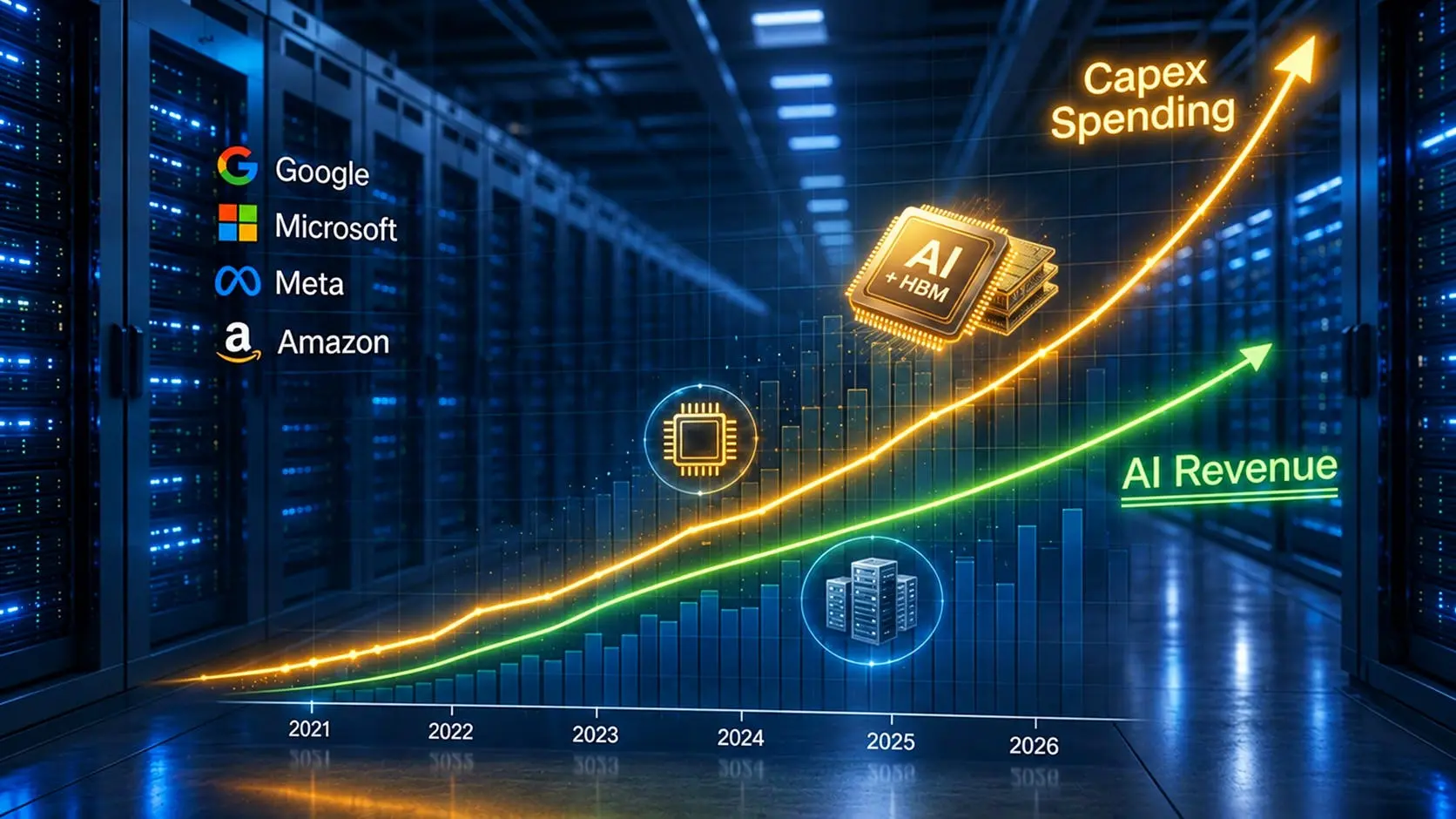
- Capital Expenditure Milestone: Enterprise AI capital expenditure (capex) is hurtling toward a staggering $1 trillion threshold, driven by hyperscalers accelerating infrastructure scalability to capture market share.
- The Supplier Premium: While Big Tech firms (Microsoft, Alphabet, Amazon, Meta) are posting surging top-line AI revenues, hardware, semiconductor, and specialized networking suppliers are capturing outsized operating margins with lower immediate risk mitigation burdens.
- Free Cash Flow Divergence: Proprietary forecasting models from the I/O Fund indicate that hardware and picks-and-shovels suppliers offer superior valuation multiples and resilient free cash flow (FCF) yields compared to front-end application providers through 2027.
The global technology sector is locked in the most capital-intensive build-out in corporate history. As enterprises race to integrate generative intelligence into their core operations, public markets have fixated on the explosive top-line AI revenue numbers reported by the trillion-dollar hyperscalers. Yet, a deeper forensic examination of corporate balance sheets, supply chain dynamics, and capital allocation strategies reveals a starkly different reality.
According to comprehensive research and data analysis released by the I/O Fund, while Big Tech's AI revenue is undeniably surging, the true economic winners of this paradigm shift are the upstream suppliers. These foundational players—spanning advanced semiconductor foundries, high-bandwidth memory (HBM) manufacturers, optical networking innovators, and specialized power infrastructure providers—are insulated from the fierce application-layer price wars while retaining pricing power that defies traditional cyclicality.
For institutional investors, venture allocators, and enterprise strategists, understanding this structural asymmetry is paramount. The rush to secure cloud compute architecture is transferring unprecedented volumes of capital from consumer and enterprise software balance sheets straight into the pockets of hardware titans. To evaluate where long-term enterprise value truly accumulates, one must analyze the macroeconomic forces driving the $1 trillion capex wave and decode the underlying financial metrics shaping the market.
The Anatomy of the $1 Trillion Capex Super-Cycle
Test Our Free AI & Tech Utilities Suite
Calculate LLM API token costs, analyze article dwell-time, or simulate tech DCA returns.
To contextualize the current market architecture, one must look at the velocity of capital deployment. Hyperscale cloud providers have systematically raised their capital expenditure guidance over successive quarters. The race to achieve artificial general intelligence (AGI) supremacy—or at least to prevent competitor lock-in—has rendered traditional Return on Invested Capital (ROIC) frameworks temporarily secondary to absolute market dominance.
However, this aggressive front-end spending introduces significant financial friction. Building, cooling, and powering next-generation data centers requires massive upfront cash outlays. Hyperscalers are absorbing heavy amortization schedules and depreciation costs on expensive GPU clusters that face rapid technological obsolescence cycles. Every 18 to 24 months, new architectures render previous-generation silicon less efficient on a performance-per-watt basis, compressing margins for the buyers while padding the order books of the sellers.
Conversely, the suppliers operating at the foundational layer of the AI supply chain enjoy a more favorable risk-reward profile. They sell into a guaranteed, highly consolidated buyer base—the magnificent handful of tech giants who cannot afford to slow down their infrastructure build-out without ceding catastrophic competitive advantage. This dynamic grants top-tier hardware and component manufacturers exceptional pricing power, shielding them from the margin compression hitting downstream software and platform providers.
Comparative Financial Metrics: Big Tech vs. AI Infrastructure Suppliers

A granular review of financial models from the I/O Fund highlights the shifting dynamics in free cash flow generation and margin expansion projected through 2027. The data illustrates why upstream providers are positioned to deliver superior risk-adjusted returns.
| Metric / Category | Big Tech Hyperscalers (Q2 2026) | AI Infrastructure Suppliers (Q2 2026) | Projected 2027 Outlook |
|---|---|---|---|
| Aggregate Capex Velocity | Accelerating exponentially (Multi-billion quarterly increases) | Capital-efficient manufacturing & R&D expansion | Capex expected to approach cumulative $1 Trillion industry-wide |
| Operating Margin Profile | Under pressure due to heavy depreciation and energy costs | Expanding, supported by high-margin proprietary silicon and HBM | Supplier margins projected to maintain premium over cloud software |
| Free Cash Flow (FCF) Yield | Temporarily depressed by heavy infrastructure outlays | Robust conversion rates driven by immediate cash-settled purchase orders | Significant FCF inflection expected for suppliers by late 2027 |
| Valuation Multiples | Moderating as growth faces high base effects | Supported by persistent structural demand and earnings beats | Valuation rationalization dependent on enterprise ROI realization |
Industry & Market Implications: Navigating the Value Chain
The economic fallout of this capex super-cycle extends far beyond Silicon Valley and Wall Street trading desks. It is actively reshaping global energy markets, geopolitical trade corridors, and corporate governance standards. As power grids strain to supply the gigawatts required by hyperscale data centers, energy procurement has become a core competency for tech executives, directly binding utility stocks and nuclear energy providers to the AI narrative.
For investors, portfolio construction requires a sophisticated approach to risk mitigation. While betting exclusively on front-end application developers exposes portfolios to monetization bottlenecks—specifically, whether enterprise clients will ultimately pay enough for AI copilots and automated workflows to justify the underlying hardware costs—investing in upstream suppliers provides a diversified hedge.
If enterprise ROI proves slower to materialize than anticipated, hyperscalers may eventually moderate their capital expenditure growth. However, until that inflection point is reached, suppliers continue to lock in record-breaking revenues with minimal counterparty risk, backed by the pristine balance sheets of the world’s most capitalized corporations.
Frequently Asked Questions (People Also Ask)
Why are AI infrastructure suppliers outperforming Big Tech on profit margins?
Suppliers operate at the foundational layer of the AI ecosystem, where specialized manufacturing, advanced packaging, and proprietary chip designs command high pricing power. Unlike hyperscalers, who must shoulder massive data center depreciation, continuous power acquisition costs, and competitive application-layer price compression, suppliers enjoy high gross margins and immediate cash conversion with minimal direct exposure to end-user monetization risk.
What is driving the projected $1 trillion AI capital expenditure milestone?
The explosive growth in capex is fueled by the relentless demand for cloud compute architecture, specialized AI accelerators, high-bandwidth memory, and high-density liquid-cooling data centers. Hyperscale cloud providers are locked in an arms race to scale training and inference capabilities, leaving them little choice but to continuously inject massive capital into physical infrastructure.
How do macroeconomic factors and interest rates impact AI hardware suppliers?
While high interest rates traditionally increase the cost of capital for long-duration growth assets, the primary buyers of AI hardware possess immense net-cash reserves and generate billions in baseline operating cash flow. Consequently, upstream suppliers remain insulated from traditional borrowing constraints, as their enterprise clients fund purchases directly from robust corporate balance sheets.
Future Outlook and Key Milestones to Watch
As the market navigates the second half of the decade, several critical inflection points will dictate whether suppliers maintain their dominance or if downstream application revenues begin to catch up with infrastructure spending:
- Enterprise ROI Realization: Watch for empirical proof of enterprise productivity gains. If corporate buyers successfully monetize AI tools at scale, hyperscalers will feel validated to sustain their aggressive capex trajectories.
- Power Grid and Energy Constraints: The physical bottleneck of electricity generation will test infrastructure scalability. Suppliers providing power management, grid-interconnection tech, and alternative energy solutions will emerge as critical sub-sector winners.
- Next-Gen Silicon Architecture Transitions: Monitor the commercial adoption rates of upcoming GPU and ASIC iterations. The speed at which data centers upgrade their fleets will directly influence supplier revenue velocity through 2027 and beyond.
Ultimately, while everyday consumers and business analysts marvel at the groundbreaking features of artificial intelligence applications, the fundamental wealth creation is occurring deep within the supply chain. By supplying the picks and shovels for the modern digital gold rush, hardware and infrastructure titans are securing the most lucrative and resilient position in the modern global economy.