Executive Takeaways
- Exponential Capital Expansion: According to benchmark analysis from Future Market Insights, the global space economy market is projected to surge from USD 449.8 billion in 2025 to USD 935.6 billion by 2035, compounding at a robust 7.6% CAGR.
- Infrastructure Scalability Driving ROI: Decreasing payload costs per kilogram, driven by reusable launch vehicle architectures, are transforming orbital assets from high-risk government expenditures into cash-flow-positive enterprise investments.
- Commercialization Beyond Low Earth Orbit (LEO): Private equity, sovereign wealth funds, and venture capital syndicates are aggressively shifting capital allocation toward deep-space logistics, in-orbit manufacturing, and commercial space stations.
- Regulatory and Geopolitical Headwinds: As spectrum congestion, orbital debris mitigation, and international defense treaties evolve, compliance and risk mitigation are becoming top-tier operational priorities for aerospace boards.
For decades, the final frontier was characterized by geopolitical prestige, Cold War brinkmanship, and multi-billion-dollar cost-plus government contracts managed by a handful of defense prime contractors. Today, that paradigm has been entirely dismantled. As institutional capital floods into aerospace manufacturing, satellite communications, and orbital infrastructure, the space economy has transformed into a ferocious commercial theater. According to comprehensive data released by Future Market Insights, the global space economy market is on an aggressive trajectory, scaling from USD 449.8 billion in 2025 to an estimated USD 935.6 billion by 2035, fueled by a compound annual growth rate (CAGR) of 7.6%.
This structural acceleration is not merely a byproduct of billionaire vanity projects or exploratory zeal. It is driven by hard enterprise mathematics. Corporate boardrooms across telecommunications, energy, agriculture, and finance are realizing that low-earth orbit (LEO) and medium-earth orbit (MEO) assets are no longer optional adjuncts to their operational models, but core infrastructure components. From high-throughput satellite constellations delivering global broadband to precision earth-observation analytics optimizing supply chain logistics and carbon accounting, space-based services have embedded themselves into the bedrock of the modern digital economy.
The Catalytic Shift: Reusability, Falling Launch Costs, and Private Equity
Test Our Free AI & Tech Utilities Suite
Calculate LLM API token costs, analyze article dwell-time, or simulate tech DCA returns.
To understand the valuation multiples currently commanding boardrooms across the aerospace sector, one must analyze the supply-side economics of getting payload to orbit. Historically, the prohibitive barrier to entry in the space economy was the staggering cost of launch. In the Space Shuttle era, placing a kilogram of payload into LEO cost upwards of $54,000, rendering speculative commercial business models economically unviable.
The arrival of reusable rocket architectures, spearheaded by private launch providers over the past decade, has compressed marginal launch costs to historic lows—in some configurations dipping below $1,500 per kilogram. This dramatic cost reduction has triggered a massive expansion in market liquidity. Venture capital firms, private equity syndicates, and institutional asset managers that previously avoided aerospace due to extreme capital expenditure (CapEx) hurdles and prolonged gestation periods are now deploying capital with unprecedented velocity.
Furthermore, the democratization of satellite manufacturing through commercial-off-the-shelf (COTS) components and CubeSat standardization has compressed satellite development cycles from a decade to mere months. Enterprise CFOs are evaluating space investments through traditional corporate finance metrics: calculating internal rates of return (IRR), modeling enterprise ROI, and assessing risk-adjusted cash flow horizons. This financial maturation of the space sector has transitioned it from an experimental science experiment into a premier asset class for growth-oriented institutional portfolios.
Sector Breakdown: Where the Trillions Are Flowing
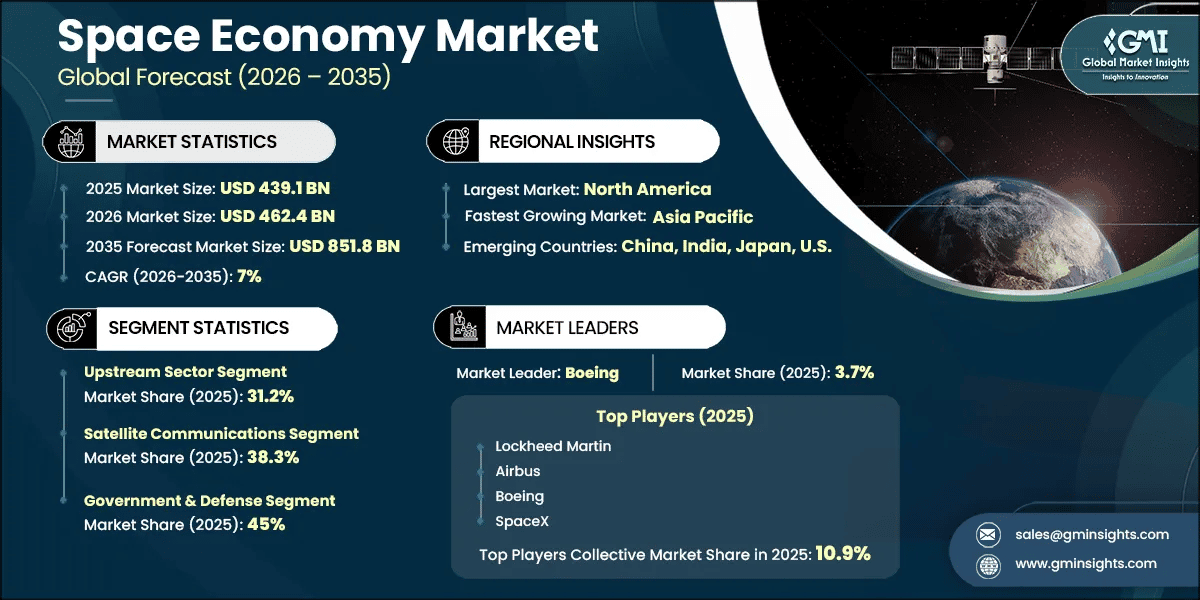
The path from a $449.8 billion market in 2025 to nearly $1 trillion by 2035 is paved across several distinct operational verticals. Each sub-sector exhibits unique growth dynamics, regulatory environments, and revenue models:
- Satellite Communications (SatCom) and Direct-to-Device Connectivity: High-throughput satellites (HTS) and mega-constellations in LEO are capturing massive market share by bridging the digital divide, servicing maritime and aviation broadband needs, and enabling direct-to-cellphone connectivity in remote terrains.
- Earth Observation (EO) and Geospatial Intelligence: Utilizing advanced synthetic aperture radar (SAR) and hyperspectral imaging, EO firms provide institutional clients with real-time analytics regarding crop yields, maritime traffic, infrastructure degradation, and military movements. This data feeds directly into enterprise cloud compute architectures, driving automated decision-making.
- In-Orbit Manufacturing and Servicing: Microgravity environments offer unprecedented conditions for manufacturing high-purity fiber optics, pharmaceutical proteins, and semiconductor crystals. Coupled with robotic servicing satellites designed to refuel or de-orbit aging legacy platforms, this sector represents the bleeding edge of orbital industrialization.
- Deep Space Logistics and Lunar Infrastructure: Backed by government procurement contracts such as NASA’s Artemis program, private aerospace firms are building the lunar landers, habitation modules, and communication relays required to establish a permanent human presence on the Moon, laying the groundwork for eventual asteroid resource utilization.
| Metric / Parameter | Baseline (2025) | Projection (2035) | Strategic Growth Drivers |
|---|---|---|---|
| Global Space Economy Market Valuation | USD 449.8 Billion | USD 935.6 Billion | Compound Annual Growth Rate (CAGR) of 7.6% driven by commercialization and falling launch costs. |
| Primary Revenue Engine | Satellite TV & Consumer Broadband | Enterprise Data Analytics, Direct-to-Device & Cloud Integration | Shift toward B2B geospatial intelligence, IoT integration, and low-latency global communications. |
| Launch Cost Economics (per kg to LEO) | ~$2,500 – $4,000 | < $1,000 (Projected mature fleets) | Full rocket reusability, rapid turnaround pads, and heavy-lift architecture standardization. |
| Capital Allocation Focus | Government Defense & Prime Contracting | Private Equity Syndicates, Venture Capital, Sovereign Wealth | Stronger commercial valuation multiples and predictable recurring SaaS-style revenue models. |
Industry & Market Implications: Winners, Losers, and Macro Risks
As capital allocation shifts toward orbital infrastructure, the broader macroeconomic landscape is experiencing profound restructuring. Discerning institutional investors must evaluate both the tailwinds propelling market leaders and the structural vulnerabilities threatening legacy incumbents.
The Winners: Agile, vertically integrated aerospace manufacturers and commercial operators that control their supply chains from raw material fabrication to final orbital insertion are capturing outsized market share. Furthermore, software-defined satellite operators—firms capable of updating satellite payloads via firmware patches post-launch—are creating high-margin, sticky enterprise software-as-a-service (SaaS) revenue models that insulate them from hardware obsolescence.
The Losers: Defense prime contractors and legacy aerospace suppliers bound to legacy cost-plus contracting models are struggling to pivot toward commercial velocity. Burdened by bureaucratic inertia, slow development timelines, and inflexible manufacturing footprints, these traditional giants risk losing dominant market positioning to lean, private-equity-backed upstarts capable of iterating hardware iterations in months rather than decades.
Macro Risks and Regulatory Bottlenecks: Despite the optimistic 7.6% CAGR projection from Future Market Insights, significant risks loom on the horizon. Orbital congestion and space debris accumulation present existential threats to continuous operations; a single high-profile Kessler Syndrome event could trigger cascading insurance rate hikes and grounding orders. Furthermore, regulatory compliance regarding radio frequency spectrum allocation, national security export controls (such as ITAR), and international space law remain complex minefields requiring sophisticated legal and operational risk mitigation strategies.
Frequently Asked Questions (People Also Ask)
What is the projected market size and growth rate of the global space economy?
According to market analysis from Future Market Insights, the global space economy is valued at USD 449.8 billion in 2025 and is projected to reach USD 935.6 billion by 2035. This expansion represents a robust compound annual growth rate (CAGR) of 7.6%, driven by surging commercial demand, falling launch costs, and increased private capital investment.
What are the primary drivers behind the commercialization of space?
The primary catalysts include dramatic reductions in launch costs per kilogram driven by reusable rocket technology, the miniaturization of satellite hardware (such as CubeSats), and rising enterprise demand for high-throughput broadband, real-time earth observation analytics, and direct-to-device communication infrastructure.
Which sectors within the space economy offer the highest investment return potential?
Investors and analysts point to satellite communications (specifically direct-to-device and low-latency broadband), advanced geospatial intelligence (Earth observation with AI-driven analytics), and emerging in-orbit manufacturing/servicing markets as the most lucrative segments with scalable, recurring revenue models.
What are the major risks facing the expanding space economy market?
Key risk factors include escalating orbital debris and congestion (which threaten operational assets), complex international regulatory compliance regarding spectrum allocation and national security, high upfront capital expenditure requirements, and geopolitical tensions impacting global supply chains.
Future Outlook: Strategic Milestones to Watch Through 2035
As the space economy charges toward the psychological and economic milestone of USD 1 trillion, industry observers must monitor several critical inflection points. First, the commercial viability of private space stations—designed to succeed the International Space Station (ISS) post-retirement—will test whether a sustainable, non-government-funded human orbital ecosystem can generate reliable enterprise cash flows.
Second, the integration of artificial intelligence and edge computing onboard satellites will redefine the value proposition of space-based data. Instead of raw imagery streaming back to terrestrial servers for delayed processing, future constellations will analyze data locally in orbit, transmitting only actionable intelligence to enterprise clients in real-time.
For institutional investors, corporate strategists, and policymakers, the message is unequivocal: space is no longer an isolated scientific frontier. It is the vital operating layer of the global terrestrial economy. Those who master its infrastructure scalability, navigate its complex regulatory matrix, and allocate capital with disciplined risk mitigation will define economic dominance for the next half-century.