Executive Takeaways
- Unprecedented Capital Allocation: Hyperscalers have committed a staggering $828 billion toward AI infrastructure scalability and data center architecture.
- Market Liquidity Shock: Wall Street wiped over $1 trillion in market capitalization from major indices as valuation multiples collided with delayed enterprise ROI realization.
- Compute Architecture Bottlenecks: Supply chain constraints for next-generation GPUs and heavy energy grid demands are compressing projected operating margins.
- Strategic Pivots Ahead: Institutional investors are demanding rigorous risk mitigation and immediate monetization strategies over long-term speculative promises.
NEW YORK & LONDON — In a jarring reminder that gravity still applies to equity markets, Wall Street delivered a brutal verdict on the artificial intelligence boom. Over a succession of volatile trading sessions, global indices suffered a historic hemorrhage, wiping more than $1 trillion in aggregate market value from the stock market. At the epicenter of this financial tempest is a simple, sobering realization: the world's most valuable technology conglomerates are engaged in an $828 billion capital expenditure sprint that is testing the limits of corporate balance sheets, cloud compute architecture, and investor patience.
For nearly two years, institutional portfolios rode an unstoppable wave of generative AI enthusiasm. Hyperscalers—Alphabet, Microsoft, Amazon, and Meta Platforms—drove equity markets to repeated record highs, fueled by the narrative of a generational technological paradigm shift. However, as quarterly earnings reports laid bare the sheer velocity of cash burn required to build out sovereign AI foundations, sentiment inverted. Chief investment officers and risk managers across major financial capitals began asking an unavoidable question: When, exactly, will this $828 billion infrastructure bet generate sustainable free cash flow?
The Anatomy of a Sell-Off: From Euphoria to Capital Discipline
Test Our Free AI & Tech Utilities Suite
Calculate LLM API token costs, analyze article dwell-time, or simulate tech DCA returns.
The mechanics of the $1 trillion correction reveal deep-seated anxieties regarding capital allocation efficiency. What began as a routine rotation out of richly valued growth stocks quickly metastasized into broad-based liquidation. Tech-heavy benchmarks absorbed the brunt of the blow, but the contagion rapidly spread to semiconductor designers, enterprise software providers, and industrial suppliers tied to data center grid connectivity.
The core catalyst for the correction lies in the divergence between capital expenditure (Capex) growth and revenue realization. While enterprise demand for large language models and machine learning APIs is expanding rapidly, the monetization curve is failing to match the exponential slope of infrastructure spending. Hyperscalers are aggressively procuring specialized hardware, securing long-term power purchase agreements for energy-hungry server farms, and leasing massive real estate footprints to house next-generation server racks.
According to comprehensive equity research from leading Wall Street desks, the combined forward-looking capital commitments of the top four technology giants have surged past $828 billion. This massive financial outlay has compressed forward valuation multiples, forcing portfolio managers to re-evaluate whether current equity valuations adequately price in the execution risk of such a monumental technological transition.
Deconstructing the $828 Billion AI Spending Spree
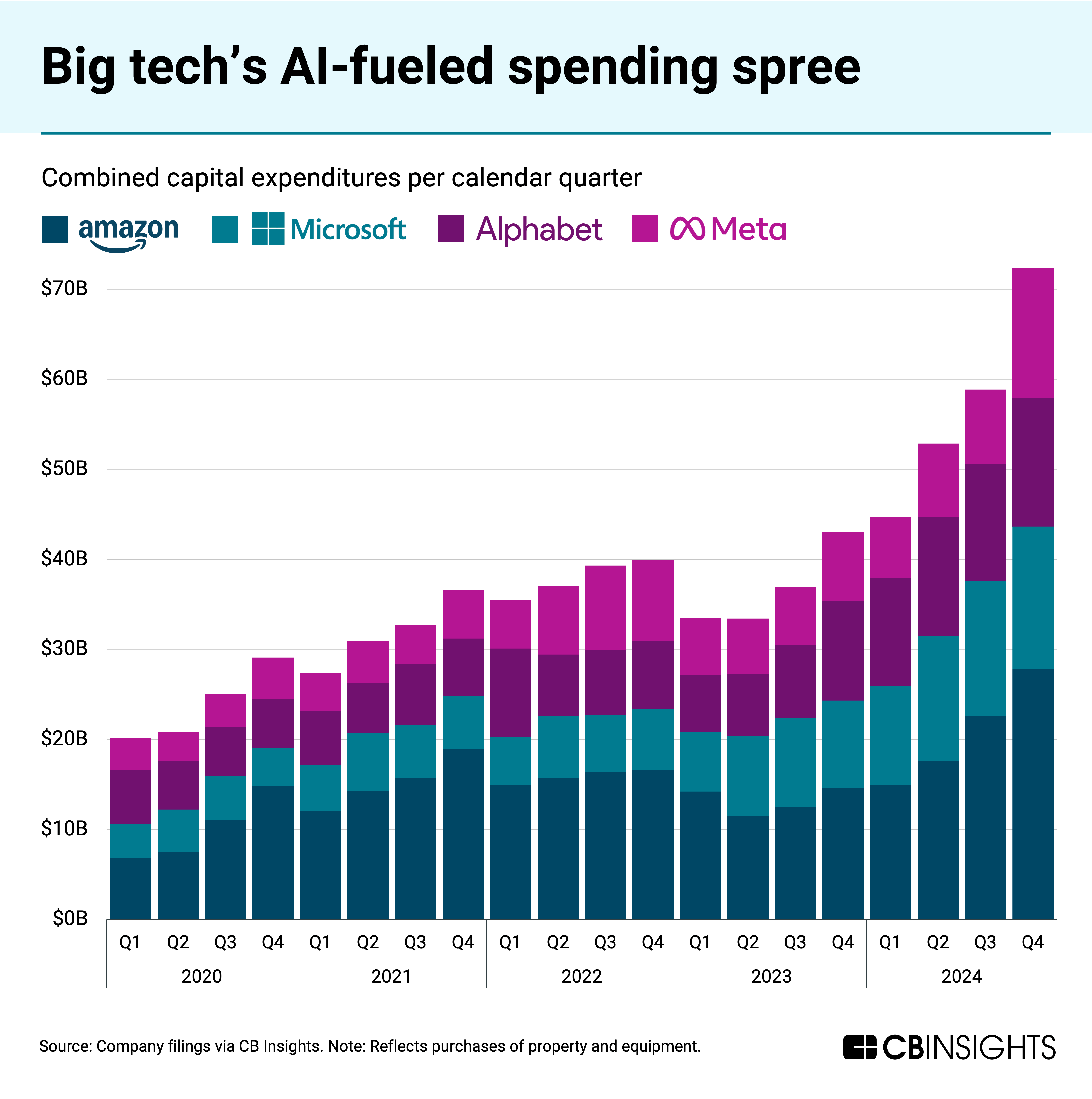
To understand the root cause of market jitters, one must examine where this staggering sum of capital is actually being deployed. The spending is not merely a line item for software development; it represents a physical, industrial-scale overhaul of global digital infrastructure.
- Silicon Procurement & Advanced Compute: Billions are flowing directly into high-performance accelerator chips, forcing a complete redesign of data center layouts to handle unprecedented thermal dissipation and power loads.
- Data Center Real Estate & Power Grids: Hyperscalers are locking down multi-gigawatt power supply agreements—often turning to nuclear and renewable energy sources—to guarantee uninterrupted operational uptime for neural network training clusters.
- Talent Acquisition & R&D: Specialized engineering talent commands compensation packages that rival boutique hedge funds, escalating operating expenses across the board.
- Supply Chain and Logistics: Securing advanced packaging, high-bandwidth memory (HBM), and networking gear requires massive upfront deposits and multi-year supply commitments.
This aggressive posture has transformed tech monoliths from asset-light software creators into capital-intensive utility providers, fundamentally altering their financial risk profile.
Market Impact & Capital Allocation Metrics
| Metric / Indicator | Prior Baseline (2023) | Current Projected (2024–2026) | Financial Implication |
|---|---|---|---|
| Aggregate Tech Capex | ~$150 Billion | $828 Billion+ | Compressed free cash flow margins; heightened balance sheet scrutiny. |
| Average Valuation Multiple (P/E) | 32x Forward Earnings | 24x Forward Earnings | Multiple contraction driven by higher cost of capital and ROI skepticism. |
| Data Center Energy Demand | Baseline Grid Load | +160% Projected Increase | Regulatory hurdles, power bottlenecks, and localized grid capacity stress. |
| Market Capitalization Wipeout | N/A | $1.02 Trillion | Broad-based liquidity contraction and re-pricing of growth premiums. |
Industry & Market Implications: Winners, Losers, and Systemic Risk
The $1 trillion market correction is not merely a temporary correction; it represents a fundamental re-pricing of risk across the global financial ecosystem. As institutional asset managers pivot toward strict capital discipline, clear divisions are emerging between corporate winners and losers in the AI race.
The Winners: Semiconductor firms with unassailable manufacturing moats, specialized networking equipment providers, and energy infrastructure developers continue to command pricing power. Furthermore, enterprise software companies that successfully embed proprietary AI tools into mission-critical workflows without incurring prohibitive compute costs are capturing investor favor. Companies possessing pristine balance sheets and robust organic cash flow are well-positioned to weather the volatility and consolidate market share.
The Losers: Highly leveraged mid-cap software firms reliant on third-party foundation models without clear pricing differentiation are facing severe valuation downgrades. Additionally, technology conglomerates unable to demonstrate a clear path to enterprise ROI on their massive infrastructure investments are experiencing aggressive institutional selling. Regulatory compliance costs and tightening antitrust scrutiny are further compounding pressures on industry heavyweights.
From a macroeconomic perspective, the sell-rate underscores the interconnected nature of modern equity markets. When mega-cap technology stocks—which account for an outsized percentage of passive index weightings—experience simultaneous valuation compression, the shockwave ripples through pension funds, retirement accounts, and sovereign wealth portfolios globally.
Frequently Asked Questions (People Also Answered)
Why did the stock market wipe out over $1 trillion during the AI spending surge?
The market correction was triggered by a growing disconnect between the massive capital expenditures ($828 billion+) committed by tech giants and the timeline for realizing tangible enterprise profitability. Investors are concerned that heavy spending on data centers, chips, and energy will compress profit margins before AI technologies achieve widespread, high-margin commercial monetization.
What does "infrastructure scalability and capital allocation" mean in this context?
In financial and tech terminology, capital allocation refers to how corporations choose to deploy their financial reserves—in this case, massive investments in physical hardware, real estate, and energy grids. Infrastructure scalability relates to whether these newly built AI data centers can be expanded efficiently to meet future computing demands without triggering diminishing financial returns.
Are big tech companies experiencing structural financial distress?
No. Major hyperscalers remain exceptionally profitable with robust balance sheets and massive cash reserves. However, Wall Street is signaling that even the wealthiest corporations are not immune to the laws of diminishing returns, demanding greater capital discipline and clearer risk mitigation strategies rather than unchecked spending.
How does the AI infrastructure boom affect everyday investors and index funds?
Because mega-cap technology stocks make up a massive percentage of major indexes like the S&P 500 and Nasdaq 100, significant valuation swings in these few companies directly impact broad market performance, mutual funds, 401(k) plans, and institutional pension portfolios.
Future Outlook: Milestones and Strategic Watchpoints
Looking ahead, the trajectory of both the technology sector and broader equity markets will hinge on a series of critical operational milestones. The era of unconditional market enthusiasm for AI announcements has officially closed; it has been replaced by an era of rigorous financial accountability and execution tracking.
Key indicators to monitor over the coming quarters include:
- Quarterly ROI Metrics: Tangible evidence of incremental revenue derived directly from AI cloud services, enterprise integrations, and proprietary software subscriptions.
- Capex Guidance Revisions: Whether hyperscalers begin moderating or rationalizing their $828 billion infrastructure spending trajectories in response to market pressure.
- Energy Grid Solutions: Successful deployment of dedicated power solutions (such as nuclear and advanced renewables) to overcome looming data center power bottlenecks.
- Regulatory and Compliance Shifts: Evolving legal frameworks governing data privacy, intellectual property, and antitrust enforcement surrounding foundational AI models.
Ultimately, the $1 trillion market correction should not be interpreted as the death knell of the artificial intelligence revolution. Rather, it marks the painful, necessary transition from speculative hype to mature, industrial-grade economic reality. Companies that successfully navigate this crucible of capital discipline will emerge as enduring market leaders, while those that fail to balance ambition with financial prudence will pay a heavy price on Wall Street.