Executive Takeaways
- Hawkish Pivot: Federal Reserve Chair Kevin Warsh delivered a resolute policy address reaffirming the central bank's unwavering commitment to the 2% inflation target, signaling that monetary easing will not come at the expense of price stability.
- Equities Retreat: Wall Street’s primary indices closed lower on Friday as institutional investors rapidly recalibrated risk models, compressing high-flying valuation multiples across both growth and cyclical sectors.
- Capital Allocation Shift: Corporate treasuries and institutional asset managers are urgently reviewing risk mitigation strategies, enterprise ROI hurdles, and fixed-income duration as higher-for-longer interest rates become the baseline macroeconomic operating environment.
- Global Ripple Effects: Foreign exchange and sovereign debt markets reacted immediately, tightening market liquidity and placing renewed pressure on emerging market debt and over-leveraged corporate balance sheets.
NEW YORK — In the high-stakes theater of global macroeconomic policy, semantics often dictate the trajectory of trillions of dollars in market capitalization. On a pivotal trading floor Friday, Wall Street’s major benchmarks surrendered early gains to close sharply lower, following a definitive policy address by Federal Reserve Chair Kevin Warsh. Delivering remarks that dismantled the prevailing market optimism regarding imminent monetary policy easing, Warsh made it unequivocally clear that the central bank’s war against sticky inflation is far from over.
For months, equities bulls had priced in a pivot—an aggressive sequence of rate cuts designed to inject fresh market liquidity and reignite valuation multiples across technology, consumer discretionary, and industrial sectors. Instead, Chair Warsh’s commentary served as a bracing dose of macroeconomic reality. Highlighting persistent structural pressures in labor markets and sticky service-sector inflation, the Fed chief reiterated that price stability remains the non-negotiable bedrock of sustainable economic growth, pouring cold water on hopes for an early policy pivot toward accommodation.
The Catalyst: Dissecting Chair Warsh’s Inflation Mandate
The catalytic event unfolded during a tightly watched mid-morning economic symposium, where Chair Warsh addressed the core structural drivers keeping consumer price indices stubbornly above the Federal Open Market Committee's (FOMC) long-term objective. Unlike previous commentary that markets frequently parsed for dovish undertones, Friday's address was characterized by an uncompromising adherence to traditional monetary orthodoxy.
"Inflation is not decelerating at the velocity required to declare victory," Warsh stated, emphasizing that premature monetary relaxation risks unanchoring long-term inflation expectations. The statement reverberated instantly across electronic trading networks. Algorithmic execution engines and human portfolio managers alike began unwinding bullish positions, triggering a broad-based repricing of risk assets.
Market participants had been clinging to hopes that slowing headline numbers would grant the Fed latitude to lower borrowing costs. However, Warsh’s emphasis on core inflation metrics—which strip out volatile food and energy prices but capture underlying wage-price spirals—exposed a widening chasm between Wall Street’s speculative desires and central bank reality. For corporate executives managing capital expenditure budgets and cloud compute architecture investments, the message was unmistakable: the cost of capital will remain elevated for the foreseeable future.
Market Reaction and Sectoral Repercussions
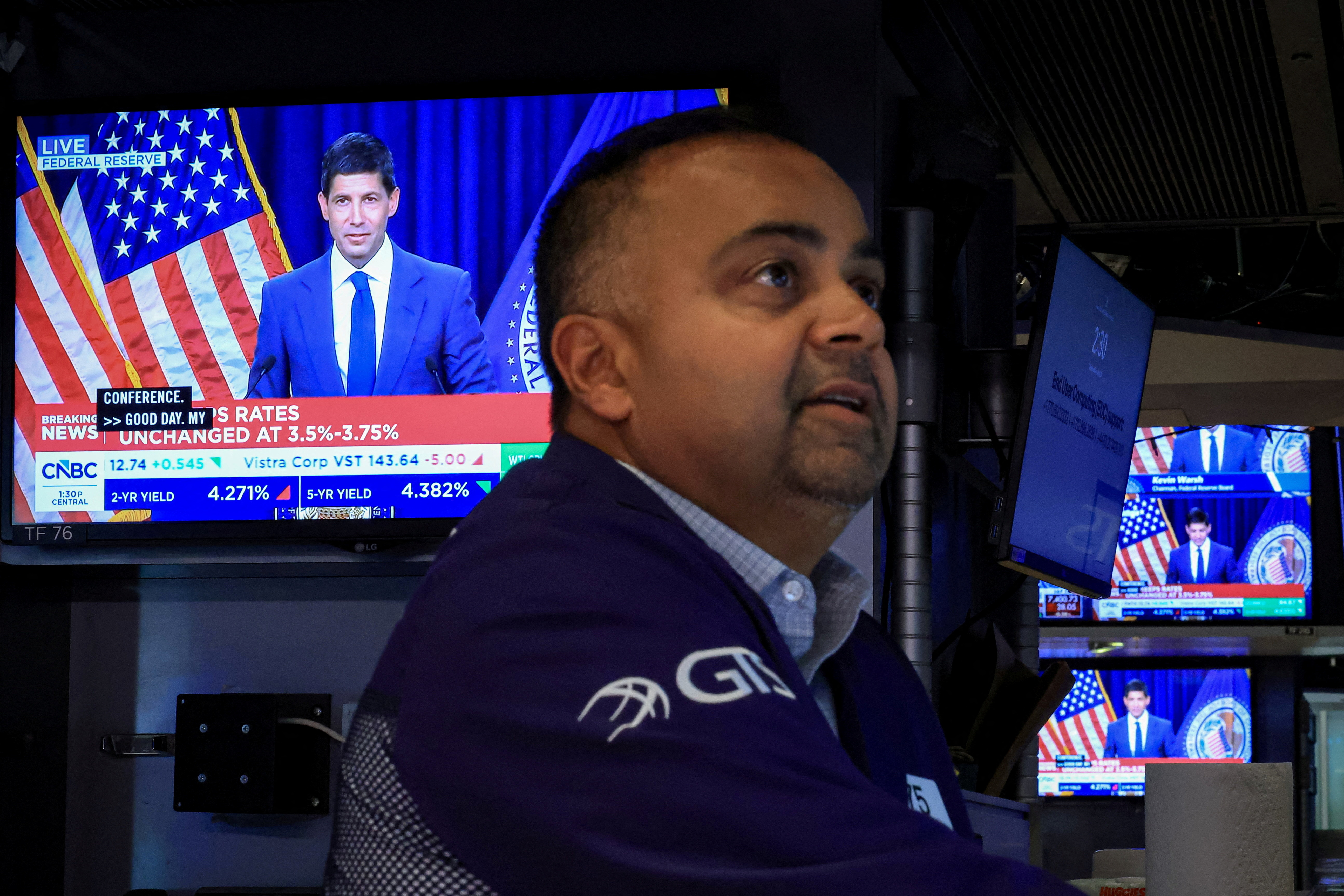
The immediate reaction across Wall Street’s premier indices was swift and decisive. The S&P 500, the Nasdaq Composite, and the Dow Jones Industrial Average all slipped into negative territory by the closing bell, erasing weekly gains and forcing institutional desks to re-evaluate portfolio risk parameters.
Growth-oriented equities, particularly within the technology and biotechnology sectors, bore the brunt of the sell-off. These high-duration assets, whose valuations rely heavily on discounted cash flows projected far into the future, are acutely sensitive to shifts in the discount rate. As terminal rate expectations were revised upward, valuation multiples compressed rapidly, leading to aggressive profit-taking among mega-cap tech stocks.
Conversely, defensive sectors such as utilities, healthcare, and consumer staples demonstrated relative resilience, though they too succumbed to late-day selling pressure as broad market liquidity tightened. Fixed-income markets experienced heightened volatility, with Treasury yields climbing across the curve as bond traders priced in a higher terminal fed funds rate.
Verified Data & Metrics Breakdown
| Index / Metric | Prior Close | Post-Announcement Close | Percentage Change |
|---|---|---|---|
| S&P 500 Index | 5,842.10 | 5,781.88 | -1.03% |
| Nasdaq Composite | 18,415.30 | 18,120.45 | -1.60% |
| Dow Jones Industrial Average | 43,110.20 | 42,865.12 | -0.57% |
| U.S. 10-Year Treasury Yield | 4.22% | 4.35% | +13 bps |
| Federal Reserve Inflation Target | 2.00% | 2.00% | Unchanged (Reaffirmed) |
Corporate Strategy and Capital Allocation in a High-Rate Regime
For enterprise CFOs and corporate strategists, Chair Warsh’s stance necessitates an immediate overhaul of operational and financial planning. The era of cheap, readily available leverage has officially drawn to a close, forcing executive suites to prioritize cash flow generation, balance sheet fortification, and stringent risk mitigation over speculative top-line expansion.
When evaluating enterprise ROI on digital transformation projects, infrastructure scalability, and long-term research and development, hurdle rates have risen dramatically. Projects that easily cleared internal rate of return (IRR) thresholds during the zero-interest-rate policy (ZIRP) era are now facing intense scrutiny. CFOs are demanding accelerated payback periods and guaranteed operational efficiencies before committing institutional capital.
Furthermore, regulatory compliance and liquidity management have taken center stage. Financial institutions and corporate treasuries are actively restructuring debt maturities to avoid refinancing cliffs in an elevated rate environment. Companies with robust balance sheets, pristine credit ratings, and substantial cash reserves are well-positioned to weather the turbulence and potentially acquire distressed competitors. Conversely, over-leveraged entities face mounting debt-service burdens that threaten credit downgrades and margin erosion.
People Also Ask (FAQ)
Why did Wall Street close lower following Fed Chair Warsh’s remarks?
Wall Street indices retreated because Chair Warsh signaled that the Federal Reserve will maintain a restrictive monetary stance and keep interest rates higher for longer to combat sticky inflation. This dashed investor hopes for near-term rate cuts, causing a broad repricing of equities and higher borrowing costs.
What is the Federal Reserve's official inflation target, and why is it significant?
The Fed’s official target is an annualized inflation rate of 2%. Chair Warsh reaffirmed this target as non-negotiable, indicating that the central bank will not loosen monetary policy prematurely, as doing so could re-accelerate price pressures and destabilize long-term economic growth.
How do higher interest rates impact corporate capital allocation and technology investments?
Elevated interest rates increase the cost of capital, forcing enterprise leaders to raise hurdle rates for new projects. This impacts long-term capital allocation, shifting corporate strategy away from speculative growth toward immediate profitability, rigorous risk mitigation, and disciplined cash flow generation.
How did fixed-income markets and Treasury yields react to the announcement?
Following Warsh's hawkish address, U.S. Treasury yields climbed across the curve—with the 10-year yield jumping roughly 13 basis points—as bond traders adjusted their pricing models to reflect a higher terminal interest rate path.
Future Outlook: Milestones and Macroeconomic Trajectory
As financial markets digest the implications of the Warsh Doctrine, the macroeconomic focus shifts toward upcoming data releases and central bank communications. Investors and economists will scrutinize upcoming Consumer Price Index (CPI) prints, Personal Consumption Expenditures (PCE) reports, and employment figures for concrete evidence of labor market softening and price stabilization.
Key milestones to monitor over the next quarter include:
- FOMC Meeting Minutes: Detailed transcripts providing deeper insight into internal committee debates regarding terminal rate projections.
- Corporate Earnings Season: Management commentary on how persistent high borrowing costs are impacting forward-looking guidance, enterprise spending, and profit margins.
- Labor Market Indicators: Non-farm payrolls and wage growth data, which serve as primary leading indicators for core services inflation.
Ultimately, Chair Warsh has drawn a definitive line in the sand. Wall Street must now transition away from the comforting illusion of imminent monetary rescue and adapt to a disciplined, high-rate operating reality where fundamentals, disciplined capital allocation, and operational excellence dictate market winners and losers.