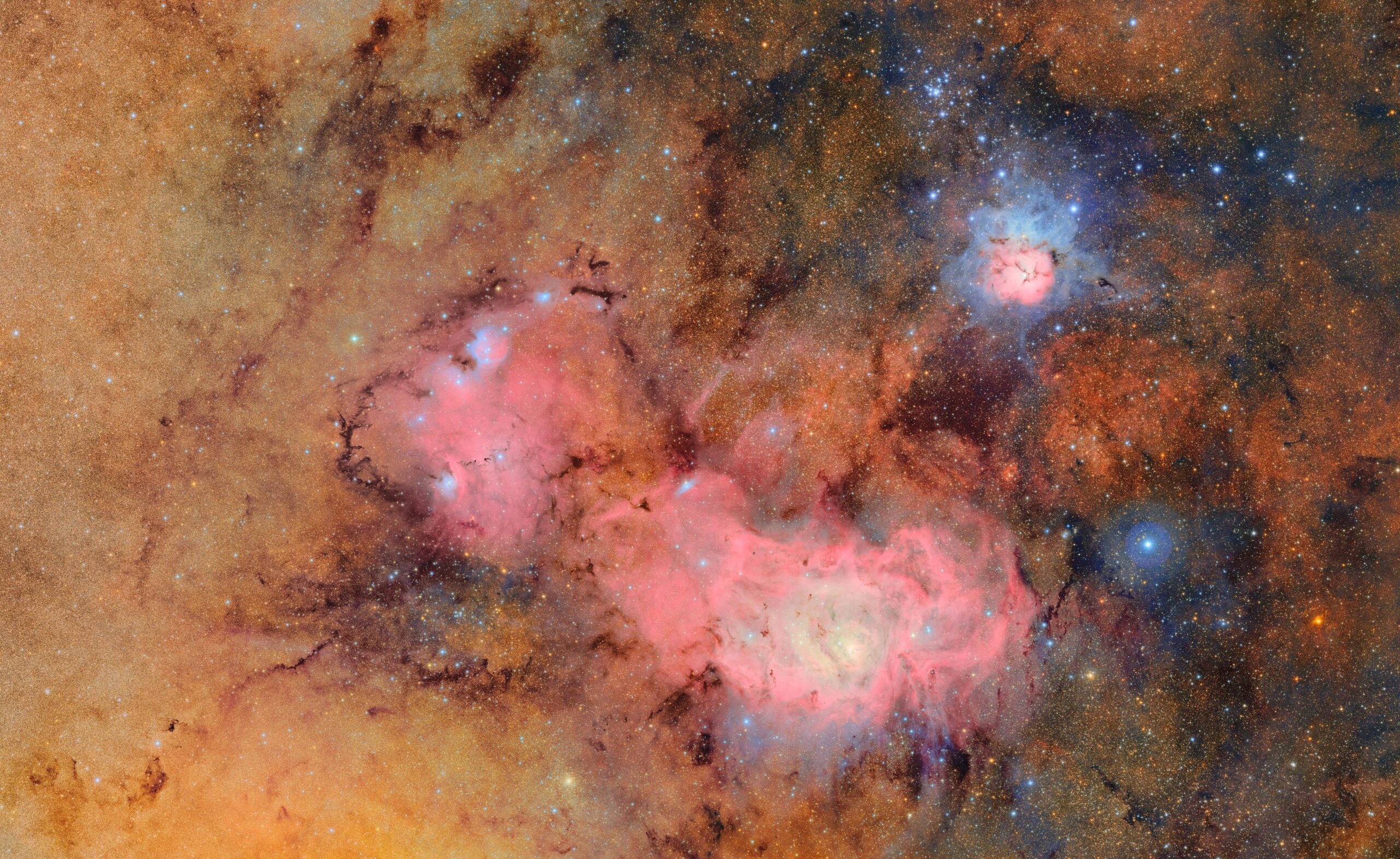
The New Space Age: How 2025’s Top 10 Breakthroughs—From Mars Biosignatures to the Starliner Rescue—Rewrote the Cosmic Playbook
NEW YORK & NEW DELHI — The year 2025 will go down in history as the pivot point where space exploration evolved from a speculative frontier into a highly contested arena of geopolitical power, massive private capital, and paradigm-shifting science. According to the definitive year-end review compiled by Astronomy Magazine, the events of 2025 did more than push the boundaries of human knowledge; they fundamentally restructured the economics of low-Earth orbit and altered our search for life in the universe.
For executive boardrooms and global policy hubs, the message is clear: space is no longer just about flags and footprints. It is an industry experiencing hyper-growth, fraught with operational risks, regulatory bottlenecks, and unprecedented technological disruption.
1. The Orbiting Crisis: The Epic Saga of Butch and Suni
No story captured the public’s imagination—and exposed the stark commercial vulnerabilities of modern spaceflight—quite like the dramatic saga of NASA astronauts Butch Wilmore and Suni Williams. What was planned as an eight-day test flight of Boeing’s Starliner spacecraft turned into an unscheduled, multi-month residency aboard the International Space Station (ISS).
Following thruster anomalies and helium leaks during Starliner's approach in mid-2024, NASA made the historic decision to return the capsule empty. Butch and Suni remained on the ISS, eventually hitching a ride home in early 2025 aboard a SpaceX Crew Dragon capsule. This dramatic rescue cemented SpaceX's operational dominance, while dealing a devastating financial and reputational blow to Boeing’s defense and space division. The incident forced a deep-seated reassessment of NASA's Commercial Crew Program and highlighted the massive premium placed on aerospace redundancy.
2. Life on the Red Planet? Perseverance Striking Scientific Gold
Millions of miles away, NASA’s Perseverance rover delivered what could be the scientific discovery of the century. Trudging through the ancient lakebeds of Jezero Crater, the rover's sophisticated onboard instruments identified a dense concentration of organic molecules and potential biosignatures within Martian rock cores.
While NASA scientists cautiously stop short of declaring a definitive discovery of past alien life, the chemical signals found in these samples are the most compelling hints yet. These findings have intensified the global geopolitical scramble over the Mars Sample Return (MSR) mission. The financial debate in Washington has shifted from "Is it worth the cost?" to "How fast can we bring these samples back to Earth?"
3. A New Eye on the Cosmos: Vera C. Rubin Observatory Goes Live
The year 2025 marked the dawn of "big data astronomy" with the commissioning of the Vera C. Rubin Observatory in Chile. Boasting an 8.4-meter telescope and a revolutionary 3,200-megapixel camera, the observatory began its Legacy Survey of Space and Time (LSST).
Every single night, the Rubin Observatory captures the entire visible southern sky, generating massive petabytes of data and detecting millions of transient events—from fast-moving asteroids to distant supernovae. This automated, AI-driven survey is democratizing astronomy, transforming how researchers identify cosmic threats and map the dark matter scaffolding of the universe.
4. The Invisible Collision: Megaconstellations vs. Radio Astronomy
As commercial internet satellite constellations grew at an exponential rate in 2025, the tension between global telecommunications and pure science reached a boiling point. Astronomers sounded the alarm as thousands of low-Earth orbit satellites began severely disrupting radio astronomy.
Unintended electromagnetic radiation "leaking" from these spacecraft has begun blinding sensitive radio telescopes, threatening our ability to study the early universe and detect faint cosmic signals. This friction has sparked intense lobbying at the International Telecommunication Union (ITU) to establish stricter global limits on satellite emissions, presenting a new regulatory hurdle for companies like SpaceX, Amazon, and OneWeb.
5. Starship’s Path to Artemis: Rapid Prototyping Pays Off
SpaceX's massive Starship rocket achieved crucial operational milestones in 2025, demonstrating successful hot-staging, orbital insertion, and critical propellant transfer tests in orbit. These achievements have brought NASA’s Artemis III mission—intended to land humans back on the Moon—closer to reality. The sheer scale of Starship’s payload capacity is already rewriting the business models for heavy satellite launches and deep-space logistics.
The Definitive Breakdown: Top 10 Space Stories of 2025
The following table outlines the defining moments of the year, tracking their primary sector, key stakeholders, and long-term global impact:
| Rank | The Story | Primary Sector | Key Players | Long-Term Global Impact |
|---|---|---|---|---|
| 1 | The Saga of Butch & Suni | Commercial Crew | NASA, Boeing, SpaceX | Reshaped aerospace safety culture and commercial contracts. |
| 2 | Perseverance Mars Biosignatures | Astrobiology | NASA, ESA | Accelerated funding and urgency for Mars Sample Return. |
| 3 | Vera C. Rubin Survey Begins | Observational Science | NSF, DOE, Chile | Created the first real-time, high-definition cosmic "movie." |
| 4 | Megaconstellation Interference | Regulatory & Sci | SpaceX, ITU, Astronomers | Triggered push for new international orbit-emission laws. |
| 5 | Starship Orbital Milestones | Heavy Launch | SpaceX, NASA | Drastically reduced the cost-per-kilogram to reach orbit. |
| 6 | Artemis II Lunar Prep | Human Spaceflight | NASA, CSA, Artemis Coalition | Solidified the West's geopolitical coalition for lunar return. |
| 7 | China’s Far-Side Conquests | Lunar Exploration | CNSA | Intensified the lunar resource and polar-landing race. |
| 8 | JWST Resolves Early Universe | Cosmology | NASA, ESA, CSA | Challenged standard models of galaxy formation and dark energy. |
| 9 | Rise of Private Space Stations | Commercial Real Estate | Axiom, Vast, Voyager | Laid the groundwork for life after the ISS de-orbits. |
| 10 | Voyager 1's Deep-Space Resilience | Interstellar Science | NASA JPL | Pushed the absolute limits of human engineering and remote recovery. |
Looking Ahead: The Strategic Outlook for 2026 and Beyond
As we move deeper into 2026, the events of 2025 have set a fast-paced trajectory. Space is no longer a niche scientific pursuit; it is a vital pillar of national security, global communications, and economic competitiveness. The transition from government-led programs to private public-partnerships is accelerating, forcing traditional aerospace giants to adapt or risk obsolescence.
With sovereign nations racing to claim prime real estate on the lunar south pole and private firms laying the groundwork for commercial orbital habitats, the regulatory, financial, and scientific stakes have never been higher. The cosmos is open for business, and the rules of engagement are being written in real time.
Frequently Asked Questions
Why did the Butch and Suni saga have such a massive impact on the aerospace industry?
Beyond the human drama, the Starliner delays highlighted the immense challenge of human spaceflight engineering. It demonstrated that even legacy aerospace giants like Boeing face steep learning curves in the modern era, and it solidified SpaceX's near-monopoly on Western orbital crew transportation, driving discussions about the need for a third commercial competitor to ensure market stability.
How does the Vera C. Rubin Observatory differ from the James Webb Space Telescope?
While the James Webb Space Telescope (JWST) focuses on incredibly deep, narrow views of specific target points in the infrared spectrum, the Vera C. Rubin Observatory is a wide-field survey telescope. Rubin images the entire visible southern sky every few nights in the optical spectrum. Webb is a cosmic microscope; Rubin is a cosmic wide-angle motion picture camera.