Executive Takeaways
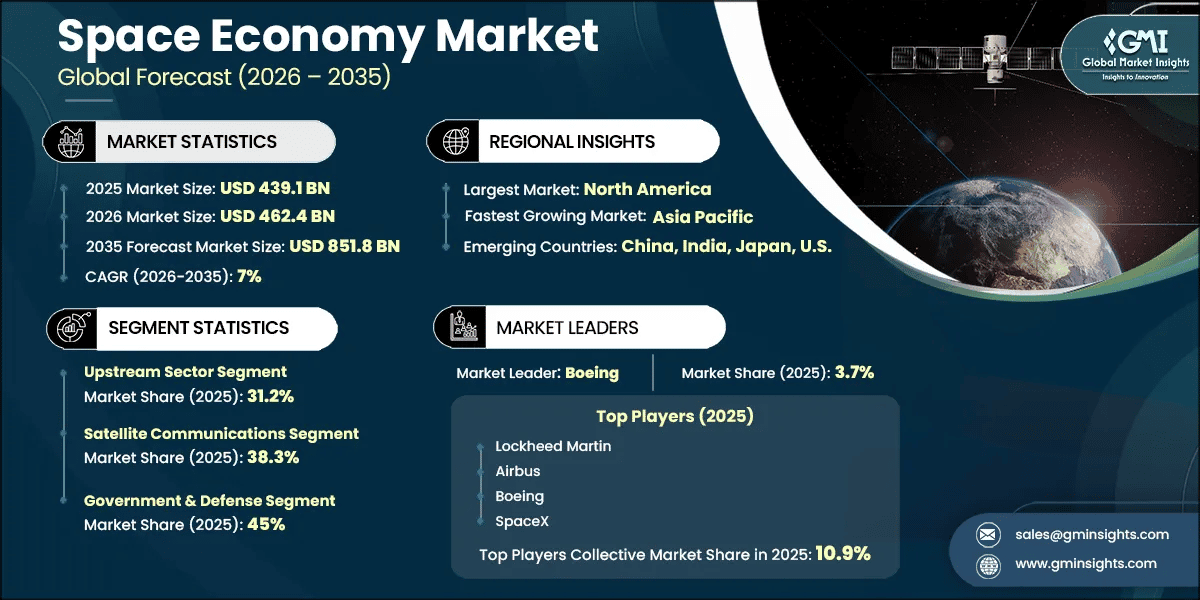
- Valuation Horizon: According to the latest global market analysis released by Future Market Insights, the space economy market is projected to expand from USD 449.8 billion in 2025 to a staggering USD 935.6 billion by 2035.
- Compounded Growth: The sector will achieve a steady Compound Annual Growth Rate (CAGR) of 7.6%, driven by private equity inflows, enterprise infrastructure scalability, and shifting geopolitical defense spending.
- Commercial Shift: Traditional government-led space exploration has officially given way to private-sector capital allocation, with low-Earth orbit (LEO) manufacturing, satellite constellations, and orbital logistics dominating valuation multiples.
- In-depth analysis of enterprise ROI, infrastructure scalability, and regulatory compliance reveals the critical pivot points for institutional investors navigating this high-stakes market.
For decades, the final frontier was the exclusive domain of sovereign states, powered by taxpayer-funded treasuries and driven by geopolitical prestige. Today, that paradigm has fundamentally shattered. As institutional asset managers, venture capitalists, and sovereign wealth funds reallocate portfolios toward high-growth technological frontiers, the space economy has emerged as a premier asset class. A rigorous global market analysis published by Future Market Insights underscores this tectonic shift: the global space economy is poised to scale from USD 449.8 billion in 2025 to a commanding USD 935.6 billion by 2035, registering a robust CAGR of 7.6%.
This comprehensive investigative report examines the structural catalysts, technological milestones, capital allocation trends, and regulatory hurdles defining this trillion-dollar inflection point. By dissecting the underlying financial architecture of the new space age, we analyze how commercial enterprises are rewriting the rules of infrastructure scalability, risk mitigation, and orbital monetization.
The Macroeconomic Catalyst: From Exploration to Enterprise ROI
Test Our Free AI & Tech Utilities Suite
Calculate LLM API token costs, analyze article dwell-time, or simulate tech DCA returns.
The transition of the space sector from a cost center to a profit-generating engine is one of the most remarkable corporate transformations of the 21st century. Historically, capital expenditure in aerospace was characterized by elongated development cycles, massive cost overruns, and binary risk profiles. However, the maturation of reusable launch systems—pioneered by private entities and subsequently adopted by international aerospace consortiums—has compressed launch costs per kilogram by over 80% during the past decade.
This dramatic reduction in barrier-to-entry costs has fundamentally altered enterprise ROI calculations. Corporations are no longer deterred by prohibitive transit expenses. Instead, boardrooms are evaluating space-based assets through the lens of terrestrial utility. High-throughput satellite (HTS) constellations, Earth-observation analytics, and quantum-encrypted orbital communication networks are now viewed as indispensable components of global enterprise cloud compute architecture and logistical supply chains.
Furthermore, venture capital and private equity deployment has matured. Early-stage speculative bets on lunar tourism have taken a back seat to cash-flow-positive business models. Investors demand predictable valuation multiples tied to recurring software-as-a-service (SaaS) models adapted for orbital data, defense-backed procurement contracts, and proprietary in-space manufacturing rights.
Deep-Dive Breakdown: Market Segments Driving the 7.6% CAGR

To understand the trajectory toward the $935.6 billion milestone by 2035, one must dissect the sub-sectors propelling this growth. The space economy is no longer a monolithic industry; it is a diversified ecosystem comprising distinct operational pillars:
- Satellite Communications and Broadband: Mega-constellations in Low-Earth Orbit (LEO) and Medium-Earth Orbit (MEO) are capturing lucrative enterprise and consumer markets. By bridging the digital divide and providing low-latency maritime, aviation, and rural connectivity, satcom remains the largest revenue generator in the sector.
- Earth Observation (EO) and Geospatial Intelligence: Utilizing advanced synthetic aperture radar (SAR) and multispectral imaging, EO firms provide real-time agricultural monitoring, supply chain visibility, and climate risk mitigation data to Fortune 500 corporations and defense agencies alike.
- In-Space Manufacturing and R&D: Microgravity environments offer unparalleled advantages for semiconductor crystal growth, fiber optics fabrication, and pharmaceutical crystallization. Early commercial trials are rapidly transitioning into pilot-scale production facilities operating autonomously or semi-autonomously in orbit.
- Launch Services and Orbital Logistics: The demand for dedicated and rideshare launch vehicles continues to outstrip supply. Orbital transfer vehicles (OTVs) and space tugs are emerging as critical infrastructure, enabling satellite repositioning, life extension services, and active space debris mitigation.
Verified Data and Metrics Breakdown
The following comparative metrics illustrate the structural expansion of the space economy market, charting its trajectory from baseline projections in 2025 to its anticipated valuation at the close of the forecast period in 2035.
| Market Metric / Indicator | Baseline Year (2025) | Forecast Horizon (2035) | Strategic Growth Dynamics |
|---|---|---|---|
| Total Market Valuation | USD 449.8 Billion | USD 935.6 Billion | Projected at a steady 7.6% CAGR over the decade. |
| Primary Growth Engine | Government Defense & LEO Satcom | Commercial Manufacturing & Logistics | Shift from public spending to private enterprise monetization. |
| Primary Wire Source | Future Market Insights (Comprehensive Global Market Analysis) | ||
| Capital Market Liquidity | High Private Equity Selectivity | Institutional Debt & Public Equity Maturity | Consolidation of tier-1 aerospace suppliers and pure-play operators. |
Industry & Market Implications: Winners, Losers, and Geopolitical Realities
As capital floods into the commercial space sector, the divergence between market winners and legacy laggards is widening. Understanding these dynamics is crucial for institutional portfolio managers seeking alpha.
Who Wins: The Agile Innovators and Infrastructure Enablers
The definitive winners of the 2025–2035 cycle will be agile private-sector pure-plays that own critical orbital chokepoints. Companies specializing in sub-system component manufacturing, radiation-hardened semiconductors, advanced propulsion systems, and automated collision-avoidance software are commanding premium valuation multiples. Furthermore, telecommunications giants that successfully integrate satellite backhaul into their terrestrial 5G and nascent 6G networks will secure sticky, high-margin enterprise accounts.
Who Loses: Legacy Bureaucracies and High-Cost Contractors
Conversely, legacy defense prime contractors reliant on traditional cost-plus government contracting models face severe margin compression. Firms unable to pivot away from bureaucratic development timelines risk obsolescence. As commercial launch providers demonstrate superior cadence and cost-efficiency, government agencies are increasingly mandating fixed-price contracts, penalizing slow-moving suppliers.
Regulatory Compliance and Orbital Real Estate Risk
The rapid densification of low-Earth orbit introduces profound operational and legal risks. Regulatory compliance is tightening across international jurisdictions. The Federal Communications Commission (FCC) and the United Nations Office for Outer Space Affairs (UNOOSA) are implementing stricter guidelines regarding spectrum allocation, orbital debris mitigation, and de-orbiting timeframes (transitioning from the old 25-year rule to aggressive 5-year post-mission disposal standards).
Failure to adhere to these regulatory frameworks exposes operators to catastrophic insurance liabilities, asset collisions, and the potential revocation of broadcast licenses. Consequently, risk mitigation and active debris removal (ADR) technologies have emerged as non-negotiable budget items for every serious orbital operator.
Frequently Asked Questions (People Also Ask)
What is the projected size and growth rate of the space economy market?
According to comprehensive market research by Future Market Insights, the global space economy is valued at USD 449.8 billion in 2025 and is projected to reach USD 935.6 billion by 2035, expanding at a Compound Annual Growth Rate (CAGR) of 7.6%.
Which sectors are driving the highest valuation multiples in the space economy?
The primary growth drivers include Low-Earth Orbit (LEO) satellite communications and broadband constellations, Earth-observation analytics for enterprise supply chains, in-space microgravity manufacturing, and commercial launch/orbital logistics services.
How are private investors approaching enterprise ROI in aerospace?
Institutional investors and venture capitalists are prioritizing cash-flow-positive business models, recurring subscription-based data services (SaaS), and defense-backed procurement contracts over speculative, long-horizon exploration projects, ensuring more reliable valuation metrics.
What are the primary regulatory challenges facing commercial space operators?
Key regulatory hurdles include complex international spectrum licensing, stringent FCC and UN guidelines on orbital debris mitigation, mandatory rapid de-orbit protocols, and navigating evolving space insurance and liability frameworks.
Future Outlook: Strategic Milestones to Watch Through 2035
As the global market advances toward the USD 935.6 billion milestone, several critical technological and financial inflection points will dictate the industry's ultimate velocity:
- The Commercial Space Station Transition: With the planned retirement of the International Space Station (ISS) approaching in the 2030 timeframe, the successful deployment and monetization of privately owned commercial space stations will test the market's appetite for orbital real estate.
- In-Space Resource Utilization (ISRU): Pilot missions testing lunar ice extraction, asteroid prospecting, and propellant depots will begin shifting from theoretical engineering concepts to capitalized venture targets, unlocking entirely new commodity markets.
- Consolidation and M&A Activity: As capital markets mature, expect a wave of mergers and acquisitions. Well-capitalized telecom and defense conglomerates will likely acquire nimble startups possessing proprietary intellectual property in laser communication, quantum sensing, and autonomous docking.
For executive leadership, portfolio managers, and strategic planners, the message is unequivocal: the space economy has graduated from a speculative frontier into a foundational pillar of global economic infrastructure. Navigating this landscape requires rigorous compliance, astute capital allocation, and an acute understanding of orbital dynamics. Those who master these elements will command the commanding heights of the trillion-dollar orbit.