Executive Takeaways
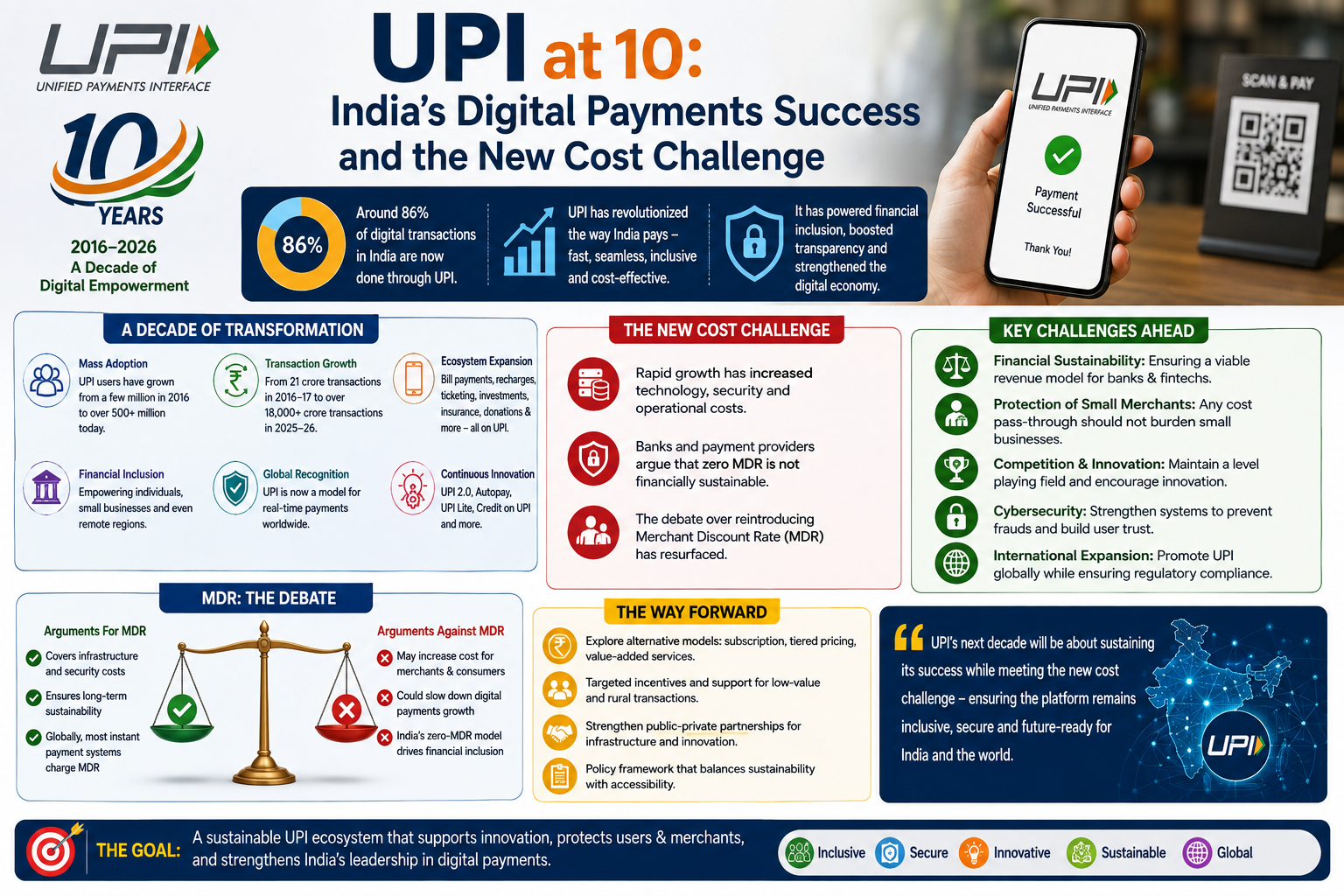
- A Decade of Unprecedented Scale: Launched in 2016 by the National Payments Corporation of India (NPCI), Unified Payments Interface (UPI) now processes over 14 billion transactions monthly worth more than $200 billion—accounting for nearly 80% of India’s consumer payment volume.
- The Zero-MDR Dilemma: Government-mandated zero Merchant Discount Rate (MDR) has democratized adoption but crippled fintech unit economics, forcing market leaders like PhonePe and Google Pay to seek monetization through cross-selling credit, insurance, and wealth management services.
- Infrastructure Under Strain: Sub-₹500 micro-transactions constitute over 60% of total volume, pushing Legacy Core Banking Systems (CBS) to maximum capacity and driving demand for enterprise cloud-native payment processors, UPI Lite, and federated architecture.
- Geopolitical & Cross-Border Expansion: As India links UPI with Singapore’s PayNow, the UAE’s Jaywan, and France’s Lyra, the network is morphing from a domestic payments rail into a sovereign, low-cost cross-border remittance architecture competing with SWIFT.
The Decennial Odyssey: From Experimental Rail to Sovereign Financial Engine
Ten years ago, the architecture of global retail payments was firmly entrenched in two legacy paradigms: card-network duopolies running on hefty interchanges, or sluggish interbank wire systems designed for high-value settlement rather than micro-retail velocity. When the National Payments Corporation of India (NPCI) launched the Unified Payments Interface (UPI) in April 2016 under the leadership of former Reserve Bank of India (RBI) Governor Raghuram Rajan and tech visionary Nandan Nilekani, traditional global financiers viewed it as an idealistic public-goods experiment.
Today, UPI represents the world's most sophisticated real-time retail payment infrastructure. Built upon the Instant Payment Service (IMPS) core and integrated with India Stack—the triple framework of digital identity (Aadhaar), consent-based data sharing (Account Aggregator), and interoperable rails—UPI transformed cash-bound India into a hyper-digitized transaction engine. Over the past decade, monthly transaction volumes expanded from a modest 1 million in late 2016 to an astronomical 15 billion transactions in 2026, settling over $2.4 trillion annualized—a velocity equivalent to more than 50% of India’s nominal GDP.
The catalytic accelerators were both regulatory and systemic. The 2016 demonetization campaign stripped physical cash out of circulation overnight, forcing small merchants and consumers onto digital rails. Subsequent smartphone proliferation, fueled by cheap mobile data, laid the physical hardware foundation. Finally, the COVID-19 pandemic permanently shifted payment behaviors across urban centers and rural hinterlands alike, converting contactless payment from a luxury into an essential utility.
The Structural Trilemma: Infrastructure Scalability, Cloud Resilience, and Bank CBS Bottlenecks
As UPI enters its second decade, its single greatest engineering challenge is structural throughput capacity. The platform was designed for financial inclusion, but its monumental success has created unexpected infrastructure bottlenecks for the banking sector’s back-end systems.
At the center of this technical bottleneck are Legacy Core Banking Systems (CBS) operated by traditional public and private sector banks. Unlike cloud-native fintech applications capable of horizontal autoscaling, traditional bank engines were architected in the mid-2000s for batch processing and moderate transaction concurrency. When a consumer scans a Quick Response (QR) code to purchase a ₹10 cup of tea, that micro-transaction initiates identical cryptographic checks, database locking, ledger posting, and multi-node settlement operations as a ₹500,000 corporate wire transfer.
Because micro-transactions (values below ₹500) account for roughly 65% of overall UPI transaction volume, legacy banking networks encounter severe load spikes during peak business hours. When major public banks experience technical declines (TD) due to CBS strain, execution success rates drop across the entire ecosystem, compromising network reliability.
Engineered Solutions: UPI Lite and Federated Cloud Architecture
To relieve pressure on banking core systems and guarantee sub-second finality, NPCI introduced UPI Lite—an on-device wallet architecture that offloads low-value micro-transactions from bank core servers. By delegating authorization to the local device interface and settling transactions in batch balance adjustments, UPI Lite slashes server calls by up to 75% for small payments. Additionally, tier-1 financial institutions are aggressively allocating capital toward enterprise cloud infrastructure, migrating from monolithic on-premise hardware to cloud-native, microservices-driven payment processors capable of sustaining over 10,000 Transactions Per Second (TPS).
The Security Frontier: Mitigating Distributed Fraud and Synthetic Identity Risks
The democratization of instantaneous financial velocity has inevitably attracted sophisticated cybercrime syndicates. Because UPI eliminates payment friction by utilizing single-click multi-factor authentication (MPIN), social engineering attacks—rather than direct cryptographic breaches—have emerged as the primary vector for financial fraud.
Modern fraudsters leverage complex manipulative tactics, including authorized push payment (APP) fraud, fake merchant QR codes, remote-access trojans (RATs), and malicious phishing applications disguised as official financial tools. As payment processing times shrink from minutes to milliseconds, traditional post-transaction anomaly detection models are no longer sufficient to protect retail users.
| Key Metric / Operating Vector | UPI System Baseline (2016–2018) | Current Operational Standard | Enterprise Impact & Risk Profile |
|---|---|---|---|
| Monthly Transaction Volume | 10 Million – 100 Million | 14+ Billion | Requires perpetual infrastructure expansion; high server load. |
| Peak Processing Capacity (TPS) | ~1,000 TPS | 35,000+ TPS (Targeting 100,000) | Demands cloud compute migration and federated ledger design. |
| Merchant Discount Rate (MDR) | 0.90% to 1.50% (Standard) | 0.00% (Government Mandated) | Zero transactional revenue for non-bank Third-Party Application Providers (TPAPs). |
| Micro-Transaction Share (<₹500) | ~30% | ~65% | Causes major technical stress on bank Core Banking Systems (CBS). |
| Dominant Fraud Vector | Skimming, basic phishing | Social engineering, APP fraud, RATs | Requires real-time AI-driven behavioral biometric monitoring. |
| Cross-Border Interoperability | Domestic only | Active in 7+ countries (PayNow, Lyra, UAE) | Replaces high-cost legacy remittance rails; bypasses SWIFT intermediaries. |
To combat this evolving threat landscape, the Reserve Bank of India and NPCI are implementing advanced behavioral analytics and dynamic risk scoring protocols. Next-generation fraud engines evaluate contextual parameters—including device telemetry, geolocation velocity, network IP reputation, and behavioral biometrics—in real time before releasing funds.
Enterprise payments applications are deploying machine learning classifiers that flag abnormal transfer requests, temporarily freezing high-risk transactions and requiring step-up authentication via facial recognition or voice verification. Furthermore, centralized fraud registries and rapid-response reporting networks (such as India's National Cyber Crime Reporting Portal) allow institutions to instantly freeze stolen funds across recipient account chains before illicit cash-outs occur.
The Monetization Paradox: Zero-MDR and the Search for Enterprise ROI
While UPI's engineering accomplishments are globally recognized, its economic business model presents a complex operational challenge for enterprise fintech providers. In January 2020, the Indian government instituted a strict Zero-MDR (Merchant Discount Rate) policy for person-to-merchant (P2M) UPI transactions using RuPay debit cards and bank accounts. The policy mandated that no acquiring bank or payment application could charge merchants processing fees for accepting digital payments.
This zero-fee policy successfully eliminated barriers to merchant onboarding, bringing tens of millions of micro-entrepreneurs into the formal banking system. However, it simultaneously stripped Third-Party Application Providers (TPAPs) such as PhonePe, Google Pay, and Paytm of their primary direct monetization mechanism—interchange revenue.
Today, running enterprise-grade payment infrastructure requires substantial capital expenditure. Companies must fund high-availability cloud hosting, advanced cybersecurity operations, real-time customer support, and continuous product development without earning direct fees on baseline payment transactions. To offset these costs, the Indian government provides annual budgetary subsidies—typically allocating roughly ₹1,500 crore to ₹2,000 crore ($180M–$240M)—to compensate banks and acquiring partners for infrastructure costs. However, industry insiders consistently note these subsidies cover only a fraction of true operating expenditure.
Pivot to Financial Services Super-Apps
To achieve enterprise profitability, third-party payment providers have pivoted toward cross-selling higher-margin financial products, evolving into integrated "super-apps":
- Credit Intermediation: Transforming payment histories into alternative credit scores. By offering Pre-Sanctioned Credit Lines on UPI and linking RuPay Credit Cards to UPI handles, platforms earn originations fees and interest margins.
- Wealth Management & Mutual Funds: Distributing retail investment products, micro-SIPs (Systematic Investment Plans), and digital gold investments directly within the transaction funnel.
- Insurance Distribution: Selling point-of-sale micro-insurance contracts, covering health, vector-borne diseases, and commercial property for merchants.
- Merchant Enterprise SaaS: Monetizing value-added merchant hardware, such as cellular payment alert speakers ("Soundboxes") and point-of-sale terminal software that carries fixed monthly subscription fees.
Market Structure and Regulatory Rebalancing: Resolving the Duopoly
The economics of payment distribution naturally create scale economies, leading to extreme market concentration in India's digital payments ecosystem. Two major non-bank entities—Walmart-backed PhonePe and Alphabet's Google Pay—collectively process over 80% of total UPI transaction volume and value. Combined with Paytm's historical presence, non-bank TPAPs hold an overwhelming majority share of consumer payment interactions, while traditional banks operate primarily as back-end clearing entities.
This market structure introduces systemic platform dependencies. To address concentration risks, NPCI proposed a 30% volume market-cap limit for third-party payment applications. The regulatory objective is straightforward: prevent single-point technical bottlenecks, promote healthy competition, and force consumer diversification toward alternative bank-owned and emerging third-party applications.
However, enforcing volume caps has proven complex. Restricting growth for market leaders risks degrading consumer experience if users are turned away at checkout. As a result, regulators have repeatedly extended enforcement deadlines, opting instead to gradually build infrastructure capacity across smaller ecosystem participants.
Frequently Asked Questions (People Also Ask)
1. What is the Zero-MDR mandate on UPI, and how does it affect fintech business models?
The Zero-MDR (Merchant Discount Rate) mandate is an Indian government policy introduced in 2020 that prohibits banks and payment service providers from charging transaction fees on merchant UPI payments. While this eliminated costs for merchants and accelerated adoption, it stripped payment platforms of payment interchange revenue. As a result, fintech platforms must monetize by cross-selling high-margin financial products like credit, insurance, mutual funds, and merchant subscription hardware.
2. How does UPI Lite work, and how does it reduce banking system outages?
UPI Lite is an on-device digital wallet feature designed for low-value transactions under ₹500. Instead of routing every micro-payment through a bank’s core banking system (CBS) in real time, funds are pre-loaded into a secure on-device balance. Payments are executed directly from the device to the recipient, reducing processing latency to milliseconds and dramatically lowering back-end query load on commercial banks.
3. Can international travelers and non-residents use UPI in India?
Yes. Non-Resident Indians (NRIs) and Persons of Indian Origin (PIOs) with Non-Resident External (NRE) or Non-Resident Ordinary (NRO) accounts linked to international mobile numbers can access UPI. Additionally, through NPCI's "UPI One World" initiative, foreign tourists and international travelers visiting India can obtain prepaid UPI handles upon arrival to make frictionless merchant payments across the country without holding an Indian bank account.
4. How is UPI expanding internationally to replace legacy cross-border rails?
NPCI International Payments Limited (NIPL) is forging direct sovereign technical linkages between UPI and international real-time payment networks. Strategic integrations with systems like Singapore's PayNow, the UAE's Jaywan, and France's Lyra allow users to perform instant cross-border remittances and merchant payments via QR codes. This setup eliminates high-cost intermediary correspondent banks and dramatically reduces FX transaction fees relative to traditional cross-border payment networks.
Future Outlook: Credit Integration, Sovereign CBDC Interplay, and Global Expansion
As UPI enters its second decade, its future growth trajectory hinges on three transformational pillars: credit integration, central bank digital currency (CBDC) interoperability, and international expansion.
The integration of credit onto UPI represents a major shift in consumer lending. By allowing consumers to link pre-sanctioned bank credit lines and RuPay credit cards directly to their UPI handles, NPCI is transforming the network from a debit-only clearing system into an instant point-of-sale credit network. This democratizes access to short-term credit, offering consumers a flexible alternative to traditional credit card issuance models.
Simultaneously, the Reserve Bank of India is actively testing the interoperability of the Digital Rupee (e-Rupee)—India's Central Bank Digital Currency (CBDC)—with existing UPI QR code infrastructure. By allowing merchants to accept programmable CBDC tokens using their existing UPI QR setups, India is establishing a dual-rail digital monetary architecture that combines commercial bank money velocity with central bank balance-sheet finality.
Globally, India's payments strategy seeks to create a frictionless, low-cost international remittance network. By linking UPI directly to national clearing networks across the Middle East, Southeast Asia, and Europe, NPCI International is building an alternative to high-cost cross-border transfer channels. As UPI scales to meet future demand, its evolution offers a powerful model for global financial infrastructure in the 21st century.