
Executive Takeaways
- Apple Margin Compression: Apple shares slid following forward guidance that signaled narrower hardware gross margins, driven by rising input costs and aggressive capital allocation toward generative AI infrastructure.
- Palantir Growth Reality Check: Palantir Technologies (PLTR) suffered an 8% post-earnings pullback as investors questioned whether enterprise AI monetization can justify its sky-high valuation multiples.
- Broad Market Re-pricing: Institutional portfolio managers are accelerating risk mitigation strategies, rotating away from premium-priced tech equities toward defensive sectors amid compressed cloud compute architecture returns.
- Capital Allocation Shifts: Corporate boards are demanding clearer enterprise ROI metrics before approving expansive software and hardware procurement budgets.
NEW YORK — Wall Street delivered a stern reality check to the technology sector as two of its most bellwether equities faced severe downward pressure. Apple Inc. shares drifted lower following an earnings call that revealed a weaker-than-anticipated margin outlook, while data analytics pioneer Palantir Technologies slumped 8% despite posting top-line revenue growth. The simultaneous sell-offs underscore a profound shift in investor sentiment: the era of unchecked valuation multiples is colliding with the hard economics of capital expenditure efficiency, rising supply chain frictions, and the elusive quest for immediate enterprise ROI.
For months, global equity markets have priced in a frictionless transition toward artificial intelligence monetization. However, financial statements filed this week reveal that building, scaling, and maintaining next-generation machine learning infrastructure is exerting severe pressure on corporate balance sheets. As institutional investors reassess their risk mitigation postures, the market is no longer rewarding top-line growth at any cost. Instead, senior analysts at leading investment banks are scrutinizing cash flow generation, gross margin resilience, and cloud compute architecture efficiency.
The Apple Margin Dilemma: Premium Pricing Meets Cost Pressures
Test Our Free AI & Tech Utilities Suite
Calculate LLM API token costs, analyze article dwell-time, or simulate tech DCA returns.
Apple’s recent market slide was not precipitated by a catastrophic collapse in consumer demand, but rather by subtle forward-looking commentary regarding its profitability metrics. While headline revenue figures managed to meet or slightly exceed consensus Wall Street estimates, the company's forward gross margin outlook missed expectations. Analysts quickly zeroed in on the structural factors squeezing Cupertino’s bottom line.
At the heart of the margin compression is an ongoing evolution in Apple’s product mix and escalating component costs. The integration of advanced silicon capable of supporting heavy on-device generative AI workloads requires more complex semiconductor fabrication processes. Furthermore, global supply chain volatility and tightening regulatory compliance overhead in key international markets have inflated operational expenditures.
Institutional portfolio managers note that Apple’s traditional playbook of maintaining elite pricing power is facing resistance in mature smartphone markets. Consumers are holding onto devices longer, forcing the tech giant to rely heavily on service revenue growth to offset hardware stagnation. Yet, as regulatory antitrust scrutiny intensifies around its lucrative App Store ecosystem, the growth trajectory of high-margin service revenue faces potential headwinds. Consequently, equity research desks have begun trimming their price targets, triggering automated sell stops and a broader retreat in mega-cap technology valuations.
Palantir’s 8% Plunge: When Exceptional Growth Meets Gravity
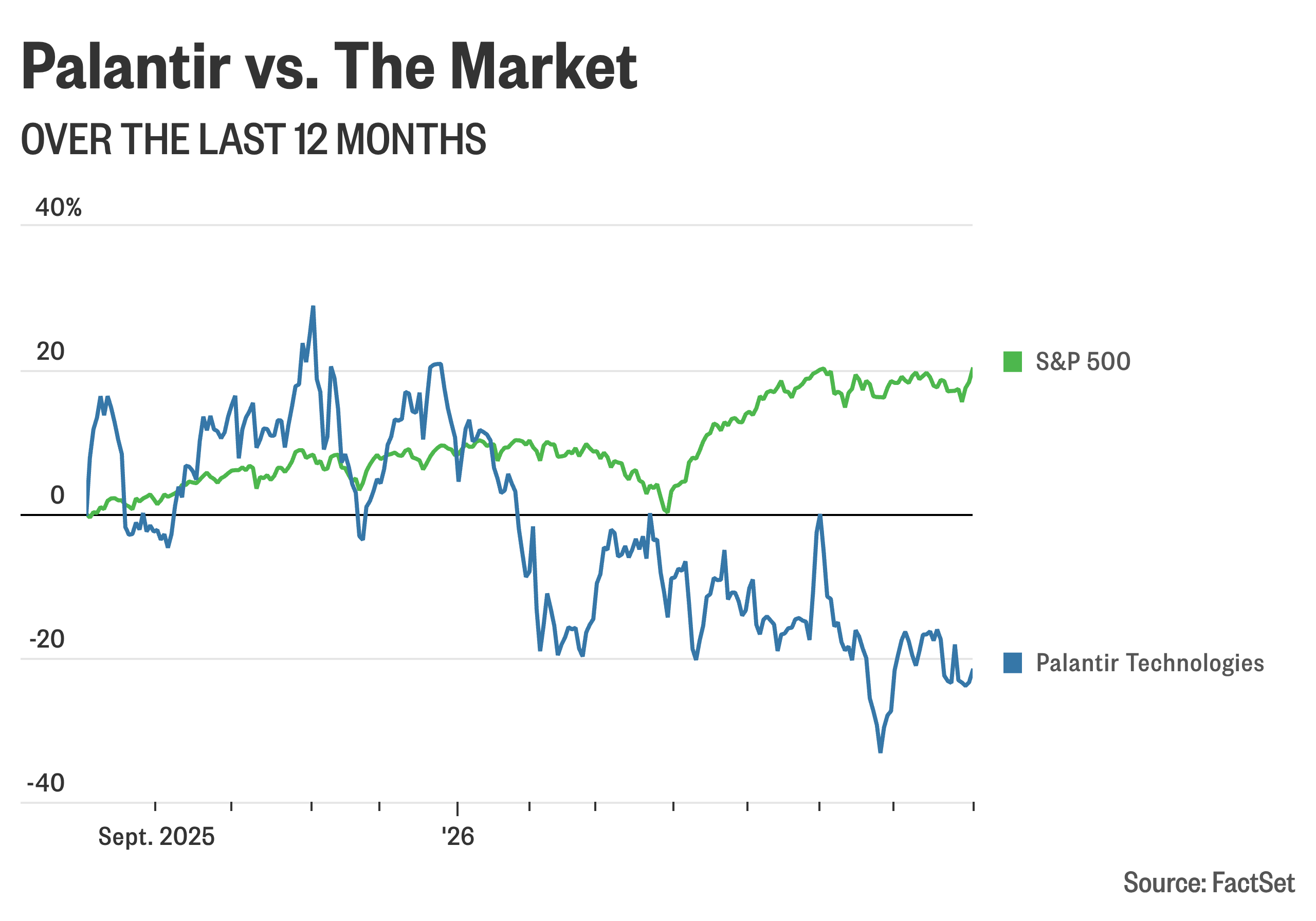
If Apple’s slide reflects traditional hardware margin pressures, Palantir’s 8% post-earnings slump is a textbook study in valuation sensitivity. Palantir has long been the darling of retail and institutional growth investors alike, championed for its revolutionary Artificial Intelligence Platform (AIP) and its dominance in government and enterprise data integration. However, in the current macroeconomic climate, even stellar execution can be punished if valuation multiples leave zero margin for error.
During the earnings conference call, Palantir reported robust commercial customer acquisition metrics, particularly within the United States. Yet, sophisticated market participants focused on the pace of enterprise conversion—the speed at which proof-of-concept bootcamps translate into multi-million-dollar, long-term procurement contracts. While enterprise ROI for Palantir’s software remains compelling, CFOs across the Fortune 500 are extending their procurement approval cycles, demanding rigorous infrastructure scalability proofs before committing capital.
Trading at a forward price-to-earnings multiple that far exceeds the broader S&P 500, Palantir’s equity was priced for absolute perfection. When quarterly results showed deceleration in international commercial growth alongside elevated stock-based compensation figures, institutional funds initiated profit-taking protocols. The resulting 8% correction illustrates that market liquidity is increasingly selective, favoring companies that demonstrate immediate cash generation over speculative long-term promise.
Verified Data & Market Metrics Breakdown
| Company / Metric | Current Quarter Result | Forward Guidance / Outlook | Market Reaction |
|---|---|---|---|
| Apple Inc. (AAPL) | In-line revenue; steady iPhone demand | Weaker gross margin outlook due to component and AI costs | Shares slide, dragging down hardware peers |
| Palantir Technologies (PLTR) | Solid top-line beat; US commercial growth up 40%+ YoY | Continued strong demand, but elongated enterprise sales cycles | 8% post-earnings slump amid multiple compression |
| Macro Sector Sentiment | High capital expenditure on AI infrastructure | Increased focus on risk mitigation and ROI verification | Sector-wide rotation toward defensive assets |
Industry & Market Implications: Winners and Losers
The simultaneous correction in Apple and Palantir shares reverberates far beyond their respective balance sheets, signaling a structural re-pricing of the broader technology sector. As central banks maintain restrictive monetary policies to manage lingering inflation, the cost of capital has fundamentally changed. Chief Executive Officers and Chief Information Officers are under immense pressure to prove that heavy capital expenditures directed toward cloud compute architecture and AI deployment will yield tangible bottom-line returns.
Who Loses: High-growth, unprofitable software-as-a-service (SaaS) providers and hardware manufacturers with inflexible cost structures are immediate losers. Companies trading at hyper-inflated valuation multiples that rely on perpetual top-line expansion without corresponding free cash flow will face severe capital starvation. Furthermore, smaller tech vendors struggling to prove clear enterprise ROI will find venture capital and institutional equity markets increasingly closed.
Who Wins: Defensive technology stalwarts boasting fortress balance sheets, substantial cash reserves, and predictable recurring revenue streams stand to capture fleeing liquidity. Additionally, enterprise infrastructure providers that specialize in cost optimization, cybersecurity compliance, and data governance are seeing heightened demand as corporations prioritize risk mitigation over speculative innovation.
Frequently Asked Questions (People Also Answered)
Why did Apple shares slide despite solid underlying revenue reports?
Apple shares slid primarily due to a weaker-than-expected forward gross margin outlook. Investors and analysts expressed concern over rising component costs, expensive on-device AI integration, and shifting product mixes that threaten to compress profitability over the coming fiscal quarters.
What drove Palantir’s 8% post-earnings drop?
Palantir’s 8% drop was driven by valuation compression rather than operational failure. Despite posting strong revenue growth and impressive US commercial adoption, its elevated price-to-earnings multiple left no room for deceleration. Investors reacted cautiously to elongated enterprise sales cycles and high stock-based compensation.
How are macroeconomic factors impacting tech sector valuations?
Elevated interest rates have raised the cost of capital, prompting institutional investors to shift from speculative, long-duration growth assets toward cash-generative equities. Market participants now demand rigorous proof of enterprise ROI and infrastructure scalability before rewarding tech stocks with premium multiples.
What does "margin compression" mean for consumers and investors?
For investors, margin compression means lower net profitability for every dollar of revenue generated, which typically depresses share prices. For consumers, it can result in higher retail pricing as companies attempt to pass rising input and regulatory compliance costs down to the end buyer.
Future Outlook: Strategic Milestones to Watch
As the market digests these earnings reports, institutional focus will shift toward upcoming macroeconomic data releases and upcoming corporate guidance revisions. The central question for technology leadership is whether the massive capital investments poured into generative AI will achieve monetization velocity before investor patience wears thin.
Key milestones to monitor over the next two quarters include:
- Enterprise ROI Conversion Rates: Evidence of whether pilot AI programs are successfully converting into recurring enterprise software contracts.
- Supply Chain Cost Trajectories: Semiconductor fabrication pricing and logistics cost trends impacting hardware gross margins.
- Regulatory Compliance Updates: Antitrust rulings and data sovereignty regulations in the European Union and United States affecting tech monetization models.
- Capital Allocation Discipline: Corporate announcements regarding share buybacks, dividend adjustments, and restraint in non-essential capital expenditures.
Ultimately, the recent market turbulence highlights a maturing technology landscape. The era of frictionless rallies is giving way to disciplined fundamental analysis, where operational execution, sustainable margins, and undeniable enterprise value separate market leaders from legacy laggards.