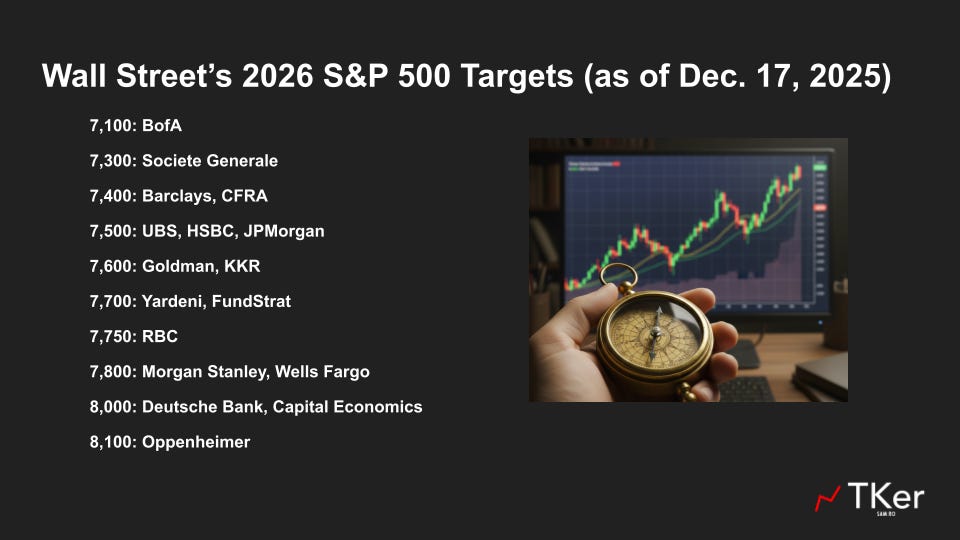
As trading desks across Lower Manhattan and Canary Wharf close the books on another volatile year, Wall Street’s elite strategists are publishing their consensus outlooks for 2026. The overarching thesis is deceptively simple: equities are poised for another solid, albeit more moderated, advance. Driven by resilient earnings expansion, a broadening economic recovery, and the continued monetization of artificial intelligence, major financial institutions project further gains for the S&P 500.
Yet, behind the bullish public forecasts and upbeat investor presentations lies a growing anxiety among chief risk officers and senior quantitative analysts. Beneath the surface of rising index levels, vulnerabilities are compounding. From stretched valuation multiples and looming fiscal policy shifts in Washington to the monumental capital expenditure requirements of enterprise tech giants, the risk-reward matrix for 2026 is rapidly evolving. For institutional allocators and high-net-worth investors alike, navigating the coming year will require rigorous risk mitigation, precise sector selectivity, and a close eye on macroeconomic liquidity.
Executive Takeaways
- Broadening Earnings Growth: Wall Street consensus expects 2026 profit growth to expand beyond the mega-cap tech sector into cyclical, industrial, and financial equities.
- The AI CapEx Dilemma: Enterprise ROI pressures are mounting as hyperscalers face questions regarding the long-term infrastructure scalability and monetization of massive generative AI investments.
- Fiscal Catalysts and Headwinds: Legislative battles over expiring tax provisions and prospective tax bills will directly impact corporate balance sheets and net margins.
- Elevated Valuation Multiples: With equity prices outpacing historical earnings averages, market liquidity and interest rate trajectories remain acute vulnerabilities for risk assets.
The Macroeconomic Landscape: Navigating Profit Expansion and Valuation Pressures
The foundational argument for a resilient equity market in 2026 rests on corporate earnings. For much of the past three years, earnings growth has been heavily skewed toward a handful of dominant technology conglomerates. However, sell-side research from premier investment banks indicates that profit growth is finally broadening out. Sectors such as industrials, healthcare, and financials are projected to capture a larger share of net income expansion as supply chains stabilize and borrowing costs normalize.
Despite this encouraging fundamental backdrop, valuation multiples remain a persistent concern. Price-to-earnings (P/E) ratios for the broader market sit comfortably above their 20-year historical averages. This valuation cushion leaves little room for operational missteps or macroeconomic shocks. When equity markets price in perfection, even minor disruptions in global supply chains, unexpected sticky inflation prints, or shifts in central bank policy can trigger sharp, sentiment-driven drawdowns.
Furthermore, capital allocation strategies are shifting. Corporate treasurers who spent the low-interest-rate era prioritizing aggressive share buybacks and speculative mergers are now forced to exercise strict balance sheet discipline. Higher baseline interest rates mean that debt refinancing walls must be managed with surgical precision, elevating the distinction between companies with pristine credit profiles and those heavily reliant on short-term debt markets.
Can the Generative AI Rally Sustain Its Momentum into 2026?
No discussion of modern equity performance is complete without examining the artificial intelligence phenomenon. The trillion-dollar rally fueled by generative AI, large language models, and advanced semiconductor manufacturing has fundamentally transformed global capital markets. As we look toward 2026, the central question occupying portfolio managers is whether this technological super-cycle can maintain its blistering pace or if it is approaching a critical maturation phase.
The primary friction point centers on enterprise ROI (Return on Investment). While hardware manufacturers, cloud compute architecture providers, and semiconductor fabricators have enjoyed unprecedented revenue surges, corporate end-users are increasingly demanding clear evidence of operational efficiency and top-line growth resulting from AI integration. Chief Information Officers (CIOs) are scrutinizing IT budgets, demanding that pilot programs transition into scalable, profit-generating deployments.
At the same time, infrastructure scalability remains a formidable bottleneck. The sheer amount of electrical power, specialized data center real estate, and advanced cooling systems required to train and run next-generation models is testing the limits of global energy grids. Investors must evaluate whether the massive capital expenditures committed by hyperscalers will yield sufficient cash flows to justify the multi-billion-dollar outlays, or if diminishing marginal returns will begin to weigh on profit margins.
Fiscal Policy, Tax Legislation, and Market Liquidity
Beyond corporate boardrooms and server farms, macroeconomic and regulatory developments in Washington will cast a long shadow over the 2026 financial markets. Legislative debates surrounding the renewal or modification of major tax provisions will play a pivotal role in shaping corporate bottom lines. Any comprehensive tax bill that alters corporate tax rates, expensing rules for research and development, or capital expenditure deductions will force immediate revisions to earnings models across every major sector.
Concurrently, market liquidity dynamics are shifting. As global central banks navigate the delicate balance between subduing residual inflationary pressures and supporting economic growth, liquidity conditions can change rapidly. Quantitative tightening programs, treasury issuance volumes, and foreign exchange fluctuations all contribute to the plumbing of global capital markets. When liquidity conditions tighten unexpectedly, highly valued growth equities and speculative assets are invariably the first to experience price compression.
| Metric / Indicator | Current Baseline (2025) | 2026 Projected Outlook | Primary Market Implication |
|---|---|---|---|
| S&P 500 Earnings Growth | Concentrated in Mega-Cap Tech (~11%) | Broadening across Cyclicals & Financials (~9-12%) | Broader market participation, reduced index fragility. |
| Enterprise AI CapEx | Aggressive, infrastructure-focused buildout | Maturing; heightened focus on software ROI | Separates hardware winners from software monetization leaders. |
| Valuation Multiples (P/E) | Elevated above 20-year historical norms | Expected to compress slightly or plateau | Requires strict earnings delivery to sustain equity gains. |
| Regulatory & Tax Environment | Status quo pending legislative calendar | Potential tax bill revisions & antitrust scrutiny | Direct impact on net profit margins and M&A activity. |
Industry & Market Implications: Winners, Losers, and Economic Realities
As these macroeconomic and structural forces converge, the divergence between market winners and losers will become starkly apparent. Institutional asset managers are advising clients to move away from indiscriminate index buying and toward active stock selection backed by fundamental research.
The Winners: Companies boasting robust pricing power, fortress balance sheets, and proven ability to convert technological innovation into recurring revenue streams will continue to attract institutional capital. Furthermore, industrial firms specializing in grid modernization, energy efficiency, and domestic supply chain reshoring stand to benefit directly from the massive infrastructure demands of the digital economy.
The Losers: Highly leveraged enterprises with thin operating margins and near-term debt refinancing requirements face an uphill battle. Similarly, technology firms that have promised revolutionary AI capabilities without a credible path to monetization risk severe valuation penalties from skeptical public markets. In an environment where capital is no longer free, cash flow generation is once again king.
Frequently Asked Questions (People Also Ask)
Q: Why is Wall Street projecting a solid year for stocks in 2026 despite growing risks?
A: The positive outlook is primarily underpinned by expectations of steady, broadening corporate earnings growth. While risks such as high valuations and fiscal policy shifts are acknowledged, sell-side analysts believe that profit expansion across non-tech sectors will offset macro headwinds and support continued equity appreciation.
Q: What are the main risks threatening the artificial intelligence rally?
A: The primary concerns center on enterprise ROI, infrastructure scalability, and energy grid limitations. Investors are demanding tangible proof that massive capital expenditures in AI hardware and data centers are translating into sustainable software monetization and bottom-line growth for corporate end-users.
Q: How will tax legislation and fiscal policy impact corporate balance sheets in 2026?
A: Pending legislative debates regarding expiring tax provisions and prospective tax bills will directly influence corporate net margins. Changes to R&D expensing rules, corporate tax rates, or capital investment incentives will require CFOs to recalibrate capital allocation strategies and earnings forecasts.
Q: How should investors adjust their risk mitigation strategies for the coming year?
A: Portfolio managers recommend focusing on active stock selection, emphasizing companies with strong balance sheets, predictable cash flows, and low debt leverage. Diversifying beyond mega-cap growth stocks into quality-screened cyclical and industrial equities can help cushion against potential valuation pullbacks.
Future Outlook: Key Milestones and What to Watch
As 2026 unfolds, market participants must maintain a vigilant, data-driven approach. The transition from speculative enthusiasm to fundamental execution will dictate market leadership. Key milestones to monitor include quarterly earnings conference calls for commentary on enterprise software adoption, legislative updates from Washington regarding corporate tax policy, and monthly inflation and employment prints that dictate central bank liquidity maneuvers.
Ultimately, while the macroeconomic trajectory points toward positive nominal returns, the margin for error has narrowed significantly. By maintaining rigorous risk mitigation standards and prioritizing operational quality over momentum chasing, institutional and retail investors can successfully navigate the complexities of the 2026 market landscape.