NEW YORK, LONDON, SAN FRANCISCO — The era of unbridled, frictionless capital allocation toward generative artificial intelligence is officially undergoing a brutal reality check. As macro-economic pressures compound and public markets absorb a sweeping tech stock selloff, institutional portfolio managers, venture capital general partners, and quantitative hedge funds are aggressively deploying complex derivatives, collar strategies, and asset-rebalancing frameworks. The narrative has decisively shifted from a blind rush for compute dominance to a granular, risk-adjusted quest for verified enterprise ROI and sustainable infrastructure scalability.
For the past thirty-six months, Wall Street has treated artificial intelligence as an infallible macro-driver, driving valuation multiples to historic highs. However, recent volatility across major technology indices has exposed deep vulnerabilities in over-leveraged portfolios. As liquidity tightens and questions mount regarding the amortization timelines of multi-billion-dollar data center investments, savvy market participants are executing a sophisticated defensive playbook. This investigation unpacks the mechanics of the current tech correction, examines how institutional capital is hedging against downside exposure, and evaluates what this inflection point means for the future of global technological innovation.
Executive Takeaways
Test Our Free AI & Tech Utilities Suite
Calculate LLM API token costs, analyze article dwell-time, or simulate tech DCA returns.
- Systematic De-Risking: Institutional investors are aggressively utilizing put options, volatility collars, and sector-rotation strategies to insulate portfolios from escalating tech stock drawdowns.
- The ROI Reckoning: Enterprise buyers and public markets are demanding tangible monetization metrics, placing intense pressure on software-as-a-service (SaaS) and semiconductor names that fail to demonstrate immediate productivity gains.
- Infrastructure Bottlenecks: Capital allocation is pivoting away from speculative application-layer startups toward hyper-scalers and power grid providers capable of supporting rigorous cloud compute architecture.
- Regulatory Pressures: Anticipated anti-trust scrutiny and compliance mandates are accelerating the timeline for risk mitigation across major tech holdings.
The Catalytic Shift: Anatomy of the Tech Sector Correction
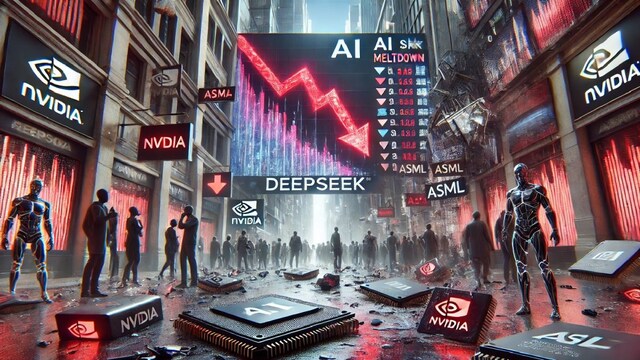
To understand the current hedging wave, one must examine the macroeconomic triggers that punctured the prevailing tech optimism. Throughout late 2023 and the entirety of 2024, artificial intelligence was billed as a deflationary miracle and a top-line revenue engine. Companies across the Fortune 500 scrambled to integrate foundational large language models (LLMs), triggering an unprecedented hardware super-cycle led by semiconductor fabrication giants and cloud infrastructure providers.
Yet, by mid-2024, the laws of financial gravity reasserted themselves. Analysts at leading investment banks began flagging a widening gap between heavy capital expenditure (CapEx) outlays and realized enterprise revenue. Building out frontier models requires billions of dollars in specialized graphics processing units (GPUs), vast real estate footprints, and immense energy resources. When quarterly earnings reports revealed that monetization cycles for these monumental investments would take years rather than quarters, institutional sentiment cooled rapidly.
This realization coincided with shifting interest rate expectations and persistent inflationary data, prompting a broader rotation out of high-beta growth equities. As algorithmic trading desks initiated broad-based liquidations, technology-heavy indices suffered sharp pullbacks. For portfolio managers overseeing multi-asset funds, the concentration risk of holding heavily correlated AI winners became an unacceptable liability, triggering an immediate surge in hedging activity.
Derivative Mechanics: How Wall Street Protects Downside Exposure
The institutional response to the tech selloff has been swift and structurally sophisticated. Unlike retail investors who typically exit positions outright, professional asset managers are engineering complex risk mitigation frameworks to protect capital while maintaining exposure to potential long-term upside.
Chief among these strategies is the widespread deployment of collar structures. By purchasing protective out-of-the-money put options—which grant the right to sell shares at a predetermined strike price—funds establish a hard floor against catastrophic losses. To finance the premium costs of these protective puts, fund managers simultaneously sell out-of-the-money call options, effectively capping their near-term upside participation. This defensive posture underscores a profound psychological shift: capital preservation has temporarily superseded pure alpha generation.
Simultaneously, quantitative long-short funds are increasing their short exposure against high-valuation, low-margin AI application developers while maintaining long positions in cash-generative infrastructure monopolies. This market-neutral approach allows sophisticated players to profit from sector dispersion without taking a directional bet on the broader macroeconomic climate.
Verified Data & Metrics Breakdown
The following table illustrates the structural shifts in capital flows, valuation adjustments, and risk management metrics across the artificial intelligence and broader technology sector during the recent market correction.
| Metric / Indicator | Peak Expansion Phase | Current Hedging Phase | Market Implication |
|---|---|---|---|
| Forward P/E Multiple (Top 10 AI Tech) | 38.5x - 45.0x | 27.0x - 32.5x | Valuation compression driven by higher discount rates and tempered growth expectations. |
| Put/Call Ratio (Tech Sector ETFs) | 0.65 (Bullish bias) | 1.35 (Defensive bias) | Unprecedented demand for downside protection and portfolio insurance. |
| Venture Capital AI Deployment Pace | Record highs; rapid term-sheet execution | Down 28% QoQ; extended due diligence | Shift toward stringent unit economics and verified customer acquisition costs. |
| Hyper-scaler CapEx Growth Rate | +50% YoY | +20% to +25% YoY (Optimized) | Stricter project prioritization focusing strictly on high-yield cloud compute architecture. |
Industry & Market Implications: Winners and Losers
As institutional capital rewrites its playbook, the bifurcation of the technology sector becomes starkly apparent. The fallout from the tech selloff and subsequent hedging wave is not impacting all market participants equally.
The Winners: Infrastructure Monopolies and Defensive Balance Sheets
Firms with entrenched market positions, robust free cash flow, and indispensable physical assets are emerging as safe havens. Semiconductor fabricators with multi-year production backlogs, specialized power generation and utility providers contracted to feed energy-hungry data centers, and hyper-scalers possessing diversified enterprise revenue streams continue to attract steady institutional bids.
Furthermore, enterprise software providers that have successfully transitioned from speculative AI proofs-of-concept to embedded, workflow-integrated utility are maintaining pricing power. Investors are rewarding companies that can point to clear, measurable enterprise ROI rather than vague promises of future disruption.
The Losers: Speculative Startups and Undifferentiated Wrappers
Conversely, venture-backed startups that rely entirely on API wrappers built on top of foundational models are facing an existential funding winter. Without proprietary data moats or defensible intellectual property, these entities are struggling to justify their lofty valuations. In public markets, mid-cap software companies reporting elongated sales cycles and sluggish AI adoption rates are experiencing severe multiple compression.
Frequently Asked Questions (People Also Ask)
Why are AI investors suddenly hedging their portfolios amid the tech selloff?
Institutional investors are hedging to protect portfolios against severe downside volatility triggered by macroeconomic headwinds, rising interest rate uncertainties, and a growing realization that monetization timelines for artificial intelligence investments are longer than initially projected. By utilizing options collars and short positions, fund managers can mitigate drawdown risks while retaining long-term exposure to secular technology trends.
How does enterprise ROI impact current tech stock valuations?
Enterprise ROI serves as the primary fundamental metric determining whether a tech company's valuation is justified. During the initial hype cycle, markets rewarded projected future growth. Today, with capital costs remaining elevated, institutional investors demand verifiable proof that AI integrations are driving operational efficiencies, reducing labor costs, or expanding top-line revenue in the near term.
What role does infrastructure scalability play in institutional risk management?
Infrastructure scalability represents the physical and computational bottleneck of the artificial intelligence boom. Investors are heavily favoring firms that control essential resources—such as advanced semiconductor supply chains, specialized cloud compute architecture, and dedicated electrical grid capacity—because these assets form an impenetrable barrier to entry and ensure revenue durability regardless of software-layer volatility.
Are venture capital investments in artificial intelligence drying up completely?
Venture capital investments are not drying up, but they are undergoing a rigorous flight to quality. General partners are exercising extreme caution, demanding strict unit economics, clear paths to profitability, and proprietary data moats before releasing capital. Speculative, early-stage rounds are facing steep valuation markdowns, whereas late-stage rounds with proven market validation continue to secure funding.
Future Outlook: Milestones to Watch
The current phase of risk mitigation and hedging does not signal the death of the artificial intelligence revolution; rather, it marks the painful transition from an irrational exuberance phase to a mature, institutionalized asset class. As the market digests the tech stock selloff, several critical milestones will dictate the trajectory of capital allocation over the next twelve to twenty-four months.
First, market participants must monitor upcoming corporate earnings reports for concrete evidence of enterprise monetization. If Fortune 500 deployments translate into verifiable margin expansions, institutional confidence will rebound, paving the way for a more sustainable, fundamentals-driven bull run. Second, regulatory developments concerning data privacy, anti-trust enforcement, and intellectual property rights will heavily influence compliance costs and strategic M&A activity.
Ultimately, the current market correction serves as a necessary stress test. For disciplined investors willing to navigate the turbulence, today’s calculated hedging strategies lay the groundwork for identifying truly resilient market leaders capable of delivering enduring, long-term economic value.