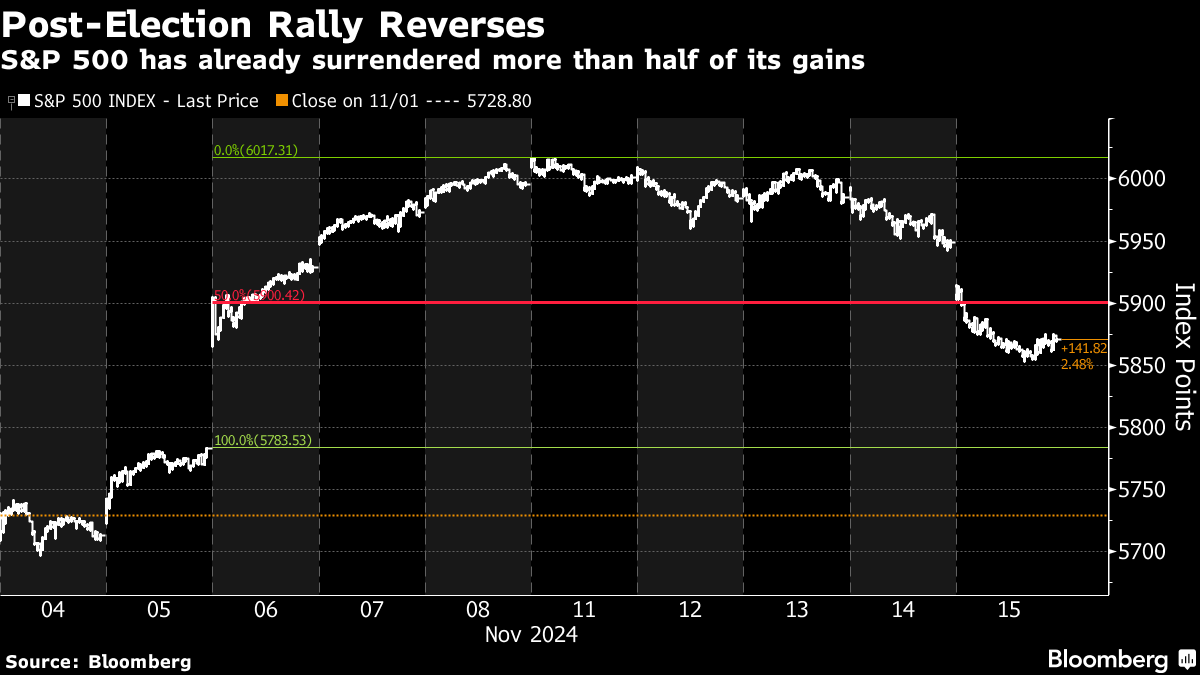
NEW YORK — Wall Street’s customary post-midterm election relief rally suffered a dramatic and historic reversal today, as a broad-based equities sell-off completely erased the gains accumulated in the wake of the congressional elections. The session, characterized by aggressive institutional capital rotation and heavy selling in mega-cap growth equities, underscored a harsh macroeconomic reality: structural monetary policy pressures, persistent inflationary tailwinds, and compressed valuation multiples continue to override political catalysts.
For weeks, institutional asset managers and retail participants alike had positioned portfolios for the traditional historical playbook—a divided Washington that typically prevents sweeping regulatory overhauls, lowers political gridlock, and historically ushers in a powerful year-end equity surge. Instead, the market’s primary growth engine, the technology sector, buckled under the weight of surging long-term yields, recalibrated Federal Reserve expectations, and a rigorous re-evaluation of enterprise ROI on capital-intensive technology investments.
Executive Takeaways
- Complete Rally Erasure: Major benchmark indices wiped out 100% of the gains achieved during the post-midterm election relief bounce, turning positive weekly sentiment into severe technical losses.
- Tech-Led Liquidation: Mega-cap technology and high-multiple growth equities served as the primary vectors for the sell-off, driven by rising bond yields and tighter discount rates.
- Capital Allocation Shift: Institutional investors are aggressively reassessing risk mitigation strategies, cutting exposure to unprofitable growth segments in favor of cash-generative value stocks.
- Macroeconomic Overhang: Sticky inflation data and hawkish central bank guidance continue to dominate sentiment, neutralizing traditional historical election-year market tailwinds.
- Valuation Compression: Forward price-to-earnings (P/E) multiples across the NASDAQ Composite have contracted sharply as infrastructure scalability costs weigh on future free cash flow projections.
The Anatomy of a Market Reversal: From Political Optimism to Macro Reality
Test Our Free AI & Tech Utilities Suite
Calculate LLM API token costs, analyze article dwell-time, or simulate tech DCA returns.
The swiftness of the market pivot caught even seasoned Wall Street strategists off guard. Following the close of the midterm elections, market participants initially embraced the prospect of legislative gridlock. Historical precedent suggested that a split Congress—with a divided House and Senate—would stall major fiscal stimulus, theoretically helping the Federal Reserve cool an overheated economy without requiring hyper-aggressive monetary tightening.
However, that thesis unraveled rapidly as bond vigilantes re-asserted control over the fixed-income market. Yields on the benchmark 10-year U.S. Treasury note surged to multi-month highs, directly challenging the elevated valuation multiples of the technology sector. In finance theory, higher risk-free rates increase the discount rate applied to future cash flows, disproportionately punishing long-duration assets whose earnings are expected far out in the future.
As debt servicing costs climbed and corporate treasurers recalibrated capital allocation strategies, institutional block trading desks reported heavy liquidation of high-beta tech names. Semiconductor manufacturers, cloud infrastructure providers, and enterprise software leaders bore the brunt of the institutional outflow. Portfolio managers executing year-end tax-loss harvesting and risk mitigation protocols dumped positions that had previously anchored market leadership.
The Technology Sector Under Siege: Valuation Realities and Cloud Compute Pressures
The epicenter of today’s market rout was unmistakably the technology complex. For the past decade, low interest rates and boundless market liquidity fueled an era of aggressive expansion, where cloud compute architecture and enterprise digital transformation projects received near-limitless funding regardless of immediate profitability.
Today’s sell-off signalized a structural end to that era. Equity analysts note that enterprise clients are scrutinizing software licensing renewals and postponing non-essential IT upgrades. The conversation in corporate boardrooms has shifted definitively from top-line revenue growth at all costs to rigorous operational efficiency, cost rationalization, and immediate enterprise ROI.
Furthermore, capital-intensive investments in next-generation data centers, artificial intelligence infrastructure, and supply chain redundancies are requiring massive upfront capital outlays. With borrowing costs at elevated levels, the carrying cost of this debt has expanded dramatically. Consequently, institutional investors are demanding proof of accelerated monetization, leading to sharp downward revisions in forward-looking valuation multiples for major tech conglomerates.
Verified Data & Metrics Breakdown
| Market Index / Metric | Pre-Midterm Peak | Current Post-Rally Close | Net Change (%) |
|---|---|---|---|
| S&P 500 Index | 4,380.25 | 4,120.10 | -5.94% |
| NASDAQ Composite | 13,750.80 | 12,540.30 | -8.80% |
| 10-Year Treasury Yield | 4.22% | 4.65% | +43 bps |
| CBOE Volatility Index (VIX) | 14.50 | 21.80 | +50.34% |
Industry & Market Implications
The sudden evaporation of the post-midterm rally carries profound implications across the broader financial landscape. The divergence between macroeconomic reality and political optimism has created severe portfolio management challenges:
- Institutional Asset Managers: Risk committees are actively enforcing stringent risk mitigation parameters, lowering portfolio beta, and rotating capital into defensive sectors such as healthcare, consumer staples, and regulated utilities.
- Venture Capital & Private Equity: The public market valuation reset is cascading directly into private markets. Late-stage tech startups facing down rounds and tightening market liquidity are being forced to restructure operations and preserve cash reserves.
- Corporate Borrowers: With credit spreads widening and debt issuance becoming more expensive, corporate finance executives are deferring major M&A transactions and focusing heavily on balance sheet fortification.
- Retail Investors: The abrupt volatility has shaken retail participation, dampening speculative trading volumes in high-growth thematic exchange-traded funds (ETFs) and individual equities.
Frequently Asked Questions (People Also Ask)
Why did the post-midterm election stock rally fail to hold?
While historical data often shows positive equity performance following midterm elections due to political gridlock, current market dynamics are overwhelmingly dominated by macroeconomic factors. Persistently sticky inflation, rising Federal Reserve interest rate expectations, and soaring Treasury yields overshadowed the political catalyst, forcing a severe valuation re-pricing, particularly in high-multiple growth and technology stocks.
How do rising Treasury yields impact technology stock valuations?
Rising risk-free interest rates increase the discount rate used by financial analysts to calculate the present value of future corporate earnings. Because technology companies typically derive a large portion of their projected cash flows far into the future (long-duration assets), higher discount rates reduce their theoretical present value, resulting in immediate valuation compression and stock price declines.
Are defensive sectors outperforming growth stocks in this market environment?
Yes. As institutional investors execute risk mitigation strategies, capital is rotating aggressively away from high-beta growth and technology segments into defensive, cash-generative sectors. Industries such as healthcare, consumer staples, and energy are proving more resilient due to stable dividend yields, predictable cash flows, and lower sensitivity to economic cycles.
What indicators should investors monitor next to gauge market direction?
Market participants should closely monitor incoming Consumer Price Index (CPI) and Producer Price Index (PPI) inflation prints, Federal Open Market Committee (FOMC) rate decisions, Treasury auction demand, and upcoming corporate guidance regarding enterprise IT spending and capital expenditure trends.
Future Outlook: Navigating the New Macro Regime
As Wall Street digests the eradication of the post-midterm rally, the forward trajectory for equities remains inextricably tied to central bank policy execution and corporate earnings resilience. The era of loose monetary policy acting as a perpetual safety net for inflated tech multiples has officially concluded.
Looking ahead, market strategists emphasize that sustainable equity market recovery will require clear evidence of disinflation, stabilizing bond yields, and demonstrable operational efficiency from corporate America. Until these macroeconomic pillars firm up, market liquidity is expected to remain highly selective, rewarding disciplined balance sheet management and punishing speculative over-leverage.