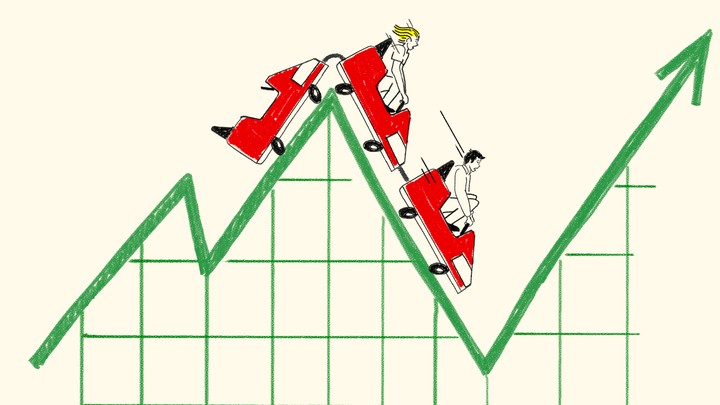
The Gravity-Defying Bull: Why Global Stocks Keep Heading Into Orbit Despite Yesterday’s Rules
NEW YORK & LONDON — Nothing, it seems, can dent the almost inexplicable optimism coursing through global financial markets. Where once, years ago, stock markets would shudder and capitulate at the mere hint of escalating geopolitical tensions, stubborn inflation, or hawkish central bank warnings, today’s trading floors tell a completely different story. Equity indices from New York to Tokyo, and Mumbai to Sydney, are not just weathering the storms—they are using them as fuel to propel themselves further into orbit.
As of mid-April 2026, the global equity rally has defied the traditional gravity of macroeconomic theory. According to wire reports from the Australian Broadcasting Corporation (ABC) and global trading desks, the relentless upward march of equities has left seasoned analysts scratching their heads, forcing a fundamental rewrite of the market playbook. What was once considered "bad news" is now routinely shrugged off, digested, and transformed into another leg of this historic bull run.
The Great Decoupling: Shrugging Off the Old Playbook
To understand why global markets are heading into orbit, one must first look at what is not happening. In previous market cycles, a combination of prolonged high-interest rates and regional military conflicts would trigger a flight to safety—typically into gold, government bonds, or cash. Today, capital is aggressively flowing in the opposite direction: straight into equities.
"The market has developed a form of structural immunity to bad news," notes Marcus Vance, Chief Global Strategist at Apex Capital Holdings. "A decade ago, a hawkish pivot by the Federal Reserve or an escalation in energy supply-chain bottlenecks would trigger a 5% to 10% correction. In 2026, those same events are viewed as temporary disruptions, prompting immediate buy-the-dip behavior from institutional algorithms and retail investors alike."
This psychological shift has created a self-fulfilling prophecy. Because investors collectively believe that markets will inevitably bounce back, downside volatility is short-lived. The "fear of missing out" (FOMO) has transitioned from a speculative retail trend into an institutional mandate.
Three Invisible Engines Driving the Global Market Surge

The relentless climb of the world's major indices isn't purely psychological. Under the hood, several structural macroeconomic shifts are providing the momentum necessary to sustain these record valuations:
- The Commercialization of the AI Frontier: Unlike the speculative AI hype of 2023 and 2024, 2026 has witnessed genuine, measurable productivity gains. Companies across all sectors—from manufacturing to healthcare—are reporting expanded operating margins directly attributed to automated workflows, proprietary LLMs, and advanced machine learning integrations.
- The Liquidity Cushion: Despite central banks maintaining higher-for-longer interest rates to combat sticky baseline inflation, massive pools of private capital, corporate cash reserves, and sovereign wealth funds remain highly liquid. This "dry powder" is constantly seeking yield, and equities remain the only asset class capable of outperforming inflation.
- Corporate Earnings Resilience: Blue-chip corporations have successfully passed rising input costs down to consumers. Profit margins have not compressed as predicted; instead, companies have streamlined operations, resulting in robust balance sheets that justify higher equity valuations.
Global Market Performance Snapshot (YTD 2026)
To illustrate the sheer scale of this global surge, the following table tracks the performance of key benchmark indices as of April 17, 2026:
| Global Benchmark Index | Current Level (Apr 17, 2026) | Year-to-Date (YTD) Return | 3-Year Cumulative Return |
|---|---|---|---|
| S&P 500 (USA) | 6,210.45 | +12.4% | +38.2% |
| Nikkei 225 (Japan) | 42,150.00 | +14.8% | +45.1% |
| Nifty 50 (India) | 24,890.30 | +11.2% | +41.7% |
| ASX 200 (Australia) | 8,420.10 | +8.9% | +22.5% |
The Contrarian Threat: Are We Ignoring the Minsky Moment?
While the mood on Wall Street and the Economic Times' trading desks remains celebratory, some contrarian voices warn that the market's current path is unsustainable. By ignoring structural risks, investors may be laying the groundwork for a sudden, violent correction—a phenomenon economists refer to as a "Minsky Moment," where a long period of stability and rising asset prices eventually encourages so much risk-taking that it leads to a major collapse.
Historically, when markets become entirely insulated from bad news, it indicates that risk is not being priced accurately. Sovereign debt levels in major economies are at historic highs, and commercial real estate refinancing pressures continue to linger in the background. If a systemic credit event were to occur, the sheer leverage embedded in the current rally could accelerate a downward spiral.
However, for now, the momentum is firmly with the bulls. Global asset managers are operating under the assumption that central banks will step in to provide liquidity if anything truly breaks. Until that thesis is proven wrong, the trajectory for global stocks remains pointed firmly toward the stars.
Frequently Asked Questions (FAQ)
Why are global stocks rising when interest rates and inflation remain relatively high?
Historically, high interest rates depress equity prices by increasing borrowing costs and making fixed-income assets more attractive. However, in 2026, the negative impact of high rates is being offset by unprecedented corporate earnings resilience and massive productivity gains driven by artificial intelligence. Additionally, because traditional cash and bonds fail to yield returns that comfortably outpace real-world inflation, global capital is heavily favoring equities as a wealth-preservation tool.
Is this current global stock market rally a speculative bubble?
Opinions are split. Skeptics argue that current price-to-earnings (P/E) ratios are stretched and reflect dangerous complacency toward geopolitical and debt risks. Optimists and structural analysts, however, maintain that this is not a speculative bubble like the 2000 Dot-Com crash, because today's market leaders are highly profitable, cash-flow-positive enterprises with fortress balance sheets that justify their premium valuations.