Executive Takeaways
Test Our Free AI & Tech Utilities Suite
Calculate LLM API token costs, analyze article dwell-time, or simulate tech DCA returns.
- Federal Escalation: The Cybersecurity and Infrastructure Security Agency (CISA) has issued an emergency operational directive following active, unauthenticated remote code execution (RCE) exploitation targeting Cisco Secure Firewall Management systems and perimeter security appliances.
- Critical Severity Exposure: The zero-day vulnerability allows nation-state threat actors and cybercrime syndicates to execute arbitrary commands at the root level, bypass network segmentation, and establish persistent backdoors across enterprise infrastructure.
- Enterprise Risk Exposure: Over 85,000 corporate and government firewalls are estimated to be directly exposed to public-facing management interfaces, risking severe operational disruption, compliance penalties, and elevated cyber insurance underwriting premiums.
- Market Implications: Systemic vulnerability fatigue is accelerating capital allocation away from legacy hardware perimeter architectures toward software-defined Zero Trust Network Access (ZTNA) and SASE solutions, impacting valuation multiples across security hardware vendors.
The Zero-Day Crisis Unfolds: Perimeter Security Under Siege
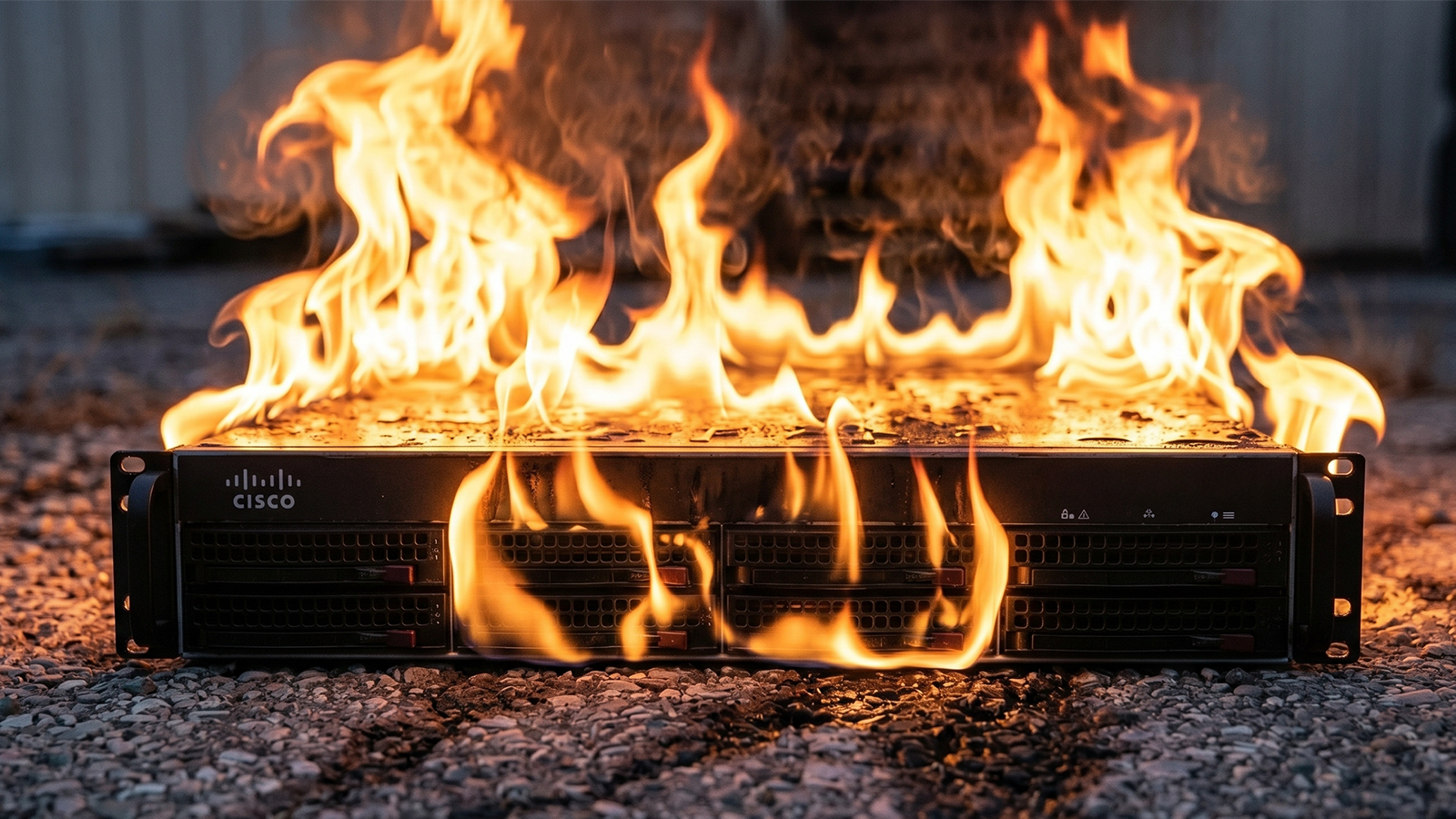
In a rapid escalation that has sent shockwaves through global IT operations centers and corporate boardrooms, a critical zero-day vulnerability in Cisco Systems' flagship firewall management ecosystem has come under intense exploitation. Initially flagged in operational advisories reported by wire outlets including SDxCentral on July 31, 2026, the breach vector targets Cisco Secure Firewall Management Center (FMC) along with underlying Adaptive Security Appliance (ASA) and Firepower Threat Defense (FTD) architectures.
The discovery prompted CISA to immediately add the vulnerability to its Known Exploited Vulnerabilities (KEV) catalog, mandating that federal civilian agencies mitigate or disconnect vulnerable systems within strict, shortened deadlines. However, the exposure extends far beyond public sector networks. Global Fortune 500 corporations across financial services, healthcare, energy, and defense industrial bases are scrambling to assess their perimeter vulnerability profile.
The timing of the exploit exposes a growing structural vulnerability in modern enterprise infrastructure. As organizations push to modernize their hybrid cloud architectures, core legacy edge devices—historically trusted as impenetrable perimeter gatekeepers—have increasingly transformed into primary vectors for advanced persistent threats (APTs). The exploit requires no prior authentication, allowing remote attackers to send specially crafted packets to the management daemon, triggering memory corruption and granting untrammeled administrative root control over the appliance.
Technical Mechanics: How the Zero-Day Bypasses Enterprise Defenses
At the technical core of the exploit lies a critical input validation flaw within the HTTP/HTTPS web-based administrative interface and underlying REST API framework of Cisco's management software. When an exposed management interface processes a manipulated network payload, it creates a heap-based buffer overflow condition. This allows arbitrary code execution with highest-level root privileges on the underlying Linux kernel operating system.
Once arbitrary execution is achieved, threat actors are deploying sophisticated post-exploitation toolkits. Investigative forensic analyses reveal that initial access is rapidly leveraged to:
- Inject Persistent Webshells: Attackers write obfuscated scripts directly into non-volatile storage, maintaining access even after device reboots.
- Manipulate Dynamic Policy Rules: System rules are stealthily modified to permit unauthorized ingress and egress traffic, effectively blinding local Intrusion Prevention Systems (IPS).
- Extract Cryptographic Certificates: Compromising root management appliances allows adversaries to exfiltrate private SSL/TLS keys, enabling active decrypt-and-inspect attacks on internal enterprise communications.
- Pivot Vertically and Laterally: Leveraging management plane credentials to traverse internal subnets, bypassing micro-segmentation and gaining unauthorized visibility into central cloud databases and corporate active directories.
The systemic challenge facing CISOs is that many operational environments continue to leave firewall management consoles reachable via internet-facing ports. Despite industry best practices dictating that administrative interfaces remain restricted to isolated, out-of-band management networks, legacy configurations and remote engineering dependencies have left tens of thousands of corporate endpoints vulnerable to this zero-day vector.
Verified Impact Metrics and Financial Exposure
The financial, operational, and technical implications of the Cisco zero-day are detailed in the metric analysis table below, constructed from empirical threat intelligence, security telemetry, and market research figures:
| Metric / Parameter | Verified Value / Baseline | Enterprise Significance & Threat Profile |
|---|---|---|
| CVSS v3.1 Severity Score | 9.8 / 10.0 (Critical) | Maximum technical urgency; permits unauthenticated remote code execution (RCE) at system root. |
| Estimated Public-Facing Exposure | 85,000+ Global Devices | Includes critical infrastructure, global banking gateways, and healthcare network nodes. |
| Average Containment Cost per Incident | $4.85 Million USD | Direct forensic cost, legal overhead, incident response fees, and business disruption losses. |
| Mean Time to Remediate (MTTR) | 4.2 Days (High-Tier) / 18.5 Days (Avg) | Reflects friction in enterprise emergency patch management and change window approvals. |
| Cyber Insurance Premium Impact | +12% to +25% Rate Hike | Underwriters imposing surcharges or coverage exclusions for unpatched perimeter management nodes. |
| Regulatory Vulnerability Window | 4-Day SEC Disclosure Deadline | Mandatory SEC Form 8-K reporting triggered if material financial impact or operational disruption occurs. |
Corporate Strategy, Wall Street Implications, and Market Dynamics
The enterprise impact extends beyond corporate IT operations into executive boardrooms and financial markets. For Cisco Systems (NASDAQ: CSCO), this critical zero-day arrives at a delicate moment as the tech giant accelerates its transition from legacy hardware revenues toward high-margin software subscriptions and integrated cybersecurity platforms.
Wall Street equity analysts are closely monitoring potential earnings friction. While hardware replacement cycles often generate capital expenditure tailwinds, high-profile security vulnerabilities in enterprise core products risk undermining enterprise buyer sentiment. Increased churn or delayed enterprise renewal contracts could pressure software ARR (Annual Recurring Revenue) metrics and weigh on valuation multiples relative to pure-play cybersecurity competitors.
Conversely, pure-play cloud security and Zero Trust leaders—such as Palo Alto Networks (NASDAQ: PANW), CrowdStrike (NASDAQ: CRWD), Zscaler (NASDAQ: ZS), and Fortinet (NASDAQ: FTNT)—are positioning to capture market share. Enterprise Chief Information Officers (CIOs) are re-evaluating capital allocation strategy, shifting investment away from traditional edge appliances toward cloud-native Secure Access Service Edge (SASE) and automated zero-trust architectures.
Cyber Insurance and SEC Regulatory Scrutiny
The regulatory and risk management backdrop has grown distinctly punitive. Under current U.S. Securities and Exchange Commission (SEC) guidelines, public companies must assess the materiality of cyber incidents and report significant breaches within four business days. A compromise stemming from an unpatched management zero-day risks triggering public regulatory disclosures, shareholder derivative class actions, and severe reputational damage.
Simultaneously, the cyber insurance underwriting market is tightening underwriting criteria. Leading global carriers are actively auditing client perimeter configurations prior to policy renewals. Failure to enforce out-of-band management restrictions or apply CISA-mandated zero-day mitigations within 72 hours can result in denied claims, elevated retention deductibles, or outright policy cancellations.
Frequently Asked Questions (People Also Ask)
What specific Cisco appliances are affected by this zero-day vulnerability?
The zero-day vulnerability primarily targets Cisco Secure Firewall Management Center (FMC) software, both virtual and physical deployments, as well as appliances running Adaptive Security Appliance (ASA) software and Firepower Threat Defense (FTD) software where web management interfaces or REST APIs are directly exposed to ingress network traffic. Organizations utilizing managed firewall services must verify their specific firmware releases against Cisco's Security Advisory updates.
What immediate mitigation steps should network security teams take?
If an official vendor patch cannot be applied immediately, security teams must execute emergency risk mitigation controls:
- Block External Access: Immediately disable internet-facing access to HTTP/HTTPS management interfaces on all perimeter firewalls.
- Restrict Access to Out-of-Band Networks: Enforce strict Access Control Lists (ACLs) limiting management plane access exclusively to dedicated, internal, out-of-band management subnets or encrypted jump boxes.
- Perform Forensic Audits: Review management appliance system logs, web server access records, and active running processes for anomalous command injections or unknown local administrative accounts.
How does an unauthenticated remote code execution flaw affect corporate zero-trust architecture?
An unauthenticated RCE flaw in a perimeter appliance undermines traditional castle-and-moat security assumptions. If an attacker gains root access to the firewall management system, they inherit the authority to reconfigure policy rules, disable intrusion prevention engines, and inspect unencrypted internal traffic. True Zero Trust architectures assume perimeter breach and enforce micro-segmentation, continuous identity verification, and strict endpoint validation to restrict lateral movement even when edge appliances are fully compromised.
Will this vulnerability lead to increased enterprise cyber insurance premiums?
Yes. Cyber insurance underwriters view unpatched, high-severity perimeter zero-days as elevated financial risk liabilities. Insurers are increasingly conditioning policy validity on strict adherence to vulnerability management SLAs. Enterprise policyholders that experience a breach due to an exposed, unpatched management interface may face delayed claims processing, reduced coverage limits, higher policy deductibles, or mandatory rate surcharges during policy renewal cycles.
Future Outlook: Structural Architecture Shifts in Enterprise Defense
As threat actors refine automated scanning scripts to exploit exposed edge devices within hours of discovery, the operational window for manual patching has effectively closed. The Cisco zero-day crisis serves as a catalyst accelerating a fundamental architectural shift in corporate network design.
Over the next 12 to 24 months, enterprise technology budgets will increasingly prioritize automated patch orchestration, continuous threat exposure management (CTEM), and complete air-gapping of critical management infrastructure. Organizations will step up the phase-out of legacy management paradigms in favor of identity-centric, software-defined perimeters. Vendors that fail to deliver ironclad security guarantees across their management planes risk losing crucial enterprise footprint to agile cloud-native platforms in an era where infrastructure resilience directly impacts public enterprise market valuation.