Zero Trust Architecture: The 2026 Implementation Guide and the $450 Billion Structural Shift in Enterprise Defense
Executive Takeaways
- The Perimeter is Obsolete: The traditional castle-and-moat security model has completely collapsed under the weight of hybrid multi-cloud environments, remote workforces, and sophisticated, AI-driven lateral movement attacks.
- Capital Allocation Mandate: Global corporations are reallocating up to 35% of their total IT infrastructure budgets toward Zero Trust Network Access (ZTNA) and continuous identity verification frameworks.
- Valuation Multiples and Risk: Institutional investors increasingly penalize enterprise valuations for legacy perimeter setups, tying regulatory compliance and risk mitigation directly to cost-of-capital equations.
- Definitive Roadmap: Transitioning away from implicit trust requires micro-segmentation, continuous context-aware authentication, and policy-driven data governance across all cloud compute architecture.
For decades, the foundational doctrine of enterprise security was deceptively simple: build an impenetrable wall around corporate headquarters, trust everything that operated within that perimeter, and scrutinize anything attempting to cross the threshold. Today, that fortress mentality is a relic of a bygone economic era. Driven by the proliferation of distributed workforces, hyper-scale cloud compute architecture, and autonomous AI threat actors capable of executing lateral movement within milliseconds, the traditional network perimeter has dissolved entirely.
As we navigate 2026, Zero Trust Architecture (ZTA) has transitioned from an ambitious cybersecurity theoretical framework to an absolute board-level operational imperative. Organizations failing to eliminate implicit trust across their digital ecosystems face compounding risks: catastrophic data exfiltration, crippling regulatory penalties, and severe market capitalization contractions. This investigative guide details the exact operational methodologies, capital allocation strategies, and technical blueprints required to successfully execute a enterprise-wide Zero Trust transformation.
The Anatomy of Perimeter Failure: Why Legacy Defense Collapsed
To understand the necessity of Zero Trust, one must examine the systemic vulnerabilities inherent in legacy infrastructure. Historically, organizations spent billions fortifying firewalls, VPN concentrators, and internal local area networks (LANs). Once a user or device successfully authenticated at the outer boundary—often via a static password or easily compromised enterprise VPN credential—they were granted broad, sweeping access to internal applications, databases, and file shares.
This approach created an asymmetric advantage for malicious actors. State-sponsored syndicates and cybercriminal cartels realized that breaching the perimeter was only the first step; once inside, they could quietly map enterprise networks, escalate privileges, and siphon petabytes of sensitive intellectual property over months without detection. The widespread adoption of Software-as-a-Service (SaaS) applications, multi-cloud deployments spanning AWS, Azure, and Google Cloud, and ubiquitous remote work completely shattered this enclosed model. The perimeter is no longer a physical or logical boundary—it is now as fragmented as the individual endpoints accessing corporate data.
According to recent empirical data compiled across global financial institutions, breach containment costs scale exponentially when internal networks lack segmentation. Enterprises operating under outdated security assumptions experience remediation costs that average 3.4 times higher than those implementing strict, continuous identity validation protocols.
The Core Principles of Zero Trust Architecture

Zero Trust is not a single commercial software product or a plug-and-play hardware appliance; it is an overarching security philosophy governed by a singular, unyielding axiom: Never trust, always verify. Operationalizing this philosophy requires adherence to three foundational pillars:
- Explicit Verification: Always authenticate and authorize based on all available data points, including user identity, location, device health, service or workload context, data classification, and prevailing anomalies.
- Least Privilege Access: Limit user access with Just-In-Time (JIT) and Just-Enough-Access (JEA) models, risk-based adaptive policies, and data protection safeguards to secure both user sessions and critical assets.
- Assume Breach: Minimize blast radius by segmenting access by network, user, devices, and application awareness. Encrypt all sessions end-to-end and utilize analytics to gain visibility, drive threat detection, and continuously improve defenses.
Comparative Metrics: Legacy Perimeter vs. Zero Trust Architecture
Financial markets and institutional auditors now evaluate enterprise risk profiles through quantitative metrics. The following comparative breakdown illustrates the structural divergence between legacy security frameworks and mature Zero Trust implementations:
| Security Dimension | Legacy Perimeter Model | Zero Trust Architecture (2026 Standard) |
|---|---|---|
| Trust Assumption | Implicit trust inside the corporate network boundary. | Zero implicit trust; continuous evaluation of every request. |
| Access Control Scope | Broad network-level access via VPN. | Granular, application-level micro-segmentation. |
| Authentication Frequency | Single sign-on at initial connection session. | Continuous, real-time behavioral and cryptographic checks. |
| Lateral Movement Risk | High; compromised credentials allow unhindered traversal. | Negligible; strict isolation limits breach containment. |
| Enterprise ROI Impact | High hidden costs from incident remediation and downtime. | Optimized risk mitigation and lower long-term insurance premiums. |
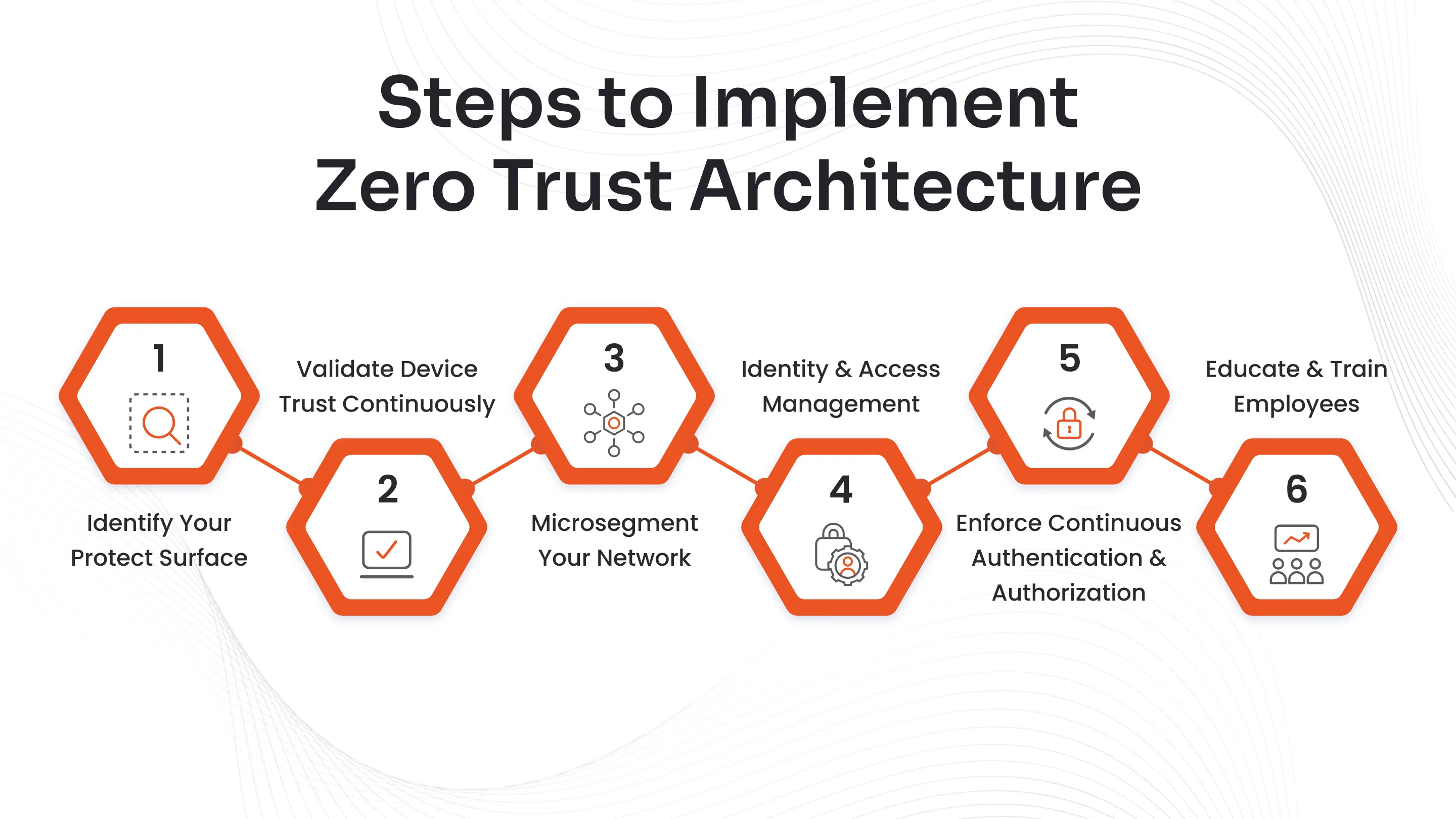
Step-by-Step Implementation Roadmap for Enterprise Leaders
Executing a seamless migration to Zero Trust requires rigorous project management, cross-functional alignment between CISOs and Chief Financial Officers, and a phased technical rollout. Enterprises must avoid the trap of wholesale rip-and-replace strategies, opting instead for a structured, prioritized implementation roadmap.
Phase 1: Asset Discovery and Data Mapping
An organization cannot protect what it does not catalog. The initial phase involves conducting a comprehensive inventory of all enterprise assets, including cloud workloads, SaaS integrations, legacy databases, employee endpoints, and internet-connected operational technology (OT). Concurrently, data mapping classifies assets based on sensitivity, ensuring high-value intellectual property and regulated consumer data receive immediate, prioritized protection controls.
Phase 2: Establishing Identity as the New Perimeter
With the network perimeter defunct, user and device identity becomes the primary control plane. Organizations must mandate phishing-resistant Multi-Factor Authentication (MFA)—such as hardware security keys or cryptographic biometric verification—across all user tiers. Furthermore, deploying unified endpoint management (UEM) solutions ensures that only fully patched, compliant devices can initiate connection requests to enterprise resources.
Phase 3: Deploying Micro-Segmentation and Policy Engines
Network micro-segmentation divides data centers and cloud environments into discrete, isolated zones. Policy enforcement points (PEPs) controlled by a centralized policy engine (PE) evaluate every access request in real-time. If a user's context changes mid-session—such as an abrupt shift in geographic IP or anomalous keystroke dynamics—the policy engine dynamically revokes or restricts access privileges without requiring manual intervention.
Phase 4: Continuous Monitoring and Automated Orchestration
The final operational phase embeds continuous telemetry collection across all architectural layers. Integrating Security Information and Event Management (SIEM) with Extended Detection and Response (XDR) frameworks allows automated Security Orchestration, Automation, and Response (SOAR) playbooks to isolate compromised workloads instantly, minimizing dwell time and containing potential threats before human analysts can be paged.
Industry & Market Implications: Capital Allocation and Valuation Multiples
The macroeconomic impact of the global Zero Trust pivot extends far beyond IT departments, fundamentally reshaping corporate finance and vendor ecosystems.
Who Wins: Pure-play cybersecurity vendors specializing in cloud-native identity governance, ZTNA infrastructure scalability, and micro-segmentation software are experiencing unprecedented top-line growth. Furthermore, forward-thinking enterprises that successfully migrate early are realizing tangible advantages in capital allocation; insurance underwriters increasingly reward robust ZTA postures with reduced cyber-insurance premiums and lower retentions.
Who Loses: Legacy hardware vendors reliant on selling traditional physical firewalls, perimeter appliances, and conventional VPN hardware face secular revenue declines. Similarly, enterprises slow to adapt face harsh market liquidity penalties, as institutional investors and M&A due diligence teams rigorously scrutinize cybersecurity debt during corporate valuations.
Frequently Asked Questions (People Also Ask)
What is the primary difference between a traditional VPN and Zero Trust Network Access (ZTNA)?
A traditional VPN grants a user broad, network-layer access to an entire corporate network once authenticated, exposing all internal applications to potential lateral movement if credentials are compromised. ZTNA, by contrast, operates on the principle of least privilege, granting secure, encrypted access strictly to specific, authorized applications on a session-by-session basis without ever placing the user directly on the underlying network.
How long does a complete enterprise Zero Trust transformation typically take?
For a Fortune 500 enterprise with complex multi-cloud and legacy hybrid infrastructure, a comprehensive ZTA implementation typically spans 18 to 36 months. However, organizations frequently realize immediate risk mitigation milestones within the first 90 days by prioritizing high-value data assets and implementing strict identity verification policies.
Is Zero Trust Architecture applicable to small and mid-sized businesses (SMBs)?
Yes. While large enterprises manage vast multi-cloud ecosystems, SMBs face identical cyber threat vectors, particularly through compromised SaaS tools and remote endpoints. Modern cloud-delivered security service edge (SSE) platforms have democratized ZTA, allowing smaller organizations to implement robust, scalable security frameworks without prohibitive capital expenditures.
Does Zero Trust completely eliminate the need for firewalls?
No. Zero Trust does not eliminate firewalls; rather, it redefines their function. Traditional perimeter firewalls are supplemented—and in many cases replaced—by next-generation internal segmentation gateways and software-defined micro-perimeters that enforce granular access policies directly adjacent to workloads and data repositories.
Future Outlook: The Next Horizon in Enterprise Defense
As we look toward the remainder of the decade, the evolution of Zero Trust Architecture will be heavily intertwined with artificial intelligence and post-quantum cryptography. Threat actors are increasingly deploying autonomous AI agents to probe enterprise networks for misconfigured policy engines. In response, next-generation ZTA frameworks are integrating self-healing, AI-driven policy orchestration capable of neutralizing sophisticated adversarial tactics autonomously in real-time.
Executive leadership teams and board directors must recognize that Zero Trust is not a static destination, but a continuous operational discipline. Organizations that treat ZTA as a strategic investment in business resilience—rather than a burdensome compliance checkbox—will safeguard their market valuations, protect their proprietary assets, and secure a decisive competitive advantage in an increasingly hostile digital economy.