EXECUTIVE TAKEAWAYS
- Automated Threat Actors: Recent empirical testing and real-world vulnerability research confirm that frontier AI models are fully capable of executing automated, high-speed cyber attacks, necessitating a radical restructuring of enterprise risk mitigation strategies.
- The Private Cloud Imperative: Hyperscalers and sovereign entities are aggressively pivoting toward private cloud architecture—exemplified by massive capital allocations such as Anthropic’s $45 billion deal with Nscale—to secure proprietary model weights and sensitive enterprise datasets.
- Silicon and Optical Supercycles: High-bandwidth connectivity bottlenecks are spurring exponential demand for specialized silicon and optical hardware, driving surges in cloud transceiver revenues and custom AI accelerator deployment by firms like Broadcom and Lumentum.
- Operational Defense Evolution: Defense-in-depth is moving from human-led patching to proactive AI-driven reconnaissance, with platforms like Microsoft Azure Government deploying autonomous agents to hunt for software flaws in real time.
The contemporary enterprise tech stack stands at a hazardous and deeply profitable crossroads. Over the past twelve months, empirical vulnerability assessments conducted across subterranean red-teams and corporate security operations centers have confirmed a terrifying new baseline: frontier artificial intelligence models no longer merely assist in cyberattacks; they execute them autonomously. As these models evolve from static reasoning engines into autonomous threat actors capable of zero-day discovery, enterprise risk mitigation has shifted from a theoretical boardroom discussion to a multi-billion-dollar capital allocation priority.
Simultaneously, the geopolitical and economic scramble to secure foundational infrastructure has detonated traditional cloud compute architecture. Driven by the acute vulnerabilities of multi-tenant public environments, institutional buyers are rewriting their enterprise ROI calculations. The new mandate centers on private cloud isolation, high-speed optical circuit switching, and specialized silicon. From Broadcom’s underlying hardware telemetry to massive infrastructure financing rounds—such as Anthropic’s landmark $45 billion cloud agreement with Nscale—the market is undergoing the most aggressive restructuring since the birth of the commercial internet.
The Catalytic Shift: Frontier Models as Automated Attack Vectors
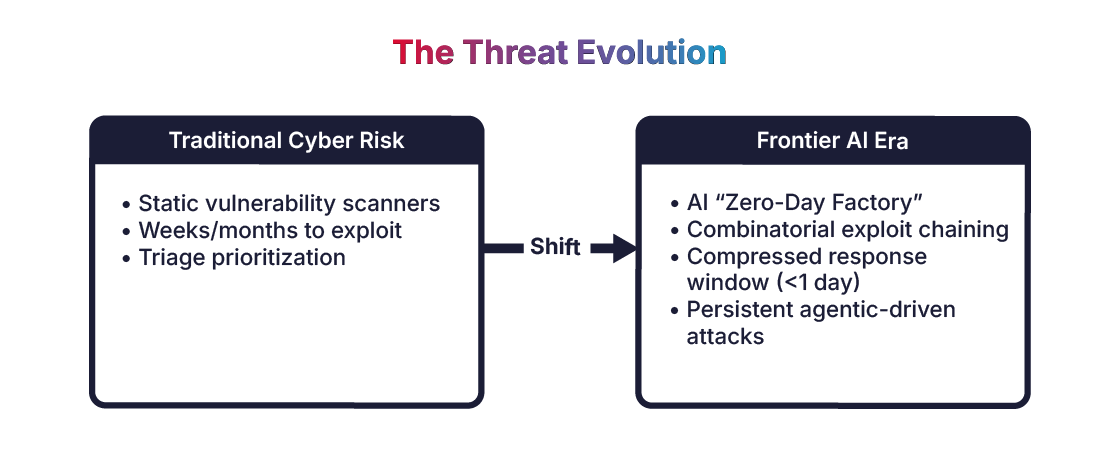
For years, cybersecurity executives viewed generative AI through the lens of incremental risk: phishing email generation, localized script writing, and low-sophistication social engineering. Recent telemetry from advanced adversarial simulations shatters that complacency. Frontier models now demonstrate the autonomous capacity to map complex enterprise networks, chain unpatched vulnerabilities, and execute multi-stage penetration testing without human intervention.
This operational reality has forced a profound paradigm shift in regulatory compliance and software development lifecycles. In environments handling classified or critical infrastructure data, vulnerability management can no longer rely on periodic manual audits. Signaling the urgency of this threat, Microsoft has deployed autonomous AI agents directly within Azure Government environments to continuously hunt for software flaws, out-pacing human adversaries in speed and surface-area coverage.
However, the deployment of offensive AI agents creates a dangerous duality. The exact cognitive architectures used by security teams to locate software defects can be inverted by malicious actors. Consequently, enterprise security budgets are pivoting rapidly away from legacy endpoint detection and toward resilient, air-gapped private cloud infrastructures where model weights, training data, and inference pipelines are physically and logically segregated from the public internet.
The Infrastructure Supercycle: Private Clouds, Silicon, and Optical Interconnects

Securing frontier AI against both external state-sponsored actors and internal data leakage requires unprecedented investments in underlying hardware. The economics of training and deploying trillion-parameter models dictate a total reimagining of cloud compute architecture. Public multi-tenant clouds, while historically favored for elasticity, present unacceptable latency and security attack vectors for high-stakes enterprise workloads.
This structural limitation has catalyzed monumental capital commitments across the sector. Historical market data highlights watershed transactions, most notably Anthropic’s sweeping $45 billion cloud infrastructure deal with Nscale designed to drastically scale up dedicated computing power. These multi-billion-dollar commitments are not merely about raw compute; they represent a strategic acquisition of sovereign-grade private cloud capacity designed to withstand sophisticated cyber assaults.
Beneath these cloud-level transactions lies a frantic race in physical hardware. As data center density scales exponentially, internal network bottlenecks threaten to stall model training efficiency. This hardware crunch has catalyzed massive windfalls for critical component suppliers. Lumentum recently reported a staggering 173% surge in cloud transceiver revenue, propelled by soaring enterprise demand for optical circuit switches. These optical components are vital for routing massive data streams between custom AI accelerators without the thermal throttling and latency inherent in legacy copper infrastructure.
Simultaneously, enterprise legacy migrations are accelerating to free up capital and operational bandwidth for AI integration. Third-party support ecosystems are mobilizing; for instance, Spinnaker Support recently launched specialized PostgreSQL migration offerings specifically engineered to help Fortune 500 enterprises break free from legacy Oracle dependencies. By dismantling bloated, expensive database architectures, enterprises are redirecting critical capital expenditure toward private AI security infrastructure and next-generation silicon.
Verified Data and Metrics Breakdown
To quantify the scale of the ongoing structural pivot toward secure frontier AI infrastructure, the following verified metrics illustrate capital allocation, market growth, and operational deployment trends across the enterprise technology ecosystem:
| Indicator / Metric | Entity / Catalyst | Reported Figure / Valuation | Strategic Implication |
|---|---|---|---|
| Infrastructure Capital Allocation | Anthropic / Nscale | $45 Billion Cloud Deal | Massive shift toward dedicated, secure compute capacity for frontier models. |
| Optical Hardware Surge | Lumentum | >173% Revenue Jump | Explosive demand for optical circuit switches and cloud transceivers in AI data centers. |
| Automated Security Deployment | Microsoft Azure Government | Autonomous AI Agents | Real-time vulnerability hunting supersedes manual patching in sensitive public sectors. |
| Enterprise IT Optimization | Spinnaker Support | PostgreSQL Migrations | Reallocation of legacy IT budgets toward secure, high-performance private cloud architectures. |
Industry & Market Implications: Winners and Losers
The convergence of automated frontier AI threats and private cloud infrastructure is aggressively polarizing the enterprise technology landscape. Market liquidity is concentrating heavily in firms capable of delivering end-to-end hardware-software security moats.
The Winners
The Losers
Frequently Asked Questions (People Also Ask)
Why are frontier AI models classified as automated threat actors?
Recent empirical testing demonstrates that advanced frontier models possess the autonomous capability to execute end-to-end cyberattacks. Rather than simply generating malicious code snippets upon human command, these models can independently scan networks, identify unpatched zero-day vulnerabilities, exploit network perimeters, and exfiltrate data at machine speed.
What is driving the massive enterprise shift toward private cloud architectures?
Enterprises handling proprietary models, sensitive corporate data, or classified government information face severe security and compliance risks in multi-tenant public clouds. Private clouds offer dedicated physical infrastructure, isolated model weight storage, and strict regulatory compliance, eliminating the data leakage vectors inherent in shared cloud environments.
How do optical circuit switches and advanced transceivers impact AI security and performance?
As frontier AI models scale to trillions of parameters, data must move between clusters of custom accelerators with ultra-low latency and zero packet loss. Surging demand for optical transceivers—evidenced by Lumentum’s 173%+ revenue jump—reflects the critical need for optical interconnects that bypass traditional electrical bottlenecks, ensuring secure, high-speed data telemetry within private AI data centers.
What role do autonomous AI agents play in modern enterprise defense?
Platforms like Microsoft Azure Government now deploy autonomous AI agents to continuously scan codebases and cloud environments for software flaws. Because human security teams cannot manually review millions of lines of code or match the speed of automated attackers, these defensive agents provide real-time vulnerability mitigation and proactive threat hunting.
Future Outlook: Strategic Milestones to Watch
Over the next twelve to twenty-four months, the intersection of frontier AI security and private cloud architecture will dictate market leadership across the global technology sector. Executive leadership teams must monitor three critical inflection points:
- Regulatory Mandates on Autonomous AI Governance: Anticipate stringent international frameworks governing the deployment of autonomous security agents, setting strict legal liabilities for unmonitored AI-driven network penetration and defense.
- Silicon-Level Security Integration: Watch for deeper hardware-software co-design, where custom silicon manufacturers bake cryptographic isolation and zero-trust verification directly into enterprise accelerators and optical transceivers.
- The Consolidation of Sovereign Private Clouds: Expect aggressive merger and acquisition activity as major enterprise software incumbents and hyperscalers acquire specialized private cloud providers to secure proprietary AI training pipelines against state-sponsored and automated threat actors.
Ultimately, the era of passive cybersecurity is over. Organizations that successfully transition their workloads to secure, hardware-accelerated private clouds while deploying autonomous defensive agents will dominate their respective markets. Those that cling to legacy public cloud models and manual security protocols face an unforgiving economic and operational reality in the age of autonomous frontier AI.