Special Report by the Investigative Desk | Published by Capital & Markets Wire
Wall Street’s Multi-Billion-Dollar Perimeter Fall: How Adaptive Zero Trust Architecture Is Rewriting Financial Defense
Test Our Free AI & Tech Utilities Suite
Calculate LLM API token costs, analyze article dwell-time, or simulate tech DCA returns.
As legacy network perimeters collapse under the weight of hybrid work and sophisticated state-sponsored cyber syndicates, financial institutions are executing a generational capital reallocation. The Bank Policy Institute’s foundational analysis on Adaptive Trust outlines the high-stakes migration to Zero Trust Architecture (ZTA)—a paradigm shift redefining infrastructure scalability, regulatory compliance, and valuation multiples across global banking.
Executive Takeaways
- The Perimeter is Obsolete: The shift to cloud compute architecture and remote operations has rendered traditional "castle-and-moat" network security an existential vulnerability for tier-one financial institutions.
- Regulatory Capital Mitigation: Implementing dynamic, policy-based Adaptive Trust frameworks directly minimizes systemic risk exposure, satisfying rigorous Basel Committee and SEC oversight.
- Enterprise ROI & Valuation: While initial capital expenditure is substantial, long-term operational resilience shields valuation multiples from catastrophic breach-induced equity write-downs.
The Anatomy of Perimeter Collapse: Why Legacy Banking Security Failed
For decades, the global financial services industry operated on a foundational, albeit increasingly flawed, security premise: the "castle-and-moat" doctrine. Under this model, once a user, device, or application successfully authenticated at the network edge via VPN or physical branch connection, they were implicitly trusted across the internal corporate network. By March 2022, as advanced persistent threat (APT) groups evolved their lateral movement tactics, industry analysts and institutional policy groups—most notably highlighted in critical advisory literature by the Bank Policy Institute—recognized that this perimeter-based approach was fundamentally unsustainable.
The catalytic events forcing this realization were multifold. The rapid, pandemic-accelerated migration to hybrid work decentralized the corporate footprint. Millions of retail, commercial, and investment banking employees began accessing sensitive ledger databases, high-frequency trading engines, and core banking applications from residential broadband connections and unmanaged endpoints. Simultaneously, cloud compute architecture adoption fractured the monolithic data center model. Financial institutions could no longer draw a hard line around their digital assets.
In this high-threat operating environment, legacy defenses resulted in catastrophic blast radii. When a single credential was compromised via sophisticated social engineering or software supply-chain vulnerabilities, attackers enjoyed unrestricted lateral movement across flat internal networks. Market liquidity, client data, and proprietary algorithmic systems were left perilously exposed. The strategic imperative became clear: the financial sector required an architectural philosophy rooted in permanent skepticism—Adaptive Trust and Zero Trust Architecture (ZTA).
Architectural Pillars of Adaptive Trust in Financial Services
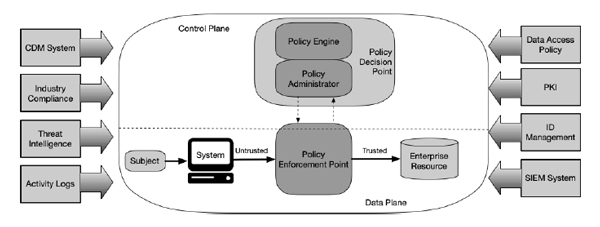
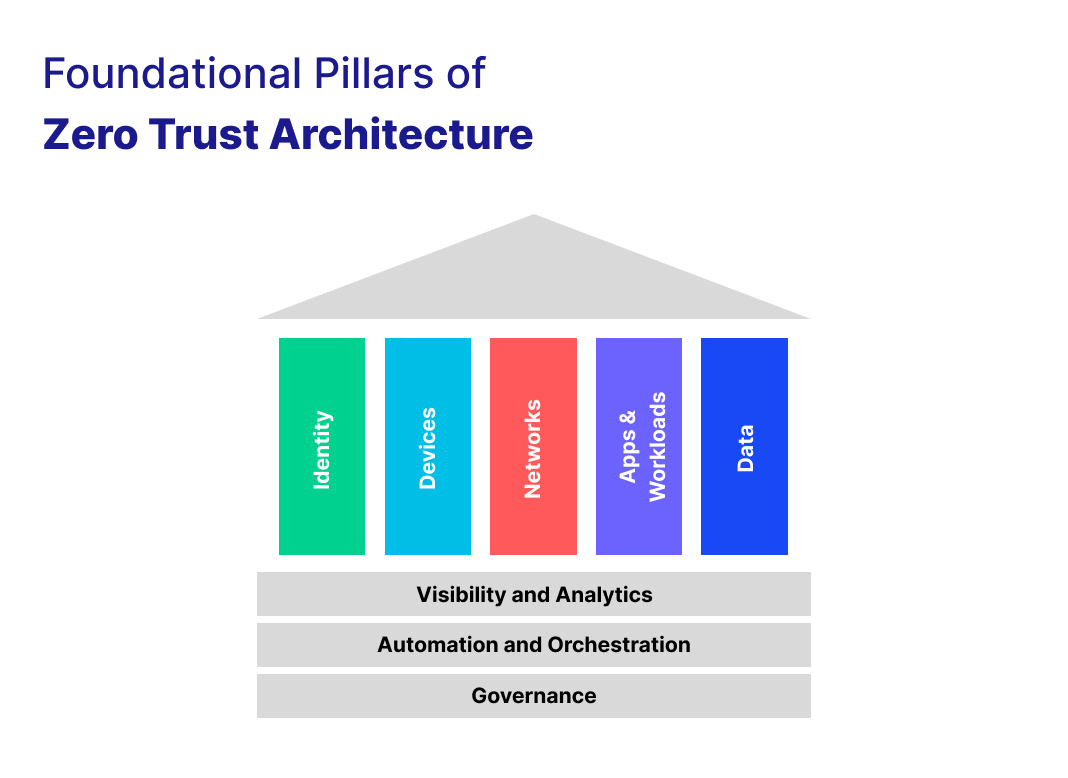
Unlike static security updates, ZTA is not a single software product that can be procured off the shelf; it is an exhaustive, enterprise-wide overhaul of identity, data, and network orchestration. In a financial services context, Adaptive Trust introduces real-time, context-aware decision engines that evaluate risk continuously rather than episodically.
At its core, the framework operates on three non-negotiable tenets:
- Verify Explicitly: Every access request must be authenticated and authorized based on all available data points, including user identity, location, device health, service or workload classification, data classification, and operational anomalies.
- Use Least Privilege Access: Access is restricted via Just-In-Time (JIT) and Just-Enough-Access (JEA) models, combined with risk-based adaptive policies and data protection to secure user credentials both in transit and at rest.
- Assume Breach: Network segmentation, end-to-end encryption, analytics, and automated response systems are deployed to limit the blast radius of any security incident, ensuring that a compromised endpoint does not equate to a compromised enterprise ledger.
For chief information security officers (CISOs) at bulge-bracket investment banks and systemic retail institutions, integrating these pillars requires deep coordination across legacy mainframe systems, modern microservices containers, and third-party SaaS vendors. The operational complexity is immense, yet the capital allocation is non-negotiable as cyber extortion syndicates target financial market utilities.
Verified Data & Metrics Breakdown: Legacy Security vs. Zero Trust Architecture
To quantify the financial and operational necessity of this transition, industry benchmarks illustrate a stark divergence in risk mitigation and recovery economics between traditional perimeter security and mature Adaptive Trust models.
| Metric / Dimension | Legacy Perimeter Model | Adaptive Trust / ZTA Model | Financial Impact / Variance |
|---|---|---|---|
| Lateral Movement Risk | High (Flat internal networks permit wide access) | Minimal (Micro-segmentation restricts traversal) | Reduces potential breach blast radius by up to 85% |
| Authentication Paradigm | Static (Perimeter-based single sign-on/VPN) | Dynamic (Continuous behavioral & contextual checks) | Drastically lowers credential-stuffing success rates |
| Regulatory Audit Friction | High compliance overhead, manual attestation | Automated telemetry, policy-as-code validation | Lowers SEC/Basel compliance reporting costs over time |
| Average Cost of Data Breach | Significantly higher due to undetected dwell times | Mitigated via rapid containment and telemetry | Saves millions per incident in remediation and fines |
Industry & Market Implications: Capital Allocation and Valuation Multiples
The institutional adoption of Adaptive Trust carries profound implications for market valuation, vendor ecosystems, and systemic risk management. Wall Street analysts are increasingly factoring cyber resilience into equity research reports. Financial institutions that fail to modernize their infrastructure face punitive valuation discounts from institutional investors wary of catastrophic regulatory penalties and operational outages.
Who Wins: Enterprise cybersecurity providers specializing in identity and access management (IAM), micro-segmentation, and continuous diagnostic monitoring are seeing unprecedented enterprise software demand. Furthermore, cloud infrastructure providers that natively bake Zero Trust primitives into their developer toolkits capture dominant market share among tier-one banks.
Who Loses: Legacy hardware vendors relying on traditional appliance-based firewalls and perimeter VPN gateways face secular revenue declines. Additionally, financial institutions slow to divest from monolithic, debt-laden legacy systems find themselves saddled with unsustainable maintenance overhead and heightened regulatory scrutiny.
From a macroeconomic perspective, systemic risk mitigation directly protects market liquidity. A coordinated cyber assault on a critical clearinghouse or systemic bank could freeze credit markets; robust ZTA implementation acts as an economic shock absorber, preserving confidence across international financial plumbing.
Frequently Asked Questions (People Also Ask)
What is the primary difference between traditional network security and Zero Trust Architecture in banking?
Traditional network security relies on a "castle-and-moat" model that implicitly trusts users and devices once they breach the outer perimeter via a VPN. Zero Trust Architecture assumes breach from the outset, requiring continuous, dynamic authentication and authorization for every single user, device, and API interaction, regardless of network location.
How does Adaptive Trust impact regulatory compliance for financial institutions?
Adaptive Trust provides granular, automated audit trails and policy enforcement mechanisms. This satisfies stringent regulatory frameworks mandated by the SEC, Basel Committee, and prudential regulators by proving that access to sensitive financial records and core ledgers is continuously monitored, restricted, and auditable.
What are the main financial and operational hurdles in migrating to a Zero Trust environment?
The primary hurdles include significant upfront capital expenditure (CapEx), the complex integration of modern ZTA protocols with legacy mainframe systems, potential user friction during initial authentication rollouts, and the organizational challenge of re-architecting internal data flows without disrupting daily trading and retail operations.
Future Outlook: Milestones and Strategic Horizons
As financial technology evolves through 2026 and beyond, Adaptive Trust will transition from a sophisticated security roadmap to an existential baseline requirement. Key milestones for institutional leadership include the complete deprecation of legacy VPN infrastructure across global offices, the widespread deployment of AI-driven behavioral anomaly detection engines, and the establishment of interoperable zero-trust standards across open-banking APIs.
For executive management teams and boards of directors, cyber risk is no longer merely an IT operational metric—it is a core balance-sheet liability. Institutions that successfully execute this architectural transformation will secure a decisive competitive advantage, ensuring uninterrupted market liquidity, regulatory favor, and resilient shareholder value in an increasingly hostile digital domain.