The Autonomous Enterprise: Inside the Multi-Billion-Dollar Pivot to Agentic AI and the 11 High-Yield Business Deployments
Executive Takeaways
- The Paradigm Shift from Assistance to Agency: Enterprise technology has decisively crossed the chasm from passive, prompt-and-response generative models to autonomous, multi-agent goal-seeking architectures capable of executing complex business processes with minimal human supervision.
- The 2026 CIO Mandate: Technology leaders are moving past experimental sandbox allocations, requiring agentic deployments to demonstrate measurable enterprise ROI, balance-sheet operational efficiency, and reductions in mean time to resolution (MTTR) across core workflows.
- Capital Allocation and Infrastructure Strain: Agentic deployment is reshaping enterprise software valuations and hyperscaler capital expenditure, shifting cloud compute architectures toward continuous asynchronous inference, robust orchestration runtimes, and low-latency API fabrics.
- Systemic Risk and Governance: As deterministic human checkpoints diminish, enterprise risk management teams are scrambling to deploy real-time monitoring rails to prevent catastrophic algorithmic drift, unauthorized transactions, and compliance failures across regulated corridors.
The Death of the Chatbot and the Rise of Autonomous Execution

For three years, the corporate world poured hundreds of billions of dollars into generative artificial intelligence that largely functioned as glorified scribes. Large language models drafted preliminary emails, generated synthetic imagery, and synthesized vast PDFs into bulleted summaries. Yet enterprise CFOs quietly lamented that while employee productivity showed localized spikes, corporate operating margins remained largely unchanged. The human was still required to verify every output, execute the subsequent API call, route the data across fragmented enterprise resource planning (ERP) silos, and manually close the business loop.
That era of passive assistive technology has ended. As revealed in global enterprise briefings and field reports published across enterprise technology corridors, the mandate for modern Chief Information Officers has fundamentally changed: facilitate AI adoption across the enterprise not at the level of conversational interfaces, but through autonomous execution. The industry calls this Agentic AI—systems endowed with persistent memory, tool-use capabilities, environmental perception, and the mandate to self-correct and execute multi-step objectives autonomously.
Unlike basic generative scripts, agentic architectures operate through looped reasoning frameworks (such as ReAct, Plan-and-Solve, and hierarchical tree search). They decompose broad corporate mandates—such as "rebalance Western European supply chain inventories against impending tariff shifts"—into discrete, sequentially executed sub-tasks. They access enterprise databases via secure Model Context Protocol (MCP) layers, reconcile balance discrepancies, initiate financial transactions, and verify downstream operational status with zero direct human intervention. As enterprise spending shifts toward high-eCPM infrastructure and compute architecture optimization, organizations that crack the agentic deployment code are unlocking asymmetric competitive advantages.
The 11 Enterprise-Grade Agentic AI Use Cases Driving Balance Sheet Impact
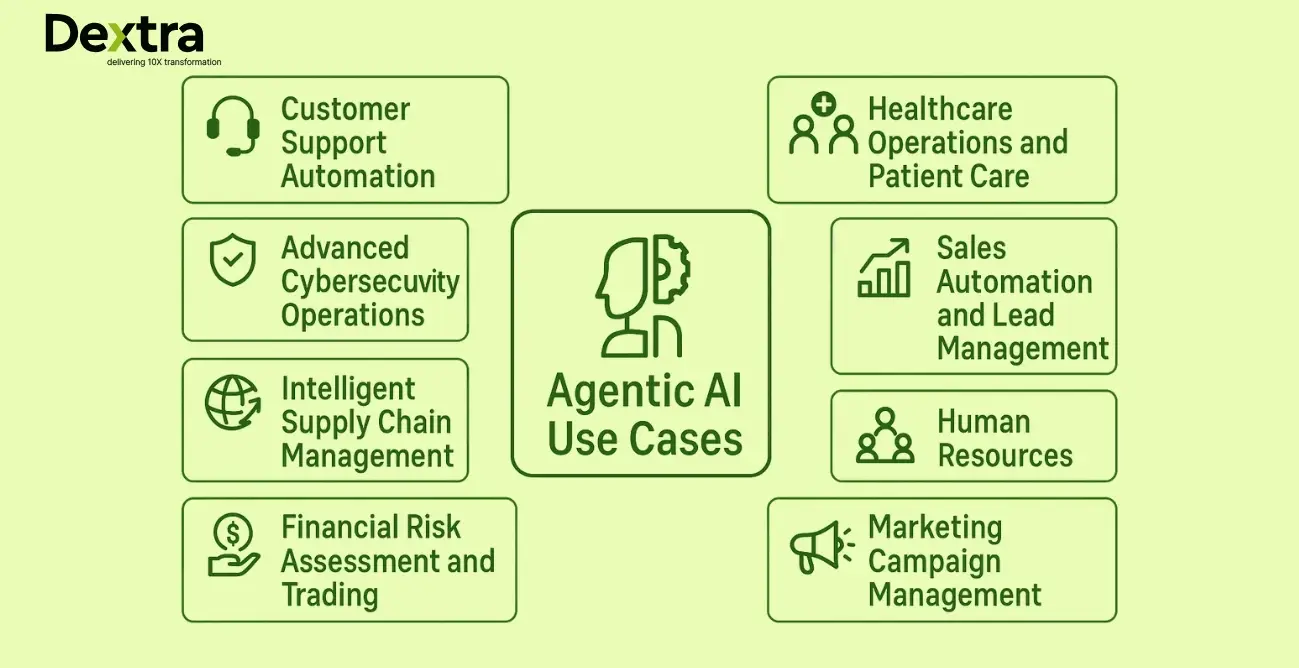
Interviews with engineering executives, systems integrators, and Fortune 500 technology leaders illuminate the eleven specific commercial use cases where Agentic AI is moving from controlled technical demonstration to hardened corporate reality.
1. Autonomous Supply Chain Self-Healing and Dynamic Procurement
Modern global logistics networks are fragile, susceptible to geopolitical disruption, climate bottlenecks, and localized labor volatility. Traditional enterprise software relies on rigid heuristics that alert logistics managers hours or days after a disruption has already cascaded. Agentic supply chain orchestrators continuously ingest live telemetry from marine transponders, port customs interfaces, meteorological radar, and carrier manifests.
When an agent detects a disruption—such as a canal closure or terminal strike—it does not merely sound an alarm. It evaluates available warehouse inventory, reviews active supplier master service agreements, models freight spot prices across alternative carriers, and autonomously executes spot purchase orders and route reassignments within pre-authorized capital limits, mitigating costly factory downtime.
2. Real-Time Algorithmic Financial Reconciliation and Audit Orchestration
Corporate financial close cycles historically consume thousands of human hours each quarter as forensic accountants manually match invoices against purchase orders, identify ledger discrepancies, and resolve currency hedging friction. Agentic finance frameworks operate continuously at the transaction layer. These agents ingest heterogeneous financial telemetry across disparate global banking portals, treasury management platforms, and legacy ERP instances, autonomously resolving line-item variances, identifying anomalous billing vectors, and compiling audit-ready compliance packages, compressing the multi-week financial close down to minutes.
3. Automated DevOps, CI/CD Pipelines, and Self-Healing Cloud Compute
Software development has advanced beyond automated code completions. Agentic DevOps systems monitor production cloud environments, ingest multi-cloud observability feeds, and autonomously resolve site outages. When a microservice fails or an application performance anomaly emerges, the agent isolates the aberrant container, reviews runtime commit histories, analyzes the stack trace, provisions an ephemeral sandbox, writes a regression patch, tests the code for vulnerability vectors, and applies the production hotfix—reducing Mean Time to Resolution (MTTR) from hours to sub-minute horizons.
4. Dynamic Cyber Threat Hunting and Zero-Day Incident Remediation
The speed of offensive algorithmic cyber warfare has rendered traditional Security Operations Centers (SOCs) structurally obsolete. Agentic cyber defense meshes continuously scan internal network topologies, identifying lateral movement patterns, privilege escalations, and API abuse. Upon detecting a zero-day exploit, the defense agent autonomously isolates the compromised endpoint, revokes active OAuth tokens, generates and implements bespoke firewall and egress filtering rules, and back-traces the telemetry path to patch the baseline configuration before data exfiltration occurs.
5. Cross-Border Regulatory Compliance and Real-Time Policy Adaptation
Global enterprises operate within an increasingly fractured regulatory landscape, spanning the EU AI Act, expanding ESG reporting frameworks, cross-border privacy boundaries, and dynamic trade sanctions. Agentic compliance networks continuously monitor global legal registers, map changing statutory requirements to internal data pipelines, execute risk scoring against transactional data flows, and automatically generate verified regulatory disclosures, mitigating institutional exposure to punitive statutory fines.
6. Hyper-Personalized Omnichannel Customer Lifecycle Resolution
First-generation enterprise customer service bots operated on decision trees or conversational retrieval-augmented generation (RAG), routinely frustrating consumers through circular dialogues and an inability to alter enterprise databases. Agentic service systems possess tool-execution access. They diagnose warranty issues, check real-time stock levels, authorize refunds via payment gateways, adjust subscription tiers within CRM systems, and dispatch replacement parts, resolving end-to-end customer support journeys in a single session without Tier-1 human escalation.
7. Algorithmic M&A Due Diligence and Capital Allocation Modeling
Corporate development and private equity teams face data room bottlenecks during competitive acquisitions. Agentic due diligence engines ingest hundreds of thousands of pages of unstructured data—including customer contracts, pending litigation dockets, lease agreements, and proprietary software repositories. The agents cross-reference balance sheets against tax returns, identify undisclosed counterparty liabilities, calculate operational synergies, and model complex discounted cash flow (DCF) scenarios under diverse macroeconomic assumptions, condensing institutional deal diligence cycles from months to days.
8. Intelligent Contract Lifecycle Management and Counterparty Arbitrage
Enterprise procurement departments frequently struggle with "contract leakage"—untracked auto-renewals, uncollected rebates, and non-standard indemnification liabilities buried across legacy archives. Contractual agent networks parse enterprise contract repositories, identify approaching termination milestones, benchmark price points against dynamic market indices, and autonomously draft, negotiate, and execute counterparty renewals within pre-set risk and pricing constraints.
9. Accelerated Clinical Trial Data Aggregation and Pharmacovigilance
In life sciences, processing clinical trial data and monitoring adverse drug reactions requires exhaustive labor. Agentic life-science pipelines continuously ingest patient electronic health records (EHRs), lab diagnostics, and decentralized trial telemetry. They reconcile protocol deviations, cross-reference adverse reactions against international toxicological ontologies, compile regulatory safety reports for submission to bodies like the FDA and EMA, and dynamically optimize patient cohort selection for ongoing pharmaceutical clinical phases.
10. Dynamic Pricing, Inventory Allocation, and Yield Optimization
In fragmented, margin-compressed markets such as global freight, hospitality, and retail, static pricing engines struggle to adapt to localized demand swings. Agentic yield optimization networks monitor hyper-local competitor pricing, inventory degradation rates, regional weather forecasts, and consumer sentiment indices. These agents continuously alter pricing models, adjust digital merchandising real estate, and initiate inter-warehouse inventory reallocations to extract maximum yield per inventory unit.
11. Enterprise Knowledge Graph Synthesis and Workforce Productivity Multipliers
Corporate intellectual property is notoriously siloed across team wikis, communications channels, technical documentation, and departing employee tacit knowledge. Agentic knowledge architects systematically crawl enterprise interactions, synthesize fragmented documentation into unified, dynamic enterprise knowledge graphs, discover institutional workflow redundancies, and orchestrate cross-departmental business processes—effectively serving as an autonomous operating tissue across the enterprise.
Empirical Performance: Generative vs. Agentic Paradigms
Data collected across early enterprise pilot groups showcases the stark performance differential between first-wave generative AI and the emergent agentic paradigm across key operational metrics:
| Operational Dimension | Generative AI Baseline (2023–2024) | Agentic AI Infrastructure (2026 Standards) | Observed Performance Delta |
|---|---|---|---|
| Human Intervention Rate | 85% – 100% (Continuous human verification needed) | 8% – 15% (Exception-based human escalation) | -82% in labor drag per process cycle |
| Mean Time to Resolution (IT/DevOps) | 4.2 Hours (Diagnostic synthesis only) | 3.8 Minutes (Autonomous isolate-and-patch) | 98.5% reduction in operational downtime |
| Multi-Step Task Execution | Single-turn output (Text, image, code snippet) | Multi-system orchestration (End-to-end task completion) | Full lifecycle autonomy |
| Token & Compute Economics | High compute cost / low enterprise ROI | Optimized asynchronous inference runtimes | 3.4x increase in quantifiable ROI per dollar spent |
| System Integration Level | Siloed prompt interfaces / isolated web apps | Deep bi-directional enterprise ERP/CRM/API integration | Complete infrastructural mesh connectivity |
Industry & Market Implications: Capital Reallocation and the Moat Transition
The institutional transition to agentic systems is fundamentally rewriting enterprise software economics. In the public equity markets, SaaS platforms that priced their software on a per-seat, human-license model are facing existential valuation multiple compression. When enterprise workflows are managed not by thousands of knowledge workers clicking through software interfaces, but by hundreds of autonomous agents interacting via sub-second API calls, per-seat licensing models collapse.
The winners in this landscape are infrastructure-layer players: high-capacity inference providers, vector routing fabrics, low-latency API orchestration engines, and companies that own proprietary, non-public enterprise transactional data. Hyperscalers are adjusting capital allocation models away from purely training-heavy clusters toward low-latency, real-time asynchronous inference infrastructure capable of supporting persistent agent runtimes that operate 24/7/365.
Conversely, traditional business process outsourcing (BPO) firms that built their enterprise valuations on labor arbitrage are experiencing acute margin pressure. Enterprise clients are actively terminating multi-million-dollar Tier-1 and Tier-2 IT support and operational processing contracts in favor of self-hosted or managed agentic orchestration swarms, permanently altering corporate cost structures.
Frequently Asked Questions (People Also Ask)
What is the core architectural difference between Generative AI and Agentic AI?
Generative AI operates fundamentally on an input-output prediction paradigm: a user provides a prompt, and the model predicts and returns the most probable textual, visual, or programmatic response in a single, closed loop. Agentic AI, by contrast, incorporates an autonomous reasoning loop (such as ReAct or planning algorithms). It maintains stateful memory, defines self-directed sub-goals, utilizes external tools and software APIs, assesses the success or failure of its own actions, and iteratively executes tasks across external systems until an assigned high-level corporate objective is achieved.
How do enterprise CIOs address the security risks of granting AI agents execution privileges?
Enterprises are adopting "deterministic guardrails" alongside zero-trust execution sandboxes. Rather than granting agents unconstrained access to root credentials or unbounded financial limits, organizations deploy programmatic policy-as-code frameworks. These architectures mandate cryptographic transaction signing, enforce micro-budgetary spending ceilings, and implement mandatory "human-in-the-loop" verification protocols for high-consequence thresholds (such as wire transfers exceeding specified enterprise tolerances or irreversible production code deployments).
What is the expected capital expenditure and ROI horizon for agentic implementations?
While initial capital allocation for agent orchestration runtimes, context protocol engineering, and data pipeline cleaning requires significant upfront investment, institutional data indicates a compressed enterprise ROI horizon of 9 to 14 months. ROI is predominantly achieved through steep reductions in operational expenditures (OPEX), the eradication of manual process rework, sub-minute incident remediation, and the ability to scale transactional business volumes without corresponding increases in administrative headcount.
Future Outlook: The Autonomous Horizon toward 2030
The transition toward agentic architecture represents the foundational phase of a broader enterprise evolution: the formation of the fully autonomous corporate entity. Over the coming 24 to 36 months, enterprise technical architectures will shift from deploying isolated, single-domain agents toward managing heterogeneous, multi-agent federations.
In these advanced environments, autonomous procurement agents will negotiate directly with supplier-side sales agents via cryptographic smart contracts, settling transactions instantaneously through central bank digital currencies or institutional stablecoins. The legal, regulatory, and corporate governance implications will be profound. Corporate governance frameworks must adapt to address questions of legal culpability when autonomous algorithmic agents execute defective contracts or commit antitrust infractions through emergent algorithmic collusion.
For executive leadership and boardrooms worldwide, the mandate is clear: the enterprise software era of passive human assistance has drawn to a definitive close. Organizations that master agentic orchestration, data governance, and secure autonomous execution will set the operational standards and capture the profit margins of the coming decade; those that hesitate will find their business models commoditized by competitors moving at the speed of code.