Executive Takeaways
- The Paradigm Shift: The 2026 AI landscape has evolved past simple parameter counts into a specialized battle of agentic reasoning, multimodal fluidity, and rigorous enterprise ROI.
- Tier-1 Contenders: OpenAI’s GPT-5.2, Anthropic’s Claude Opus 4.6, Google’s Gemini 3 Pro, and DeepSeek-R1 dominate the conversation, each targeting distinct vectors of infrastructure scalability and computational efficiency.
- The Open-Source Disruption: Meta’s aggressive open-weights lineup and aggressive routing platforms like FastRouter are aggressively compressing enterprise software margins, forcing a complete overhaul of corporate capital allocation strategies.
- Monetization & Compliance: As cloud compute architecture costs stabilize, C-suite executives are prioritizing risk mitigation, regulatory compliance, and total cost of ownership (TCO) over raw benchmark supremacy.
The artificial intelligence ecosystem has entered its most consequential commercial era to date. Gone are the days when generative AI was judged primarily by conversational fluidity or entertaining parlor tricks. In 2026, the marketplace demands uncompromising utility, ironclad data governance, and verifiable economic return. As documented in recent industry benchmarks from outlets like Built In, the competitive chasm between top-tier foundation models has narrowed in terms of raw capability, yet widened dramatically across specialization, inference latency, and pricing architecture.
For corporate treasuries, venture capitalists, and chief technology officers, choosing a model is no longer a localized software decision; it is a fundamental bet on enterprise survival. From OpenAI’s flagship GPT-5.2 to Anthropic’s nuanced Claude Opus 4.6, Google’s deeply integrated Gemini 3 Pro, and the disruptive efficiency of DeepSeek-R1, the industry is fragmenting into highly specialized battlegrounds. This investigative report dissects the performance metrics, financial realities, and strategic chess moves defining the current market.
The State of the Art: Deconstructing the 2026 Lineup
To understand the current valuation multiples of AI infrastructure providers, one must examine the specific mechanics driving the latest cohort of models. The technological leap from 2024’s introductory models to today’s advanced architectures is characterized by the mastery of synthetic data, multi-step agentic reasoning, and radically optimized token economy.
OpenAI’s GPT-5.2: The Enterprise Heavyweight
OpenAI remains the commercial bellwether, though its dominance is under relentless siege. GPT-5.2 represents a decisive shift toward autonomous, multi-step problem-solving. Where its predecessors excelled at single-prompt generation, GPT-5.2 is engineered to function as a digital co-worker capable of executing complex, multi-day workflows across corporate databases. However, this capability commands a premium. The capital expenditure required to train and run inference on GPT-5.2 keeps its pricing at the high end of the market, forcing enterprises to carefully calculate their cost-benefit thresholds.
Anthropic’s Claude Opus 4.6: The Nuance and Safety Specialist
Anthropic has carved out an unshakeable fortress among legal, financial, and regulatory compliance teams with Claude Opus 4.6. Renowned for its superior document synthesis, minimized hallucination rates, and sophisticated understanding of corporate nuance, Opus 4.6 is the preferred engine for automated contract review and deep financial auditing. Anthropic’s constitutional AI framework provides a layer of risk mitigation that institutional risk committees demand before deploying capital into automated workflows.
Google’s Gemini 3 Pro: The Multimodal and Ecosystem Powerhouse
Google’s primary moat remains its deeply integrated ecosystem and unmatched native multimodality. Gemini 3 Pro processes massive video, audio, and text contexts simultaneously with near-zero latency. By leveraging Google’s proprietary Tensor Processing Unit (TPU) infrastructure, the company has bypassed many of the hardware supply-chain bottlenecks plaguing competitors, allowing for aggressive pricing strategies that challenge traditional cloud compute architecture models.
DeepSeek-R1 and Meta’s Open-Weights Disruption
The most profound shock to the 2026 economic equilibrium has come from the East and from open-source champions. DeepSeek-R1 proved that world-class reasoning models can be trained at a fraction of Western capital outlays, completely upending traditional valuation metrics for foundational model startups. Simultaneously, Meta’s latest open-weights lineup continues to democratize advanced capabilities. By offering models that rival proprietary titans for free or nominal hosting fees, Meta is accelerating the commoditization of base intelligence layers, shifting the capture of enterprise value up the software stack.
Verified Data & Metrics Breakdown

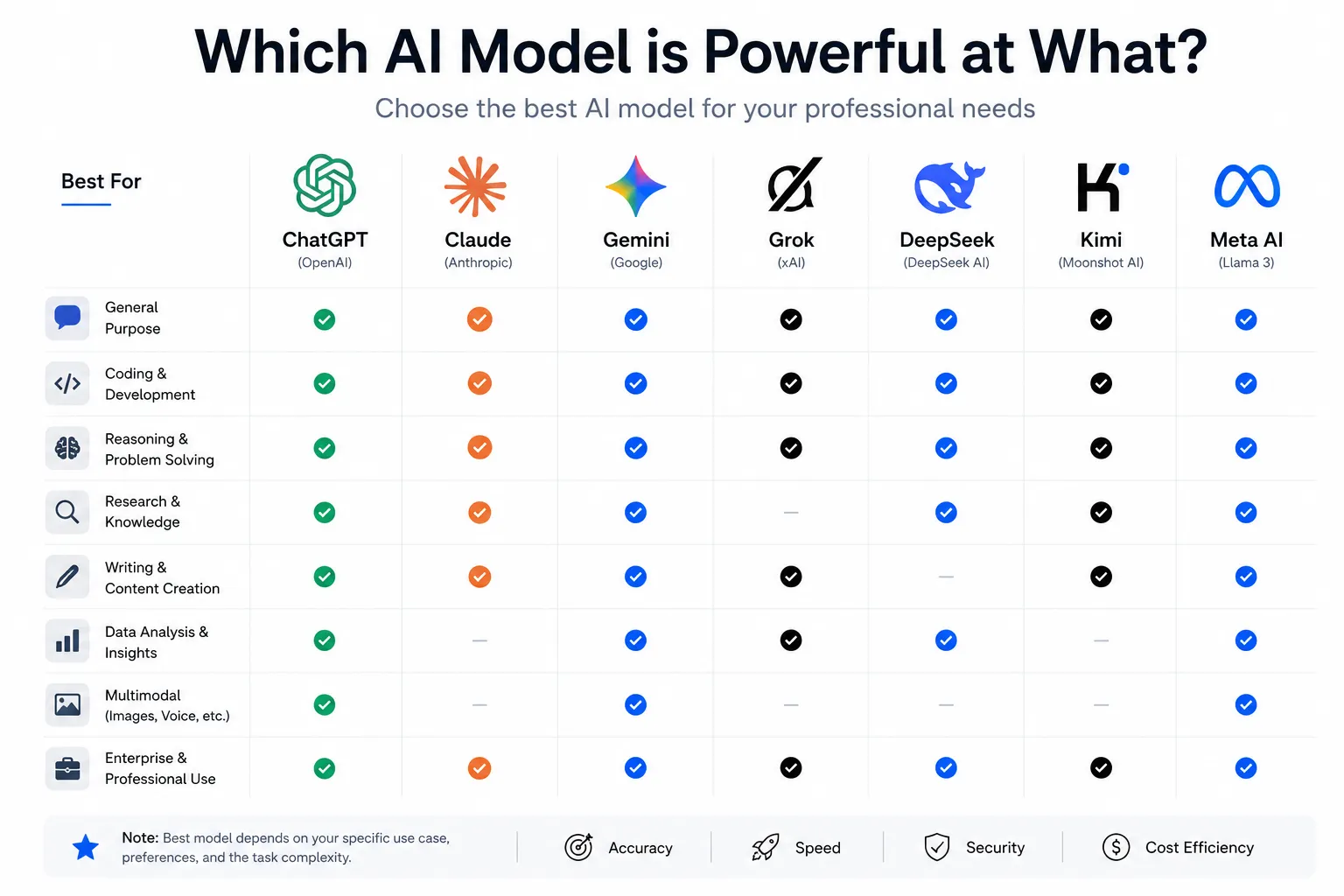
A rigorous comparative analysis requires looking past marketing claims and evaluating core architectural metrics. The following table synthesizes the operational parameters of the leading 2026 AI models:
| Model Name | Primary Developer | Context Window | Key Architectural Strength | Cost / API Tier | Enterprise Adoption Focus |
|---|---|---|---|---|---|
| GPT-5.2 | OpenAI | 500k+ Tokens | Autonomous multi-step agentic execution | High (Premium) | Complex software engineering & corporate automation |
| Claude Opus 4.6 | Anthropic | 200k+ Tokens | Advanced reasoning, nuance, & low hallucination | High (Premium) | Legal, compliance, & financial auditing |
| Gemini 3 Pro | 2M+ Tokens | Native cross-modal ingestion & massive context | Moderate-High | Enterprise search, video analysis, & ecosystem integration | |
| DeepSeek-R1 | DeepSeek | 128k Tokens | High-efficiency mathematical & logical reasoning | Very Low (Disruptive) | Cost-sensitive technical development & research |
| Meta Llama (Latest) | Meta | 128k+ Tokens | Open-weights flexibility & on-prem deployment | Free / Hosting Only | Sovereign cloud, data privacy, & custom fine-tuning |
Industry & Market Implications: Winners and Losers
The maturation of these models is triggering massive capital reallocation across global markets. As routing infrastructure like FastRouter gains traction—allowing dynamic switching between models based on task complexity and cost—the traditional vendor lock-in strategy is disintegrating.
Who Wins
- Enterprise Buyers: Corporate consumers are the ultimate beneficiaries. Intense price competition and open-weights alternatives have driven down inference costs, dramatically accelerating enterprise ROI on AI integration.
- Infrastructure Aggregators & Routers: Companies that build intelligent orchestration layers—routing simple queries to cheap open-source models and complex reasoning tasks to GPT-5.2 or Opus 4.6—are capturing outsized software margins.
- Cloud Providers with Custom Silicon: Hyperscalers who have invested heavily in proprietary silicon (such as Google’s TPUs and custom AWS/Microsoft chips) are insulating themselves from escalating NVIDIA hardware costs.
Who Loses
- Mid-Tier Proprietary Startups: Companies offering closed-source models with only marginal performance gains over open-source alternatives are facing a severe funding drought. Venture capital is fleeing me-too foundational model plays.
- Legacy IT Consultancies: Traditional system integrators slow to adopt automated agentic workflows are watching nimble, AI-native boutiques capture lucrative digital transformation contracts.
Frequently Asked Questions (People Also Ask)
How do closed-source models like GPT-5.2 and Claude Opus 4.6 justify their higher costs compared to open-weights alternatives?
Closed-source titans justify premium pricing through managed infrastructure reliability, seamless multimodal integration, advanced guardrails, and liability protections. For mission-critical enterprise deployment where failure carries severe regulatory or financial penalties, the managed safety and deterministic performance of proprietary models often outweigh raw compute savings.
What role does routing technology like FastRouter play in modern enterprise AI stacks?
FastRouter and similar orchestration technologies act as intelligent middleware. Instead of routing all company queries through an expensive model like GPT-5.2, the router analyzes the prompt's complexity and directs basic tasks to low-cost open-source models while reserving high-end reasoning engines strictly for complex, multi-step assignments. This optimizes total cost of ownership (TCO).
Why is the context window size critical for enterprise financial and legal applications?
A larger context window allows a model to ingest entire corporate ledgers, multi-volume regulatory filings, or years of legal precedent in a single prompt. This eliminates the degradation of context associated with older retrieval-augmented generation (RAG) pipelines, resulting in far more coherent, comprehensive, and accurate analysis.
Are open-source models secure enough for highly regulated banking and healthcare environments?
Yes. Because open-weights models can be deployed entirely on-premises or within secure, sovereign private clouds, they satisfy strict data residency and privacy mandates that forbid transmitting sensitive customer data to third-party API providers.
Future Outlook: Milestones to Watch
As we navigate the remainder of 2026 and look toward the horizon, three critical inflection points will dictate the next phase of the artificial intelligence economy:
- The Commoditization of General Intelligence: As base reasoning capabilities become ubiquitous and inexpensive, commercial differentiation will shift entirely to proprietary data moats, domain-specific fine-tuning, and user experience integration.
- Autonomous Agent Economies: The transition from chat-based interfaces to autonomous multi-agent systems that negotiate, transact, and execute corporate workflows independently will test the limits of current cybersecurity and compliance frameworks.
- Regulatory Clampdowns on Compute and Data: Anticipated international frameworks governing data provenance, copyright, and algorithmic transparency will likely favor well-capitalized incumbents capable of navigating complex legal compliance across multiple jurisdictions.
Ultimately, the 2026 AI model comparison reveals an industry maturing past the initial hype cycle into hard-nosed economic reality. For enterprise leaders, the directive is clear: success belongs not to those who deploy the most expensive model, but to those who architect the most intelligent, cost-effective, and secure operational stack.