The Great AI De-Risking: Institutional Investors Hedge Against Catastrophic Losses Amid Tech Stock Selloff
Test Our Free AI & Tech Utilities Suite
Calculate LLM API token costs, analyze article dwell-time, or simulate tech DCA returns.
As frothy valuation multiples collide with delayed enterprise ROI, smart-money allocators are deploying complex derivative structures, protective puts, and systemic capital allocation shifts to insulate portfolios from a broader semiconductor and cloud compute correction.
Executive Takeaways
- Institutional Hedging Surge: Options market data reveals a record-breaking influx of protective put options and collar strategies deployed by hedge funds against mega-cap artificial intelligence bellwethers.
- Valuation Compression Realities: The current tech stock selloff is being driven by mounting skepticism over infrastructure scalability, multi-billion-dollar capital expenditure cycles, and slower-than-anticipated enterprise monetization.
- Capital Allocation Pivot: Major asset managers are rotating away from speculative hardware manufacturers and over-leveraged cloud compute architectures toward cash-generative value equities and defensive fixed-income instruments.
- Ecosystem Fallout: While hyperscalers maintain long-term multi-year commitments, tier-2 AI software startups and semiconductor supply chain intermediaries face severe market liquidity constraints.
NEW YORK, LONDON, SAN FRANCISCO—In the echoing trading rooms of Wall Street and the City of London, a profound psychological and structural pivot is underway. After nearly two years of an unabated, liquidity-fueled artificial intelligence bull run, institutional investors are aggressively moving to hedge against downside risk amid a volatile tech stock selloff. The euphoria that once drove every equity associated with Large Language Models (LLMs), GPU manufacturing, and data center infrastructure to historic highs is encountering a harsh economic reality: the widening chasm between capital expenditure and enterprise return on investment (ROI).
Interviews with senior portfolio managers, derivatives strategists, and quantitative researchers across global financial centers reveal a synchronized shift in capital allocation. Rather than capitulating and liquidating long-term holdings, sophisticated market participants are engineering intricate risk mitigation portfolios. They are utilizing out-of-the-money put options, volatility swaps, and tactical sector rotation to insulate balance sheets against what many fear could be a prolonged valuation compression cycle in the broader technology sector.
Catalytic Events: The Anatomy of the Tech Selloff
The seeds of the current market correction were sown during consecutive quarters of record-shattering corporate earnings, where major technology conglomerates—often referred to as the hyperscalers—announced astronomical capital expenditure budgets dedicated exclusively to AI infrastructure buildouts. Billions of dollars have been funneled into procuring advanced silicon accelerators, expanding cloud compute architecture, and securing proprietary energy grids to power next-generation neural networks.
However, market sentiment began to fracture as chief financial officers and institutional analysts scrutinized the timeline for tangible enterprise monetization. While developer ecosystems have expanded exponentially, corporate buyers are demanding rigorous proof of operational efficiency and cost reduction before committing to enterprise-wide software licensing contracts. This friction between lofty valuation multiples and realized cash flows triggered a cascade of profit-taking, exposing the extreme concentration risk inherent in major equity indices heavily weighted toward the semiconductor and software sectors.
Concurrently, macroeconomic headwinds—including persistent sticky inflation readings, recalibrated Federal Reserve interest rate trajectories, and tightening regulatory compliance frameworks governing data privacy and algorithmic transparency—have combined to compress equity valuations. The resulting tech stock selloff caught leveraged retail participants and momentum-driven quantitative funds off guard, accelerating systemic volatility across global exchanges.
Derivatives and Defensive Positioning: How Institutions Are Hedging
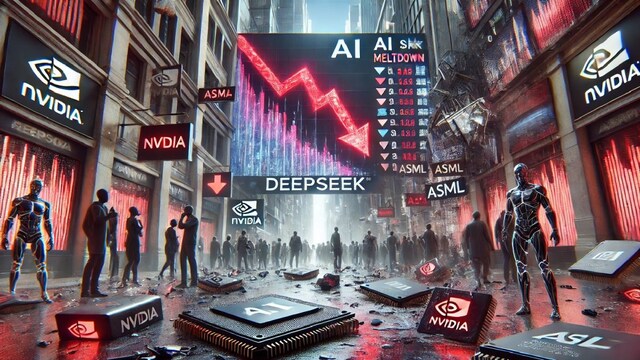
In response to heightened downside exposure, institutional asset managers have rapidly scaled up hedging operations. Proprietary derivatives desk data indicates a significant spike in put-to-call ratios across leading technology exchange-traded funds (ETFs) and individual mega-cap AI equities. Portfolio managers are deploying collar strategies—simultaneously buying protective put options to cap downside losses while selling out-of-the-money call options to finance the hedge—to preserve capital without triggering taxable realization events.
Furthermore, risk-parity funds and macro hedge funds are actively reducing gross exposure. They are reallocating capital away from high-beta software-as-a-service (SaaS) providers and cyclical hardware manufacturers into defensive asset classes, including short-duration U.S. Treasuries, investment-grade corporate debt, and cash-equivalent instruments yielding attractive risk-free returns.
Strategic Metrics at a Glance
| Metric / Indicator | Pre-Correction Phase (Q1-Q2) | Current Market Phase (Trending) | Strategic Implication |
|---|---|---|---|
| Options Put/Call Ratio (Tech) | Historically low (0.55 - 0.65) | Elevated (1.10 - 1.35) | Aggressive downside protection and fear hedging. |
| Valuation Multiples (Forward P/E) | Expanded (>35x for AI leaders) | Re-evaluating (24x - 28x) | Valuation compression to match realized cash flows. |
| Hyperscaler CapEx Growth | +40% to +60% YoY projections | Under intense shareholder scrutiny | Demand for clear enterprise ROI metrics before further scaling. |
| Market Liquidity & Flow | Heavy retail & momentum inflows | Sector rotation & de-risking | Flight to quality, cash preservation, and fixed income. |
Industry & Market Implications: Winners and Losers
As market participants reprice risk across the technology landscape, the divergence between winners and losers in the AI economy is becoming sharply defined. The overarching economic impact extends far beyond Wall Street trading desks, directly influencing corporate investment strategies, venture capital deployment, and enterprise technology adoption cycles.
The Institutional Winners
- Mega-Cap Hyperscalers with Robust Balance Sheets: Companies possessing massive organic cash reserves, diversified revenue streams (cloud, advertising, enterprise software), and existing data center footprints can weather valuation compression and continue long-term R&D investments.
- Derivatives Desks and Options Market Makers: Elevated market volatility and surging demand for protective hedging instruments have driven record trading revenues for prime brokers and institutional options desks.
- Value and Defensive Equity Sectors: Traditional sectors—such as healthcare, consumer staples, and dividend-paying utilities—are capturing capital outflows from volatile growth equities.
The Vulnerable Segments
- Pre-Revenue AI Startups & Tier-2 Hardware Providers: Venture capital and public market funding has tightened significantly. Entities relying on continuous external financing rounds to fund expensive model training face severe liquidity constraints.
- High-Beta, Unprofitable SaaS Companies: Firms trading at inflated revenue multiples that fail to demonstrate immediate operational leverage or clear AI integration paths are experiencing disproportionate equity drawdowns.
Frequently Asked Questions (People Also Ask)
Why are AI investors hedging their portfolios right now?
Investors are hedging to protect portfolios against severe valuation compression, heightened macroeconomic volatility, and mounting concerns over delayed enterprise return on investment (ROI). With monumental capital expenditures flowing into infrastructure, institutional allocators are deploying protective options and collar strategies to mitigate downside risk without liquidating long-term foundational positions.
What specific hedging instruments are institutional funds utilizing?
Sophisticated market participants are heavily utilizing out-of-the-money put options on tech-heavy indices and mega-cap bellwethers, collar option structures (buying puts funded by selling calls), volatility swaps, and tactical sector rotation into defensive fixed-income instruments and cash equivalents.
Is this tech stock selloff signaling the end of the AI bull market?
Financial analysts and senior editors characterize the current selloff not as the death of the AI revolution, but as a necessary valuation reset and maturation phase. While speculative excesses and over-leveraged startups face serious liquidity pressures, foundational technological advancements and multi-year enterprise transformation projects continue to advance.
How are corporate executives responding to investor demands for AI ROI?
Chief financial officers and tech executives are under intense pressure to demonstrate clear, quantifiable operational efficiencies, cost reductions, and revenue acceleration stemming from AI deployments, forcing a shift away from pure research expenditures toward commercially viable enterprise solutions.
Future Outlook & Key Milestones to Watch
As global financial markets navigate this critical juncture, the trajectory of artificial intelligence investments will be dictated by several pivotal milestones over the coming quarters. Institutional research desks emphasize that the market has transitioned from a phase of unchecked optimism into an era of rigorous fundamental analysis and accountability.
Market participants should monitor forthcoming corporate earnings reports for concrete metrics regarding enterprise software adoption rates and cloud infrastructure utilization efficiency. Additionally, shifts in global monetary policy, regulatory announcements concerning artificial intelligence governance, and semiconductor supply chain dynamics will serve as primary catalysts determining whether equity markets experience a prolonged consolidation or a renewed, fundamentally grounded expansion.