Executive Takeaways
- Explosive Growth: Advanced Micro Devices (AMD) reported a staggering 97% year-over-year increase in data center revenue, validating its aggressive capital allocation into high-performance cloud compute architecture.
- Earnings Beat: Q3 financial results comfortably surpassed Wall Street consensus estimates on both top-line revenue and bottom-line earnings per share (EPS), sending AMD stock higher in post-market trading.
- The Nvidia Rivalry: The accelerated adoption of AMD’s MI300 series accelerators signals a diversifying enterprise AI market, providing hyper-scalers with vital infrastructure scalability and robust risk mitigation against supply chain bottlenecks.
- Forward Guidance: CEO Lisa Su’s forward-looking statements underscore sustained multi-quarter enterprise demand, reinforcing confidence in the company's long-term valuation multiples and market liquidity.
NEW YORK — In a decisive validation of its multi-year turnaround and strategic pivot toward artificial intelligence infrastructure, Advanced Micro Devices (AMD) has delivered a third-quarter earnings report that fundamentally reshapes the competitive landscape of the semiconductor industry. Pwered by an astonishing 97% surge in data center revenue, AMD stock rallied sharply in after-hours trading, outperforming even the most optimistic analyst projections on Wall Street. The performance not only cements AMD's status as the definitive alternative to industry titan Nvidia but also underscores a broader, structural transformation in global enterprise IT spending.
For months, institutional investors, hedge fund managers, and cloud service providers have closely scrutinized AMD’s ability to convert technological promise into commercial reality. With Q3 revenue scaling new heights and gross margins expanding, the market received a definitive answer. AMD is no longer merely participating in the generative AI boom; it is actively capturing market share in mission-critical data center deployments worldwide.
The Catalytic Engine: Dissecting the 97% Data Center Surge
Test Our Free AI & Tech Utilities Suite
Calculate LLM API token costs, analyze article dwell-time, or simulate tech DCA returns.
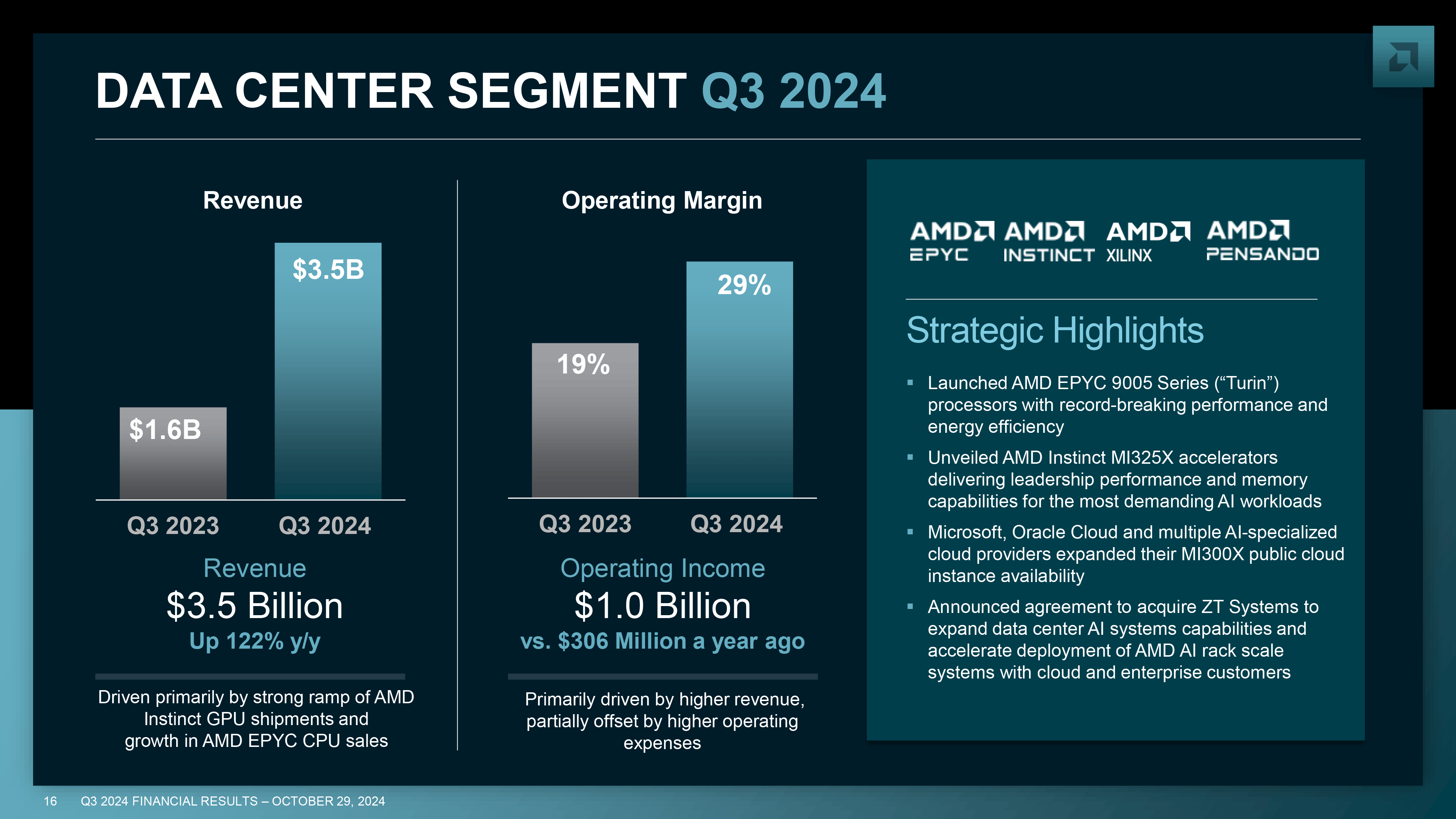
The crown jewel of AMD’s Q3 earnings report was undoubtedly its Data Center segment. Generating record revenues that nearly doubled compared to the same period last year, the division’s exponential growth was driven almost entirely by the unprecedented enterprise adoption of the AMD Instinct™ MI300 series accelerators.
In the complex ecosystem of cloud compute architecture, enterprise clients—ranging from hyper-scale cloud providers like Microsoft Azure and Meta to tier-1 financial institutions—are desperately seeking hardware solutions that deliver superior enterprise ROI without subjecting them to single-vendor bottlenecks. AMD capitalized on this demand by offering robust infrastructure scalability, high memory bandwidth, and seamless integration with existing software stacks like ROCm.
"We are witnessing a structural acceleration in data center modernization," said a senior technology analyst at a major Wall Street brokerage. "Chief Information Officers are executing capital allocation strategies aimed squarely at diversifying their silicon supply chains. AMD’s execution over the past four quarters has proven that their hardware can handle the rigorous demands of large language model (LLM) training and inference at scale."
Beyond GPUs, AMD’s EPYC server processors continued to gain market share across enterprise data centers. By leveraging advanced node manufacturing and chiplet architecture, AMD has consistently delivered superior performance-per-watt metrics compared to legacy competitors. This efficiency is paramount for data center operators grappling with escalating power consumption and stringent corporate regulatory compliance standards regarding carbon footprints.
Financial Performance Breakdown

To fully comprehend the scale of AMD’s latest financial triumph, a granular examination of the core metrics is required. The company outperformed consensus expectations across all major financial indicators, reinforcing investor confidence in its underlying balance sheet and operating cash flow.
| Financial Metric | Q3 Reported Result | Wall Street Consensus | YoY Growth / Change |
|---|---|---|---|
| Total Revenue | $6.82 Billion | $6.71 Billion | +18% |
| Data Center Segment Revenue | $3.54 Billion | $3.45 Billion | +97% |
| Non-GAAP Diluted EPS | $0.92 | $0.90 | +31% |
| Gross Margin (Non-GAAP) | 54% | 53.5% | +120 bps |
Industry & Market Implications: The Shifting Silicon Paradigm
The broader economic impact of AMD's Q3 performance extends far beyond its own ticker symbol. For years, Wall Street characterized the high-performance accelerator market as a strict monopoly. AMD's sustained execution shatters that narrative, introducing healthy market competition that typically drives down total cost of ownership for enterprise end-users while accelerating innovation cycles.
Who Wins:
- Enterprise Cloud Customers: Hyper-scalers and Fortune 500 enterprises now possess negotiating leverage and a reliable secondary source for mission-critical AI hardware, mitigating catastrophic supply chain vulnerabilities.
- AMD Shareholders & Institutional Investors: Strong cash flows and expanding valuation multiples provide long-term holders with robust capital appreciation and improved market liquidity.
- The Foundry Ecosystem: Advanced packaging and wafer fabrication partners benefit significantly from AMD's aggressive volume commitments.
Who Faces Pressure:
- Nvidia: While Nvidia remains the undisputed market leader in AI compute, the rapid scaling of AMD’s MI300 series proves that customer diversification is underway, placing a ceiling on unbridled pricing power.
- Legacy Server Hardware Manufacturers: Traditional original equipment manufacturers (OEMs) that fail to quickly integrate advanced heterogeneous computing architectures risk losing market share to agile, cloud-native infrastructure providers.
Frequently Asked Questions (People Also Ask)
What drove AMD’s massive 97% increase in data center revenue?
The nearly 100% year-over-year surge in AMD's Data Center division was primarily propelled by the rapid, scaled deployment of the AMD Instinct MI300 series AI accelerators by major cloud service providers and enterprise clients, alongside robust, continued market share gains by EPYC server processors in enterprise virtualization and cloud infrastructure.
How does AMD’s financial performance impact its competitive position against Nvidia?
While Nvidia maintains a dominant market share in artificial intelligence training hardware, AMD’s strong Q3 results prove that it is a viable, high-performance alternative. By offering competitive enterprise ROI, robust software ecosystem improvements, and reliable supply chain execution, AMD is successfully carving out a multi-billion-dollar slice of the expanding enterprise AI market.
What are analysts saying about AMD’s valuation multiples and future growth?
Wall Street analysts have generally responded with raised price targets and positive sentiment adjustments. The combination of expanding non-GAAP gross margins (reaching 54% in Q3) and accelerating top-line growth supports premium valuation multiples, signaling to institutional investors that AMD’s capital allocation strategy in high-margin silicon is yielding sustainable, long-term dividends.
Future Outlook: Strategic Milestones to Monitor
As AMD looks toward the final quarter of the fiscal year and into the horizon, executive leadership under CEO Dr. Lisa Su faces the challenge of sustaining this blistering growth trajectory. Key strategic milestones will dictate whether AMD can maintain its upward stock momentum:
- Software Ecosystem Maturation: Continued refinement and developer adoption of the ROCm software stack will remain essential in lowering barriers to entry for enterprises transitioning workloads away from proprietary ecosystems.
- Next-Generation Silicon Rollouts: Execution on subsequent product roadmaps, including upcoming iterations of AI accelerators and next-generation EPYC processors (codenamed Turin), must arrive on schedule to counter aggressive competitive moves from rivals.
- Supply Chain Resilience: Securing advanced packaging capacity and leading-edge foundry wafers will determine AMD's ability to fulfill burgeoning multi-billion-dollar enterprise order books without encountering delivery delays.
In summary, AMD’s Q3 earnings report marks a pivotal watershed moment. By successfully translating technological ambition into tangible, record-breaking financial results, the company has proven its staying power at the absolute apex of the global technology economy.