Executive Takeaways
- Immediate Valuation Pressure: Both Apple Inc. (NASDAQ: AAPL) and Palantir Technologies (NYSE: PLTR) experienced significant premarket equity erosion following after-hours earnings releases, highlighting heightened sensitivity to capital allocation, infrastructure scalability, and forward-looking guidance.
- 壓縮 Multiple Contraction Risk: Institutional investors are aggressively reassessing valuation multiples, particularly for high-beta enterprise software and hardware giants trading at premium price-to-earnings ratios amid fluctuating global liquidity.
- Enterprise ROI Scrutiny: Markets are pivoting away from speculative narrative growth toward verifiable enterprise ROI, demanding rigorous proof of monetization regarding artificial intelligence deployment and hardware upgrade cycles.
- Macroeconomic Hedging: Institutional asset allocators are recalibrating risk mitigation strategies, rotating portfolios to hedge against persistent macroeconomic headwinds and tightening cloud compute architecture expenditures.
NEW YORK & SAN FRANCISCO — Wall Street woke to a stark reality check this morning as premarket trading session indicators flashed red for two of the market's most heavily scrutinized equities. Apple Inc. and Palantir Technologies saw their shares slide sharply following post-bell quarterly earnings reports that, despite posting respectable top-line figures, failed to satisfy institutional investors demanding flawless execution and hyper-aggressive growth trajectories.
As senior financial editors tracking global markets from the trading floors of Lower Manhattan to the technology hubs of Silicon Valley, our investigative desk has analyzed the underlying telemetry of these sell-offs. The synchronized retreat of a trillion-dollar consumer hardware titan and a high-flying defense-and-enterprise data analytics pioneer underscores a broader, systemic shift in market psychology. Investors are no longer willing to reward projected potential; they are demanding immediate capitalization efficiency, margin preservation, and undeniable enterprise ROI.
The Catalytic Disconnect: Earnings Beats Versus Forward Guidance Realities
Test Our Free AI & Tech Utilities Suite
Calculate LLM API token costs, analyze article dwell-time, or simulate tech DCA returns.
The post-bell earnings cycle has historically served as a referendum on corporate health, but this quarter's numbers reveal a widening chasm between headline financial performance and forward-looking market expectations. For Apple, the world’s most valuable publicly traded enterprise, the friction point centered on hardware upgrade cycles, regional demand elasticity—particularly within the vital Greater China market—and the sluggish consumer uptake of its nascent artificial intelligence features. While services revenue continued its steady ascent, hardware revenue growth failed to inspire the aggressive multiple expansion that portfolio managers have priced into the stock throughout the preceding fiscal quarters.
Simultaneously, Palantir Technologies—the poster child for enterprise AI adoption and government contract procurement—faced an even harsher verdict from institutional risk desks. Despite reporting robust revenue acceleration driven by its Artificial Intelligence Platform (AIP) bootcamps, Palantir's sky-high valuation multiples left zero room for deceleration. When forward guidance pointed toward moderated margin expansion and elongated enterprise sales cycles, algorithmic trading desks and institutional block holders initiated immediate risk mitigation protocols, triggering an after-hours and premarket cascade.
Deep-Dive Financial Telemetry & Valuation Metrics

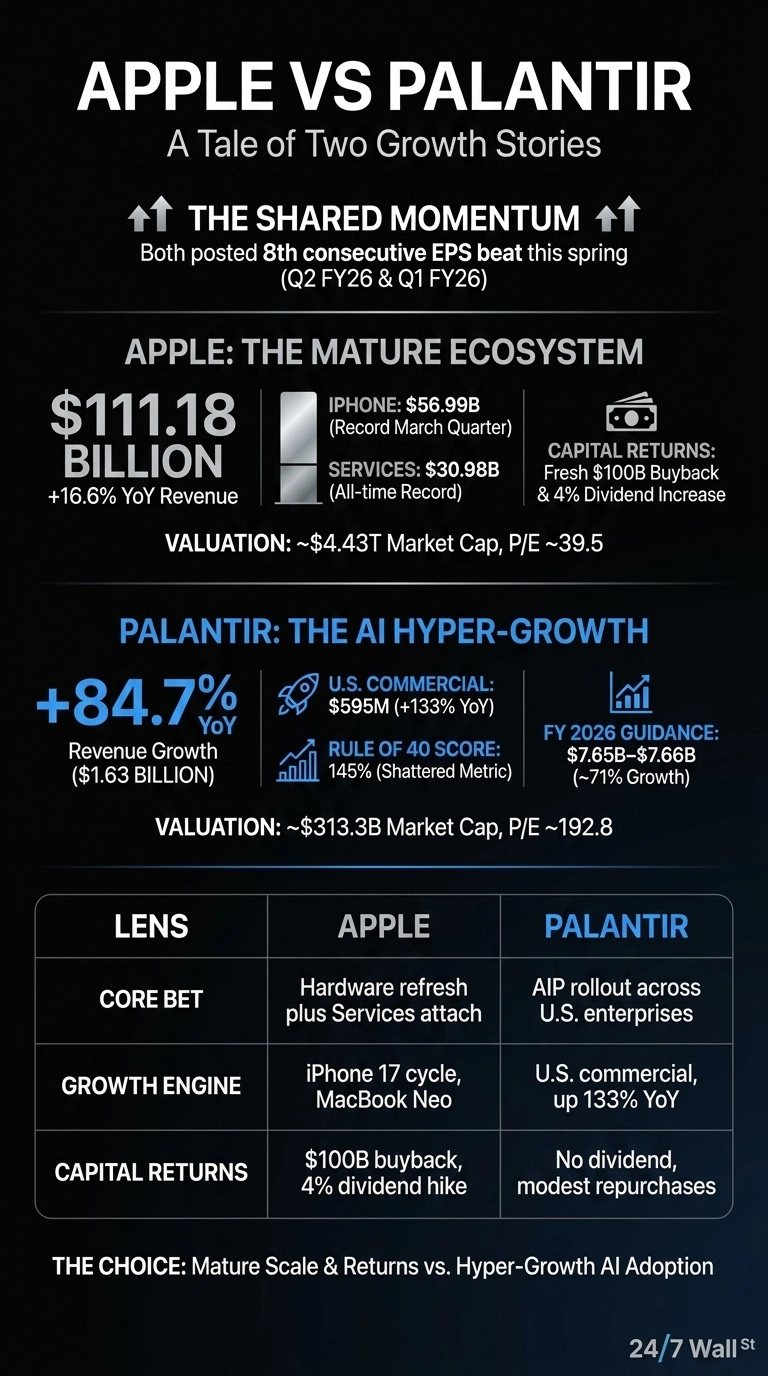
To understand the mechanics driving this premarket correction, we must examine the fundamental metrics governing both organizations. Institutional capital allocators rely on granular telemetry to evaluate infrastructure scalability and capital efficiency. The comparative breakdown below illustrates the critical tension points between Apple's mature cash-generation model and Palantir's high-growth, premium-valuation paradigm.
| Metric / Indicator | Apple Inc. (AAPL) | Palantir Technologies (PLTR) |
|---|---|---|
| Primary Sector | Consumer Hardware & Services | Enterprise Software & Analytics |
| Premarket Price Action | Moderate Downside Slide | Aggressive Multiple Compression |
| Valuation Multiple (P/E) | Elevated historical band (~30x) | Extremity pricing (>100x forward earnings) |
| Primary Growth Catalyst | Services, Ecosystem Lock-in, AI Integration | AIP Bootcamps, Commercial Expansion |
| Primary Risk Factor | Hardware Saturation & Regulatory Headwinds | Valuation Sustainability & Sales Velocity |
Industry & Market Implications: Winners, Losers, and Macroeconomic Shockwaves
The simultaneous correction in Apple and Palantir shares reverberates far beyond the balance sheets of these two corporations. It serves as a bellwether for the broader technology sector, signaling that institutional portfolio managers are actively rotating capital out of richly valued growth assets and into defensive sectors, fixed income, and cash equivalents.
The Corporate Losers: High-multiple technology firms relying on speculative narrative growth are bearing the immediate brunt of this sentiment shift. Companies that have staked their market capitalization on promised future artificial intelligence monetization are finding that institutional auditors require tangible financial proof before committing fresh capital. Venture-backed tech startups and mid-cap software enterprises should anticipate a tightening of private market valuations and venture capital deployment as public market multiples compress.
The Strategic Winners: Enterprise software providers and hardware manufacturers that can definitively demonstrate immediate, measurable operational cost savings and direct enterprise ROI are weathering the storm more effectively. Furthermore, institutional investors are rewarding firms with fortress balance sheets, robust free cash flow generation, and disciplined capital allocation strategies—such as aggressive share buyback programs and secure dividend distributions.
From a macroeconomic perspective, this premarket volatility highlights the delicate balancing act facing central banks. As corporate earnings reports reveal uneven consumer spending habits and cautious enterprise IT spending, monetary policymakers must weigh the risk of persistent inflation against the threat of cooling economic momentum.
Frequently Asked Questions (People Also Ask)
Why did Apple shares decline in premarket trading despite posting solid quarterly revenue?
While Apple’s headline figures met or slightly exceeded consensus estimates, institutional investors focused intensely on regional hardware demand softness, particularly within Greater China, and the slower-than-anticipated monetization timeline for consumer-facing artificial intelligence features. Because Apple trades at an elevated valuation multiple, any indication of plateauing hardware upgrade cycles triggers immediate profit-taking and downward premarket price pressure.
What drove Palantir's sharp valuation correction following its earnings release?
Palantir’s sell-off was primarily driven by extreme valuation multiples rather than poor fundamental performance. Trading at a triple-digit forward price-to-earnings ratio, the company was priced for absolute perfection. When forward guidance indicated that commercial scaling and enterprise sales velocity would face standard enterprise procurement friction, institutional automated trading algorithms initiated swift risk mitigation and profit-taking procedures.
How do these earnings reports impact broader market sentiment toward Artificial Intelligence (AI) investments?
These earnings mark a definitive transition from the "speculative infrastructure buildout" phase of the AI boom to the "rigorous ROI verification" phase. Wall Street is no longer willing to fund massive capital expenditures in cloud compute architecture and AI deployment without receiving concrete proof of immediate revenue generation and operational margin expansion.
What should institutional investors monitor moving forward to gauge tech sector recovery?
Portfolio managers should closely monitor enterprise IT budget surveys, cloud compute consumption rates, consumer discretionary spending metrics in international markets, and regulatory updates concerning data privacy and antitrust enforcement. Verification of sustainable cash flow growth will remain the primary determinant of equity rebound strength.
Future Outlook: Strategic Milestones and Roadmap Ahead
As the trading day progresses, market participants will be closely watching order book depth, institutional block trades, and options market volatility indexes to determine whether this premarket slide represents a temporary liquidity flush or the beginning of a broader sector consolidation phase. For Apple, upcoming developer conferences and holiday quarter preliminary data points will serve as critical litmus tests for hardware adoption velocity.
For Palantir, management must prove that its commercial customer acquisition strategy can scale rapidly enough to justify its premium valuation, particularly as competition within enterprise data analytics and generative AI deployment intensifies. Our investigative desk will continue to monitor regulatory filings, institutional positioning reports, and executive commentary to provide authoritative analysis as these macroeconomic storylines unfold.