Executive Takeaways
Test Our Free AI & Tech Utilities Suite
Calculate LLM API token costs, analyze article dwell-time, or simulate tech DCA returns.
- The Tripartite Hybrid Model: A pivotal benchmark study from FTI Consulting reveals that enterprise operations are standardizing across a three-tier architecture: deterministic automation for stable baseline processes, autonomous multi-agent orchestration for variable ambient workflows, and mandatory human oversight for high-variance strategic decisions.
- Infrastructure Bottlenecks Stifling Scaling: More than 64% of Fortune 500 agentic deployments remain trapped in proof-of-concept (PoC) staging due to legacy Identity & Access Management (IAM) deficiencies, context-window token latency, and uncontrolled operational expenditure (OpEx) costs driven by recursive inference loops.
- Shift in Enterprise Capital Allocation: Chief Information Officers (CIOs) and Chief Technology Officers (CTOs) are reallocating capital away from generic foundation model fine-tuning toward contextual retrieval-augmented generation (RAG) pipelines, low-latency vector databases, and real-time telemetry stack integration.
- M&A and Private Equity Valuation Impact: Private equity firms and equity research analysts have begun pricing "Agentic Readiness" into valuation multiples, penalizing enterprises heavily reliant on brittle, legacy Robotic Process Automation (RPA) architectures.
The Enterprise Pivot: Moving From Static Scripts to Autonomous Reasoning
For more than a decade, global enterprises built their operational efficiency playbooks around deterministic workflow engines. Systems engineered on fixed, if-this-then-that parameters—ranging from enterprise resource planning (ERP) scripts to Robotic Process Automation (RPA) pipelines—delivered significant reductions in back-office headcount and processing errors. However, as business environments face volatile supply chains, shifting geopolitical compliance regimes, and real-time market data flows, the structural fragility of static workflow automation has become an enterprise liability.
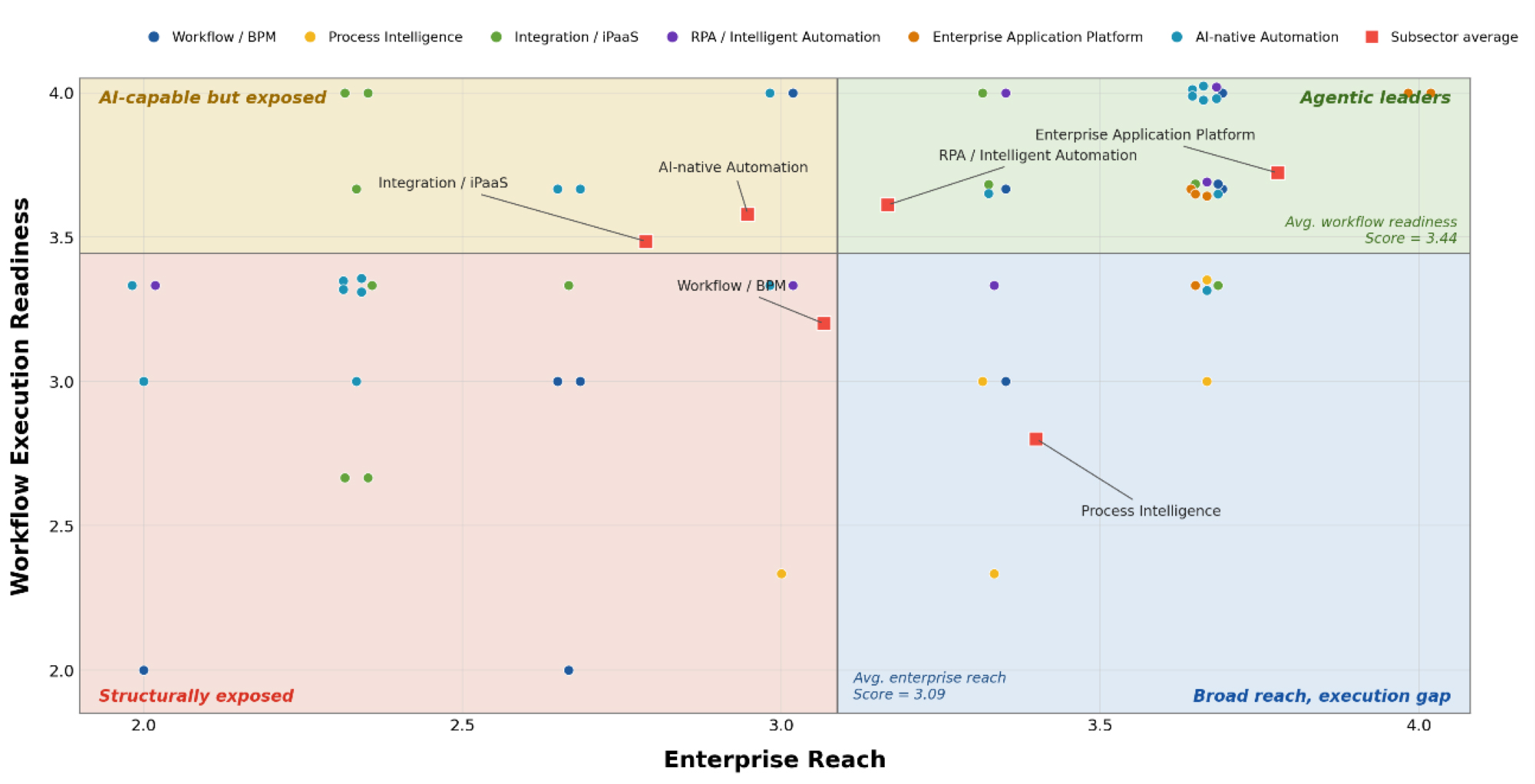
According to comprehensive wire data released last week by global business advisory firm FTI Consulting, the enterprise software ecosystem is experiencing a structural paradigm shift. The findings demonstrate that traditional workflow automation has hit a ceiling of diminishing returns. Corporate IT leaders are discovering that while static automation excels at structured, repeatable execution, it collapses when confronted with unstructured input drift, context switching, or systemic edge cases.
Enter Agentic AI: an architectural paradigm built on non-deterministic, goal-directed autonomous agents operating via Large Language Models (LLMs) and Specialized Domain Models (SLMs). Unlike legacy scripts, agentic architectures dynamically break complex enterprise mandates into sub-tasks, select appropriate internal tools or APIs, execute multi-step logic chains, evaluate their own intermediate output, and self-correct without human intervention.
Yet, the FTI Consulting analysis delivers a crucial reality check for the C-suite: Agentic AI is not a total replacement for legacy infrastructure or human capital. Instead, corporate leaders must engineer a sophisticated operational equilibrium—a hybrid architecture where predictable tasks remain strictly automated, dynamic variables are governed by agentic swarms, and high-order strategic risk remains anchored by fiduciary human judgment.
Deconstructing the Tripartite Enterprise Operating Framework
The core finding of FTI Consulting’s diagnostic framework illustrates that enterprise workload execution must be segmented into three distinct operational layers to maintain systemic stability, financial efficiency, and regulatory compliance.
1. Deterministic Automation: The Foundation of Stable Workflows
Stable, repeatable, high-volume tasks require zero probabilistic variation. Key finance functions like accounts payable batching, standard data migration, ledger balancing, and structured tax filing do not benefit from autonomous reasoning. Executing these routines through agentic AI introduces unnecessary non-deterministic risk and unsustainable cloud compute costs. Legacy iPaaS (Integration Platform as a Service) and RPA engines remain the optimal infrastructure for these stable, deterministic baseline operational tasks.
2. Agentic AI Orchestration: Managing Dynamic and Variable Execution
The operational layer experiencing the highest capital inflow comprises variable, context-dependent enterprise activities. Examples include cross-border trade discrepancy resolution, ambient supply chain rerouting, unstructured claims processing, dynamic regulatory tracking, and targeted customer retention negotiations. Agentic frameworks deploy dynamic multi-agent networks—comprising orchestrator, execute, and critic agents—that autonomously parse unstructured ambient data, formulate multi-step execution plans, invoke external enterprise APIs, and adapt execution paths when encountering anomalous responses.
3. Fiduciary Human Governance: Higher-Order Strategic Judgment
As AI systems gain operational agency, human capital is shifting upward into a supervisory and fiduciary governance posture. Higher-order strategic judgment—such as capital deployment decisions, legal risk assessment, M&A structuring, ethics compliance, and black-swan event response—remains firmly outside the domain of autonomous agents. Human-in-the-Loop (HITL) architecture ensures that critical threshold parameters trigger mandatory executive authorization before agent actions commit balance sheet capital or legally binding corporate obligations.
Enterprise Readiness Bottlenecks: Why Deployments Stall
Despite aggressive enterprise software spending, institutional transition toward agentic readiness is encountering severe technical, security, and economic friction. Investigative data highlights four primary structural bottlenecks obstructing enterprise-wide scale:
1. Legacy Identity and Access Management (IAM) Incompatibility: Modern enterprise security frameworks rely on human zero-trust access control or static service accounts. Autonomous agents require dynamic, ephemeral identity provisioning to query multi-departmental databases, call internal microservices, and execute programmatic transactions. Existing IAM infrastructure cannot adequately manage machine-agent privilege escalation, dynamic token delegation, or temporal access revocation without creating major cybersecurity exposure.
2. Compute Latency and Cost Volatility: Non-deterministic reasoning chains are computationally expensive. A single agentic loop parsing dynamic unstructured contracts can execute dozens of hidden API calls, context-window retrievals, and self-reflection validation loops. Unoptimized multi-agent reasoning often leads to exponentially rising token costs, creating severe OpEx budget overruns and unacceptable transaction latency profiles that render customer-facing applications impractical.
3. Context Drift and Governance Traceability: In regulated sectors such as financial services, healthcare, and insurance, auditability is non-negotiable. Traditional neural networks operate as black boxes, and agentic multi-step reasoning pathways can prove difficult to trace retroactively. When an autonomous agentic network reaches a flawed operational conclusion, reconstructing the exact contextual retrieval state, prompt logic, and external tool call sequence presents immense legal and compliance challenges.
4. Unstructured Enterprise Data Silos: Agentic AI depends heavily on real-time context retrieval via Retrieval-Augmented Generation (RAG) architectures. Legacy enterprise architectures choked with fragmented legacy databases, unindexed document stores, and poor data governance degrade context accuracy, triggering agent hallucinations, looped errors, or deadlocked multi-agent execution pipelines.
Comparative Analysis: Automation Architectures vs. Operational Metrics
The following metrics highlight the operational differences between legacy workflows, agentic AI frameworks, and human governance layers across key enterprise criteria:
| Operational Metric | Legacy Workflow Automation (RPA / iPaaS) | Agentic AI Orchestration (Multi-Agent Swarms) | Human Fiduciary Governance (HITL) |
|---|---|---|---|
| Core Execution Nature | Deterministic; linear if-then rules | Non-deterministic; probabilistic reasoning | Qualitative; strategic & conceptual judgment |
| Input Adaptability | Brittle; fails on input drift (>2% variance) | High; adapts dynamically to unstructured context | Maximum; handles novel ambient black-swan events |
| Unit Economics & OpEx | Low, fixed cost per workflow run | Variable token/compute cost per reasoning loop | High compensation/overhead costs |
| Latency Profile | Sub-second (Real-time execution) | Multi-second to minute reasoning cycles | Hours, days, or weeks per strategic decision |
| Regulatory Auditability | Complete; deterministic log traces | Complex; requires state & RAG tracing logging | Qualitative minutes, board & legal records |
| Primary System Failure Mode | Script breakage via UI/API structural change | Hallucinated execution & infinite loop conditions | Cognitive fatigue, bias, & operational delay |
Industry & Market Implications: Enterprise Winners, Losers, and Capital Allocation
The structural pivot toward agentic AI readiness is reshaping tech market dynamics, private equity buyouts, and global enterprise IT balance sheets.
The Enterprise Tech Stack Winners
Hyperscale cloud providers offering optimized inference clusters, vector database infrastructure vendors, and specialized observability enterprise providers are experiencing rapid tailwinds. Modern telemetry tools capable of monitoring token consumption, agent trace execution paths, and LLM orchestration errors in real time are emerging as essential components of enterprise software management.
The Brittle Software Losers
Legacy pure-play RPA vendors reliant strictly on surface-level desktop recording and static UI macro execution face accelerating market pressure. Enterprise buyers are shifting software spend away from standalone point solutions toward open, API-first software architectures capable of exposing modular endpoints directly to autonomous orchestrators.
Private Equity & M&A Valuation Frameworks
Institutional investors and corporate M&A teams are integrating "Agentic Readiness Audits" into buy-side due diligence. Target firms with clean data pipelines, modular API structures, and modern zero-trust IAM frameworks are capturing higher enterprise valuation multiples. Conversely, companies carrying heavy technical debt—specifically legacy, undocumented custom code bases—face severe operational discount penalties due to the high capital expenditure required to prepare them for agentic deployment.
Frequently Asked Questions (People Also Ask)
What is the fundamental difference between workflow automation and agentic AI readiness?
Workflow automation relies on deterministic, pre-scripted rules that follow fixed paths to execute structured, high-volume tasks. Agentic AI readiness refers to an enterprise's structural ability—across data architecture, security IAM, infrastructure, and governance—to deploy autonomous AI agents capable of context-aware reasoning, multi-step problem solving, dynamic tool usage, and non-deterministic task execution across ambient business environments.
How do CIOs calculate the enterprise ROI of agentic AI deployments?
Calculating ROI requires shifting focus from simple head-count reductions to operational speed, complex task completion rates, and error-mitigation scale. Enterprise financial models weigh compute token consumption, real-time observability telemetry costs, and context platform licensing against structural savings achieved through reduced processing cycles, decreased human escalation for intermediate exceptions, and faster multi-system business execution.
What security risks do autonomous agents pose to enterprise systems?
Primary security vectors include privilege escalation risks, prompt injection attacks, unpredictable microservice call logic, and data exposure through automated context retrieval. To mitigate these threats, enterprises must implement granular Zero-Trust Agent IAM policies, temporal micro-token authorization models, API rate-limiting rules, and automated runtime guardrails that bound dynamic execution within strict compliance parameters.
Why is a Human-in-the-Loop (HITL) model critical for enterprise AI scale?
A Human-in-the-Loop architecture ensures that high-risk, non-deterministic decisions stay anchored by fiduciary responsibility, legal oversight, and strategic oversight. By establishing clear risk-based execution thresholds, systems allow autonomous agents to operate independently on baseline dynamic tasks while automatically routing high-liability, high-capital, or anomalous edge cases to human executives for mandatory authorization.
Future Outlook: The 12-to-24 Month Roadmap
As outlined in the FTI Consulting data, the global enterprise market will move through an intense consolidation and standardization phase over the next 12 to 24 months. Organizations that navigate this transition effectively will build operational resilience by combining the low cost of legacy automation, the dynamic flexibility of autonomous agentic orchestration, and the risk mitigation of institutional human oversight.
Key technical milestones to monitor include the arrival of standardized Agentic Access Control Protocols (AACP), optimized local edge-model agent processing designed to bypass cloud compute latency, and strict industry compliance standards governing multi-agent algorithmic auditing. Enterprise executive teams that prioritize clean data governance, modern zero-trust identity layers, and robust telemetry frameworks today will secure sustainable competitive advantages and premium market valuations in the emerging era of agent-driven commerce.