Executive Takeaways
- The Genesis: Founders Mike Murchison and David Hariri embedded themselves as front-line customer service agents for months, laying the empirical groundwork for Ada’s automation architecture.
- The Breakthrough: Backed by recent strategic alignments highlighted by Bessemer Venture Partners, Ada is pioneering "fanatical CX loops" that transform static AI agents into self-optimizing enterprise systems.
- Infrastructure Realignment: The deployment of sophisticated tools like Copilot—engineered to deliver real-time, context-aware reply suggestions—signals a fundamental shift in capital allocation toward generative enterprise software.
- Economic Impact: Enterprises deploying these loops report immediate compression in operational expenditure (OpEx), fundamentally altering valuation multiples for legacy business process outsourcing (BPO) firms.
For decades, enterprise customer experience (CX) was treated as a cost center—a necessary friction point managed by sprawling call centers, rigid decision trees, and armies of outsourced agents. Today, that paradigm is collapsing. In the suite rooms of Silicon Valley and the trading floors of Wall Street, a quiet revolution is taking place, driven by foundational architectures that do not merely answer customer queries, but actively learn from every interaction. At the epicenter of this transformation is Ada, a company whose trajectory has captured the attention of top-tier venture capital, most notably Bessemer Venture Partners, as it redefines what it means to build autonomous enterprise infrastructure.
The story of Ada is not a typical Silicon Valley overnight success born out of a university dorm room. It is a masterclass in deep, empathetic market observation. Long before large language models (LLMs) dominated venture capital pitches, co-founders Mike Murchison and David Hariri made a fateful decision: they spent months working side-by-side as front-line customer service agents. They absorbed the cognitive fatigue, mapped the repetitive friction, and experienced the systemic inefficiencies that plague modern support operations. That foundational immersion dictated a radical product philosophy: enterprise software must be engineered from the agent's perspective outward.
The Anatomy of a Fanatical CX Loop
As detailed in recent disclosures by Bessemer Venture Partners, Ada’s latest market dominance hinges on a proprietary concept: "fanatical CX loops." In traditional software deployments, artificial intelligence operates in silos. A user inputs a query, a model retrieves a static response, and the interaction terminates. The system learns nothing unless subjected to laborious, manual data labeling and prompt engineering by human supervisors.
Ada’s architecture shatters this linear model by introducing a continuous, closed-loop feedback mechanism. When an AI agent interacts with a consumer, every nuance—sentiment shift, resolution time, escalation trigger, and contextual nuance—is ingested, vectorized, and processed in real time. This data does not just update a database; it actively tunes the underlying agentic logic. The result is a self-healing, self-optimizing customer experience engine that scales dynamically with enterprise demand without incurring linear headcount costs.
Central to this ecosystem is the sophisticated deployment of tools like Copilot. Unlike early-generation chatbots designed strictly to deflect human interaction, Ada’s Copilot deployment was built to operate as an intelligent co-pilot for human agents. It delivers real-time, context-aware reply suggestions, synthesizes historical account data across disparate CRM systems, and surfaces compliance-verified resolutions in milliseconds. By bridging the gap between autonomous AI agents and human oversight, Ada creates a seamless hybrid workforce model that enterprises require to mitigate operational risk.
Infrastructure Scalability and Enterprise ROI
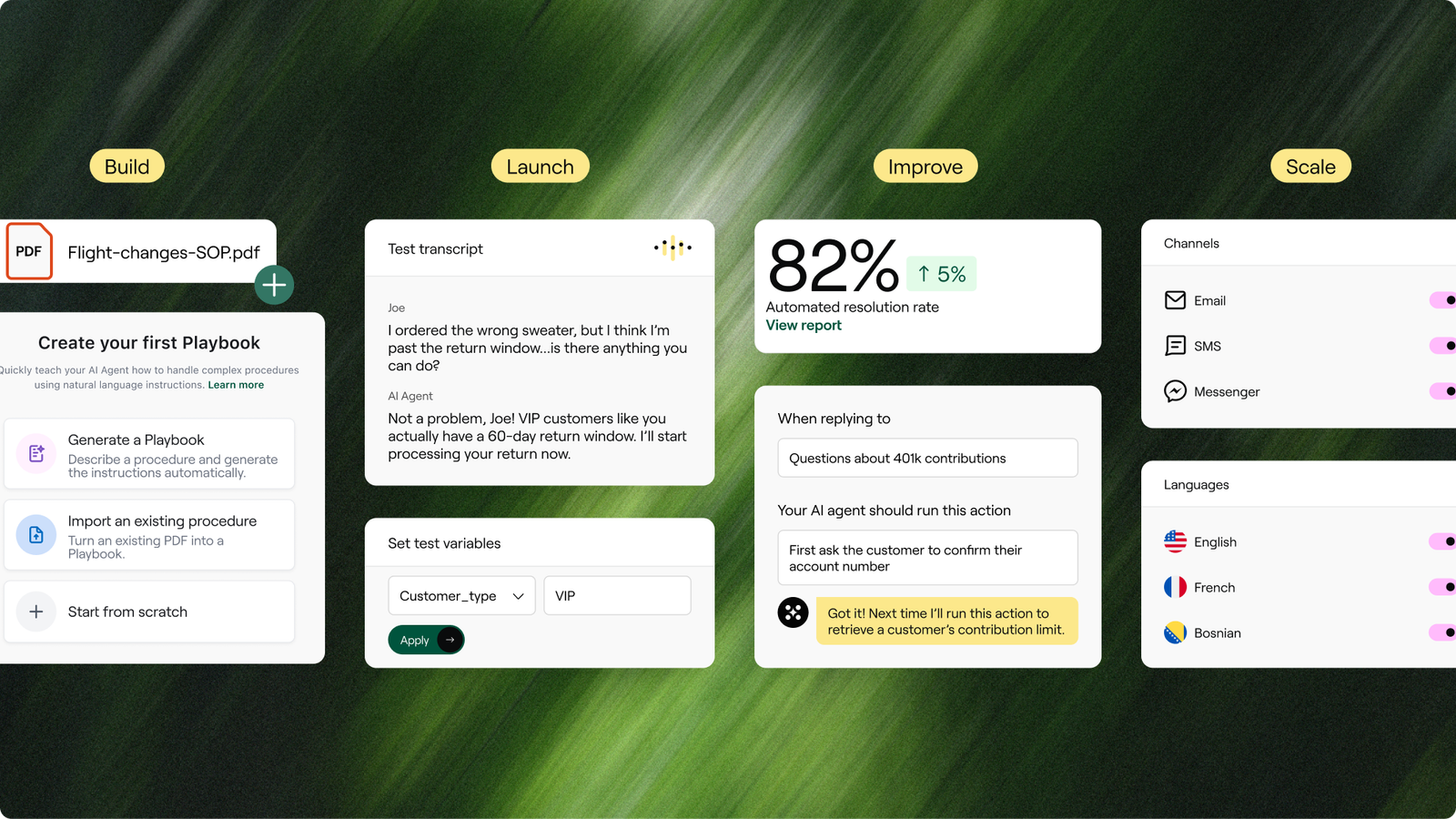
For Chief Information Officers (CIOs) and Chief Financial Officers (CFOs), the adoption of conversational AI infrastructure is no longer an exploratory line item; it is a critical mandate for capital efficiency. Traditional cloud compute architecture struggles with the latency and context-window limitations required for enterprise-grade CX. Ada’s engineering team has addressed this by decoupling reasoning engines from data storage layers, ensuring high throughput and strict regulatory compliance across global jurisdictions.
The financial implications are profound. In an economic climate characterized by compressed margins and heightened scrutiny on technology spend, enterprise software must demonstrate immediate return on investment (ROI). Companies deploying Ada’s fanatical CX loops report dramatic reductions in Average Handling Time (AHT) and significant spikes in First Contact Resolution (FCR) rates. These operational gains translate directly to bottom-line profitability, making Ada a prime beneficiary of enterprise digital transformation budgets.
| Metric / Dimension | Legacy BPO / Static Chatbots | Ada Fanatical CX Loop Architecture |
|---|---|---|
| Data Feedback Mechanism | Manual labeling & batch updates | Real-time, continuous vectorized learning |
| Agent Support Model | Rigid decision trees & static scripts | Context-aware Copilot reply suggestions |
| Operational Scaling | Linear cost correlation with headcount | Logarithmic scaling via autonomous agents |
| Regulatory Compliance | Vulnerable to human error and drift | Automated guardrails and audit trails |
Market Implications: Winners and Losers
The rise of autonomous, loop-driven CX architectures is triggering a violent realignment across the technology and service sectors. The macroeconomic shockwaves extend far beyond software vendors:
- The Winners: Forward-thinking enterprise brands that view CX as a core revenue driver. By deploying Ada, these companies capture granular consumer insights, improve retention metrics, and lower cost-to-serve. Infrastructure providers and venture capital firms like Bessemer that back category-defining workflow engines also reap outsized liquidity and valuation premiums.
- The Losers: Traditional Business Process Outsourcing (BPO) firms reliant on seat-based pricing models. As enterprise clients transition from human-heavy call centers to autonomous AI agents managed by compact oversight teams, traditional BPO revenue streams face existential structural decline. Furthermore, legacy point-solution chatbots that lack continuous learning loops are rapidly being treated as obsolete legacy tech.
Frequently Asked Questions (People Also Answer)
What exactly is a "fanatical CX loop" in the context of Ada’s AI agents?
A fanatical CX loop refers to Ada’s proprietary closed-loop infrastructure where customer interactions are continuously ingested, analyzed, and used to autonomously update the AI agent's reasoning logic and knowledge base in real time. Unlike static bots, these loops ensure the system becomes smarter and more contextually accurate with every single customer touchpoint.
How does Ada’s Copilot support human customer service agents?
Ada’s Copilot is engineered to deliver real-time, context-aware reply suggestions, summarize complex customer histories across multiple CRMs, and surface compliance-approved resolutions directly to human agents. This reduces cognitive fatigue, minimizes Average Handling Time (AHT), and empowers human representatives to focus on high-empathy, complex escalations.
What makes Ada’s foundation different from traditional enterprise chatbots?
While traditional chatbots rely on brittle, pre-programmed decision trees that frequently frustrate users and require constant manual maintenance, Ada leverages advanced generative AI models backed by continuous feedback loops. Co-founded by practitioners who worked front-line support jobs, Ada’s architecture is built specifically to handle complex enterprise workflows securely and autonomously.
How does Ada impact enterprise financial metrics and ROI?
By automating tier-one and tier-two support inquiries while optimizing human agent workflows, Ada helps enterprises significantly reduce operational expenditures (OpEx). CFOs favor the platform because it decouples customer support scaling from linear headcount growth, driving immediate margin expansion and measurable ROI.
Future Outlook: The Road Ahead
As we look toward the remainder of 2026 and beyond, the competitive moat in enterprise AI will not belong to companies with the largest language models, but to those with the deepest workflow integrations and the most robust feedback loops. Ada’s unwavering focus on architecting fanatical CX loops positions it at the vanguard of this transition.
Key milestones to watch include the expansion of multimodal agent capabilities—allowing AI to seamlessly process voice, video, and rich media in support workflows—and deeper enterprise system integrations that cross functional boundaries from support into sales and billing operations. For investors, enterprise leaders, and market observers, Ada serves as a prime case study in how empathy-driven foundational design, coupled with elite venture backing, can permanently alter the commercial landscape of global enterprise software.