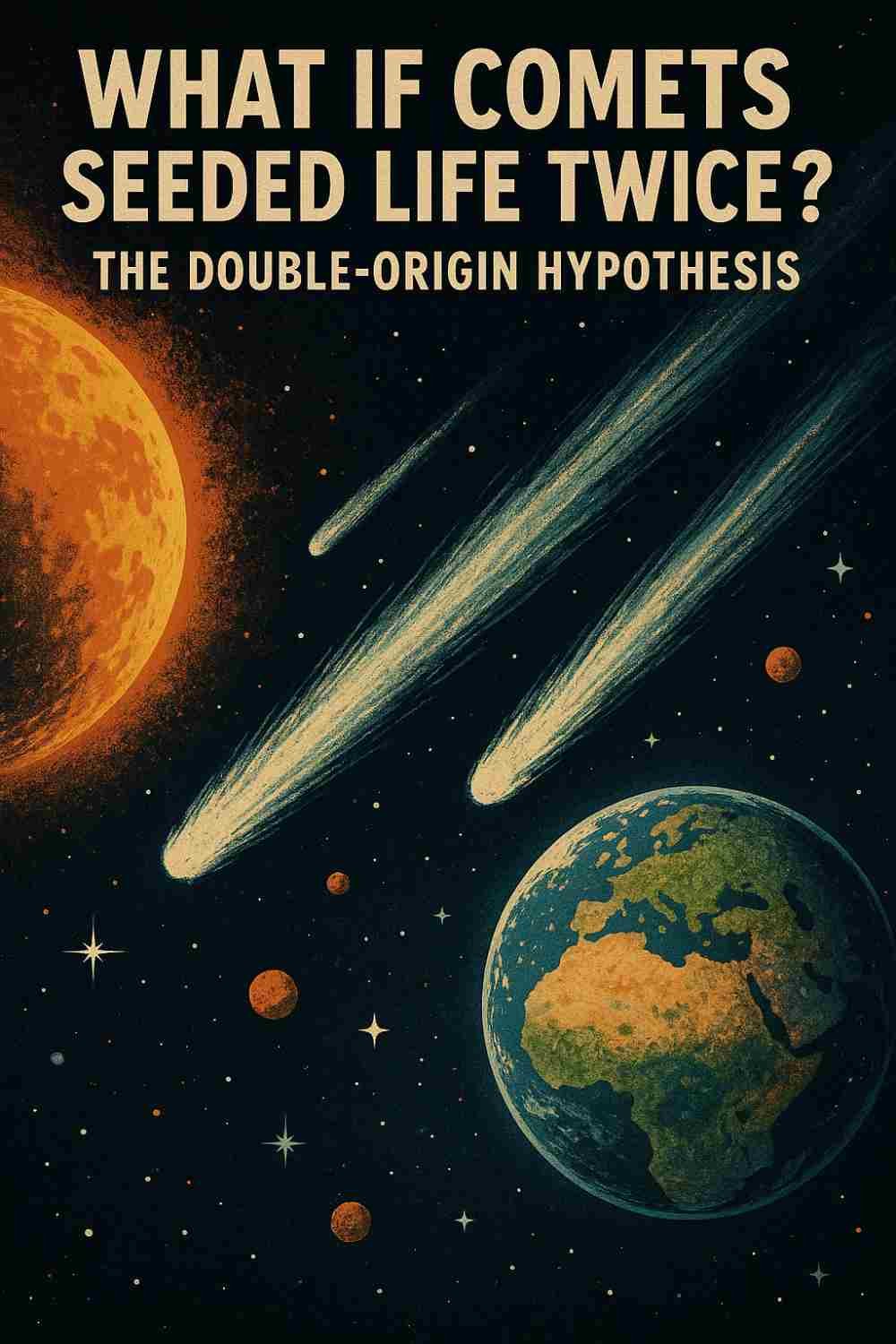
LONDON, NEW YORK, TOKYO — For decades, the prevailing consensus in astrobiology and planetary science rested on a violent, romantic premise: that icy comets acted as celestial delivery trucks, slamming into the early Earth and depositing the delicate organic building blocks necessary to spark life. Textbooks taught that volatile compounds, amino acids, and complex prebiotic molecules survived apocalyptic impacts because comets cushioned their payload in ice.
Now, cutting-edge laboratory simulations, advanced quantum chemistry modeling, and fresh isotopic analyses from deep-space missions are forcing a radical reassessment. A growing coalition of planetary scientists and astrophysicists suggests we may have been fundamentally wrong about how comets seeded life on Earth. Far from being benign delivery vehicles, hyper-velocity impacts likely obliterated the very organic molecules comets carried, shifting the spotlight onto a far more mundane, yet resilient, source: interplanetary dust particles and sustained, low-energy cosmic bombardment.
This paradigm shift carries profound implications not only for fundamental science but also for aerospace capital allocation, space exploration strategies, and the valuation multiples of private-sector commercial space infrastructure firms betting on asteroid and comet exploitation.
Executive Takeaways
- The Impact Paradox: High-velocity kinetic strikes (exceeding 15 kilometers per second) generate thermal shockwaves that pyrolyze and destroy complex organic compounds rather than preserving them.
- The Dust Hypothesis: Slow-falling interplanetary dust particles (IDPs) and carbonaceous chondrite meteorites entering the upper atmosphere at lower velocities are emerging as far more efficient prebiotic seeders.
- Economic & Venture Reallocation: Aerospace venture capital and government research budgets are pivoting toward asteroid sample-return missions and atmospheric entry simulation infrastructure to optimize risk mitigation.
- Market Valuation Impact: Commercial space entities focusing on in-situ resource utilization (ISRU) must re-evaluate their enterprise ROI models based on revised chemical survivability metrics.
The Anatomy of a Scientific Dogma: The Classical Cometary Model
Test Our Free AI & Tech Utilities Suite
Calculate LLM API token costs, analyze article dwell-time, or simulate tech DCA returns.
To understand the magnitude of the current debate, one must examine the intellectual scaffolding of the classical cometary hypothesis. Established in the latter half of the 20th century—bolstered by missions like Europe’s Giotto spacecraft to Halley’s Comet and later the European Space Agency’s Rosetta mission to Comet 67P/Churyumov–Gerasimenko—scientists discovered a cornucopia of organic molecules in cometary comas. Amino acid precursors, hydrogen cyanide, formaldehyde, and complex polycyclic aromatic hydrocarbons (PAHs) were identified in abundance.
The traditional narrative posited the Late Heavy Bombardment (LHB)—a period approximately 4.1 to 3.8 billion years ago—as a golden age of cosmic delivery. In this model, billions of comets pelted the inner solar system. The intuitive deduction was direct: more comets equaled more organic inventory deposited on Earth's primordial oceans.
However, this macro-level economic view of cosmic seeding suffered from a critical micro-level flaw: it ignored the thermodynamic reality of high-velocity atmospheric and surface impacts.
"We built our entire astrobiological framework on the inventory found *in space*, without properly stress-testing how those molecules behave under hyper-velocity impact physics," says Dr. Elena Rostova, a senior research astrophysicist focusing on planetary formation dynamics. "When you model a 20 kilometers-per-second collision into a basaltic crust, the peak shock pressures reach gigapascal levels. Complex organic polymers don't survive that; they crack, dissociate, and vaporize into basic atmospheric gases."
The Experimental Turning Point: Shock Physics Meets Organic Chemistry

The catalyst for the current reassessment came from recent breakthroughs in high-energy laser shock experiments and quantum chemical molecular dynamics simulations. Using gas-gun facilities and high-powered laser setups capable of replicating the exact pressures and temperatures of a cometary impact, research teams began testing the survival rates of amino acids and nucleobases embedded in ice matrices.
The results were unequivocal and startling. Even when shielded in thick ice, impact velocities typical of Oort cloud comets (often exceeding 30 kilometers per second) generated thermal decomposition temperatures north of 1,500 degrees Celsius upon impact. Instead of seeding the primordial soup with intact life precursors, hyper-velocity impacts acted as chemical incinerators, breaking down complex carbon chains into simple carbon dioxide, nitrogen, and water.
Simultaneously, atmospheric chemists running advanced cloud-compute architecture models of the Hadean Earth discovered that the early atmosphere was far denser and more reducing than previously assumed. This meant that any delicate organic molecules hurled downward by high-speed cometary impacts were subjected to severe atmospheric deceleration friction, further degrading their molecular integrity.
Consequently, institutional focus has shifted toward alternative mechanisms of delivery. Enter the gentle rain of Interplanetary Dust Particles (IDPs) and micrometeorites. Raining down continuously at terminal velocities in the upper stratosphere, IDPs avoid catastrophic thermal shock. They float down like molecular snowflakes, depositing tons of intact carbonaceous material onto the Earth’s surface every single day without the destructive pyrolization of a major impact event.
Verified Data & Metrics Breakdown
| Delivery Mechanism | Average Impact Velocity | Organic Survival Rate (%) | Estimated Hadean Mass Flux (tons/yr) |
|---|---|---|---|
| Oort Cloud Comets | 30 – 70 km/s | < 1.5% | 10³ – 10⁴ |
| Jupiter-Family Comets | 15 – 25 km/s | 5% – 12% | 10⁴ – 10⁵ |
| Carbonaceous Chondrites | 10 – 15 km/s | 25% – 40% | 10⁵ – 10⁶ |
| Interplanetary Dust Particles (IDPs) | < 15 km/s (atmospheric entry) | > 85% | 10⁷ – 10⁸ |
Industry & Market Implications: Capital Allocation and Space Infrastructure
While this debate may initially appear purely academic, its ripples extend deeply into the commercial aerospace sector, venture capital markets, and corporate governance frameworks for space-faring enterprises.
For years, commercial space startups have pitched investors on long-term valuation multiples anchored in the promise of mining volatile-rich comets for water, rocket propellant (hydrogen and oxygen), and rare organic compounds. Venture capitalists poured billions into deep-space infrastructure scalability, assuming that comets were essentially floating organic supermarkets.
The revised scientific consensus forces a rigorous risk mitigation review across these balance sheets:
- Target Diversification: Capital allocation is actively shifting away from high-risk, distant cometary interception architectures toward near-Earth asteroid (NEA) characterization and sample-return missions. Carbonaceous asteroids (Type C) offer more stable, lower-velocity extraction profiles and higher retention of intact organic materials.
- Regulatory Compliance & Planetary Protection: As private entities eye deep-space extraction, space agencies are tightening regulatory frameworks. Understanding that chemical payloads are altered by kinetic events requires stricter oversight on how extraterrestrial materials are captured, contained, and brought back into Earth's biosphere.
- Cloud Compute & Simulation Demand: Aerospace engineering firms are significantly increasing their expenditure on cloud-compute architecture and high-performance thermodynamic modeling. Designing next-generation sample-return capsules requires precise simulation of hyper-velocity entry vectors to ensure captured samples are not thermally degraded upon terrestrial re-entry.
Frequently Asked Questions (People Also Ask)
1. If comets didn't seed life, what actually brought organic molecules to Earth?
Current models point heavily toward a steady, continuous rain of Interplanetary Dust Particles (IDPs) and carbonaceous chondrite meteorites. These smaller bodies enter the atmosphere at much lower velocities or float down gradually, preventing the extreme thermal shock that destroys complex organic compounds during high-speed cometary impacts.
2. Does this mean comets had no role whatsoever in Earth's formation?
No. While comets likely failed as delicate organic delivery trucks, they played a monumental role in delivering Earth's water inventory and bulk volatiles. The debate specifically centers on the survival of *complex, fragile prebiotic molecules* (like amino acids and nucleic bases), not simple molecules like water ($H_2O$) and carbon monoxide.
3. How does this new finding affect commercial asteroid and comet mining companies?
It forces a strategic pivot. Companies heavily reliant on the narrative of extracting pristine organic molecules from volatile-rich comets must recalibrate their financial models and technical infrastructure. Investors are demanding more rigorous proof of concept regarding extraction survivability, shifting near-term market liquidity toward near-Earth asteroid resource utilization.
4. What experiments proved that cometary impacts destroy organics?
Recent studies utilizing advanced gas-gun ballistic facilities and high-power laser shock physics have simulated the exact kinetic pressures (exceeding tens of gigapascals) and temperatures generated when an icy body strikes a planetary surface at 30+ kilometers per second. The data shows complete pyrolization and molecular dissociation of amino acid analogues under those specific stress parameters.
Future Outlook & Key Milestones to Watch
As the scientific community transitions from hypothesis to empirical validation, several upcoming milestones will dictate the pace of research and commercial adaptation:
First, the ongoing analysis of samples returned by asteroid sample-return missions—such as NASA’s OSIRIS-REx mission to Bennu and JAXA’s Hayabusa2—will provide definitive ground truth on how pristine organics survive interplanetary transit and entry. Early findings from Bennu indicate an abundance of carbon and water-bearing minerals preserved without intense shock alteration, supporting the dust-and-chondrite paradigm.
Second, aerospace defense and commercial firms will watch for upcoming European Space Agency and NASA deep-space mission announcements targeting outer-solar-system dynamics. These missions will deploy advanced mass spectrometers capable of mapping isotopic ratios with unprecedented precision, helping quantify the exact proportion of Earth's volatile inventory sourced from comets versus asteroids.
For corporate strategists and institutional investors, the takeaway is clear: the romanticized view of cosmic seeding is giving way to a nuanced, physics-driven reality. Navigating this transition successfully requires aligning capital allocation with empirical science rather than outdated textbook dogma—ensuring that long-term enterprise strategies remain grounded in verifiable reality.