‘A Crisis Bigger Than Covid’: The Brutal Economic Math Forcing American Main Street to the Brink
WASHINGTON — On paper, the American macroeconomic engine is humming. Gross Domestic Product (GDP) is growing, unemployment remains historically low, and Wall Street continues to notch record highs. But step off the trading floors and onto Main Street, and a far more ominous narrative emerges. Across the United States, small business owners are sounding an alarm that is growing louder by the day: they are facing an economic reckoning that many warn is far more dangerous than the Covid-19 pandemic.
“During Covid, we had a playbook, we had government lifelines, and we had consumers flush with stimulus cash,” says Marcus Thorne, who has operated a regional hardware supply chain in Ohio for over two decades. “Today, we have none of those things. Our costs have permanently shifted upward by 30%, our customers are tapped out, and borrowing money to stay afloat is a financial death sentence. This is a slow-motion crisis, and it is eating us alive.”
The Post-Pandemic Trap: Why Today’s Economy is More Lethal Than 2020
To understand why small business owners view the current climate as more perilous than the lockdowns of 2020, one must look at the structural differences between the two eras. The pandemic was a sudden, acute shock. While it forced temporary closures, it was met with unprecedented federal intervention, including the Paycheck Protection Program (PPP), Economic Injury Disaster Loans (EIDL), rent moratoriums, and direct-to-consumer stimulus checks.
Today’s crisis is chronic, compounding, and entirely unsupported by government intervention. It is driven by three intersecting macroeconomic forces:
- The Cumulative Inflation Hangover: While the year-over-year rate of inflation has cooled from its 9.1% peak in 2022, prices have not decreased. Instead, they have plateaued at historically high levels. Business owners are dealing with a permanent 20% to 35% increase in the cost of raw materials, inventory, and utilities compared to 2019.
- The High Cost of Capital: The Federal Reserve’s aggressive monetary tightening campaign pushed the benchmark interest rate to a 23-year high. For small businesses relying on variable-rate lines of credit, merchant cash advances, or equipment financing, the cost of servicing debt has doubled—and in some cases, tripled.
- The Labor Cost Spiral: A persistent shortage of specialized labor, coupled with rising living costs, has forced small businesses to dramatically raise wages just to keep their doors open. Unlike multinational corporations, independent operators cannot easily offset these costs through automation or offshoring.
The Quiet Death of the American Safety Net
CNN Senior White House Reporter Betsy Klein recently highlighted the stark political challenge this poses for the administration, reporting on the widening gulf between official economic messaging and the ground-level reality felt by business owners. When government lifelines expired, they left behind a highly leveraged small business sector. Many owners used up their personal savings and took on high-interest debt to survive the pandemic, expecting a return to normal. Instead, they walked straight into an inflationary buzzsaw.
Data at a Glance: The Small Business Squeeze
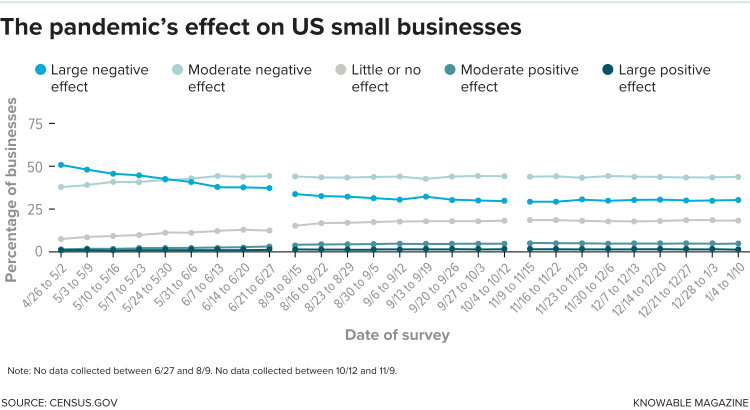
The following table illustrates the dramatic shift in operating realities for independent American businesses between the height of the pandemic and the current economic landscape.
| Economic Metric | The Covid-19 Era (2020–2021) | The Current Reality (2024) | Operational Impact on Main Street |
|---|---|---|---|
| Federal Financial Aid | Abundant (PPP, EIDL, Employee Retention Tax Credits) | None (Programs expired; tax audits increasing) | No cash buffer; immediate insolvency risk during revenue dips. |
| Average Cost of Credit | 3.25% – 5.0% (Prime Rate at historic lows) | 8.5% – 11.5%+ (Prime Rate at multi-decade highs) | Servicing existing debt eats up remaining profit margins. |
| Cumulative Cost of Goods | Highly volatile but subsidized by supply chains | Permanently elevated (up 20-30% from baseline) | Firms must choose between losing customers or eating losses. |
| Consumer Behavior | High liquidity, strong demand for local delivery/services | "Trading down" to discount giants; value-seeking behavior | Market share shifting rapidly away from independent retailers. |
The "Costco Effect" and the Squeeze on Consumer Discretionary Spend
As household budgets feel the pinch of persistent inflation and rising mortgage rates, consumer behavior has shifted dramatically. This trend works heavily in favor of massive, scaled enterprises like Costco and Walmart, while devastating local, independent businesses.
When gas prices rise and grocery bills escalate, middle-class consumers consolidate their shopping trips. They gravitate toward wholesale clubs where they can buy in bulk to save pennies per unit. Costco's consistently strong earnings reports during economic downturns prove that inflation acts as a customer acquisition tool for big-box retailers, even as it starves local specialty stores, independent grocers, and boutique retailers of vital foot traffic.
“I used to see my regular customers twice a week,” says Elena Rodriguez, owner of a boutique artisanal grocery store in Miami. “Now, I see them once a month. They tell me flat out: they love my store, but they have to do their primary shopping at bulk warehouses now just to keep their family food budget under control. I can't compete with bulk purchasing power. My margins are already down to zero.”
The Road Ahead: Is There a Way Out?
For many business owners, the current environment feels like a slow war of attrition. Unlike the sudden shock of Covid, which had a clear ending marked by vaccine rollouts and economic reopenings, the path out of today's stagflationary environment is murky.
Economists warn that unless the Federal Reserve aggressively cuts interest rates—which remains unlikely as long as core inflation remains stubborn—the cost of capital will continue to choke out small enterprises. Furthermore, as consumer credit card debt hits record highs, discretionary spending is projected to cool even further in the coming quarters.
The survival of America's small business sector will likely require radical operational pivots: aggressive menu and inventory trimming, joint purchasing cooperatives to battle big-box pricing, and a shift toward high-margin, hyper-local service models that cannot be replicated by online giants or corporate warehouses. Without these shifts, the quiet crisis on Main Street threatens to permanently reshape the landscape of the American economy.
Frequently Asked Questions (FAQ)
Why do business owners say this crisis is worse than the Covid-19 pandemic?
During the pandemic, business owners received substantial government aid (such as PPP loans and rent relief) and consumers had excess savings to spend. Today, small businesses have no government safety net, are carrying heavy debt loads from the pandemic, face much higher interest rates, and must cope with permanent inflationary price increases that have destroyed their profit margins.
How does consumer behavior during inflation hurt independent businesses?
As inflation reduces purchasing power, consumers engage in "value-seeking" behavior. They trade down from local, independent retailers to multinational big-box chains like Costco and Walmart, which have the scale to absorb price increases and offer bulk discounts. This leaves local businesses with declining foot traffic and shrinking revenues.