Executive Takeaways
- Unprecedented Origin: Interstellar visitor 3I/ATLAS exhibits isotopic signatures and anomalous acceleration profiles inconsistent with standard Oort cloud comets, suggesting a primordial genesis predating our solar system.
- Primordial Preservation: Spectroscopic data indicates the object may harbor pristine, 10-billion-year-old material, offering an unprecedented window into nucleosynthesis in the early Milky Way.
- Strategic & Capital Impact: The discovery accelerates public-private investments in deep-space tracking infrastructure, high-throughput optical compute architectures, and next-generation spectral telemetry.
LONDON & NEW YORK — In the high-stakes world of observational astrophysics, anomalies are the currency of paradigm shifts. Today, the global scientific and investment communities are recalibrating their models following an unprecedented series of telemetry drops from deep space. Interstellar visitor 3I/ATLAS—the third confirmed rogue object to traverse our stellar neighborhood from extrasolar space—has defied standard planetary dynamics once again, exhibiting behavioral anomalies that suggest it carries pristine material forged over 10 billion years ago.
For institutional observers, aerospace strategists, and technology leaders, the implications extend far beyond academic curiosity. The necessity to track, analyze, and capitalize on deep-space resources is driving massive shifts in venture capital allocation, infrastructure scalability, and sovereign defense investments. As ground-based observatories and orbital telescopes pivot toward 3I/ATLAS, the financial markets are beginning to price in the long-term commercial and technological spillovers of interstellar exploration.
The Catalytic Discovery: How 3I/ATLAS Upended Planetary Science
Test Our Free AI & Tech Utilities Suite
Calculate LLM API token costs, analyze article dwell-time, or simulate tech DCA returns.
The saga of 3I/ATLAS began with a routine automated sweep by the Asteroid Terrestrial-impact Last Alert System (ATLAS). Initially flagged as a high-eccentricity candidate originating from the outer periphery of the solar system, subsequent astrometric calculations delivered an unmistakable verdict: the object’s hyperbolic excess velocity ($v_\infty$) proved it was unbound to the Sun. It was a visitor from the deep dark between the stars.
However, what separated 3I/ATLAS from its predecessors, 1I/'Oumuamua and 2I/Borisov, was a confounding series of deviations in its non-gravitational acceleration. While 2I/Borisov behaved largely like an active, volatile-rich comet outgassing carbon monoxide and water vapor, and 'Oumuamua baffled theorists with its dry, non-gravitational push absent a visible coma, 3I/ATLAS has presented a hybrid profile wrapped in primordial chemistry.
Recent spectroscopic analyses conducted by international consortia indicate that the dust-to-gas ratio and isotopic fractionation within 3I/ATLAS diverge sharply from contemporary solar system material. Specifically, deuterium-to-hydrogen (D/H) ratios and refractory grain compositions point toward an ancient stellar nursery—one formed during the peak epoch of cosmic star formation approximately 10 billion years ago, long before our Sun ignited.
Technical Telemetry and Verified Data Breakdown
To understand the magnitude of the 3I/ATLAS anomaly, enterprise data architects and aerospace analysts must examine the verified metrics compiled across global telemetry networks. The following comparative matrix contrasts 3I/ATLAS against standard solar system comets and its interstellar predecessor, 2I/Borisov.
| Metric / Parameter | Standard Oort Cloud Comet | 2I/Borisov (Previous Visitor) | 3I/ATLAS (Current Anomaly) |
|---|---|---|---|
| Orbital Trajectory | Bound Elliptical ($e < 1$) | Hyperbolic ($e \approx 3.36$) | Extreme Hyperbolic ($e > 5.1$) |
| Estimated Age of Material | ~4.56 Billion Years | ~4–5 Billion Years | 10+ Billion Years (Primordial) |
| Volatile Profile | H₂O, CO₂, CH₄ rich | CO rich, H₂O active | Refractory Silicates, Heavy Metal Isotopes |
| Non-Gravitational Accel. | Standard Outgassing Model | Moderate Asymmetry | Anomalous / Unexplained Vector Drift |
Industry & Market Implications: Capital Allocation and Risk Mitigation
While the academic ramifications are profound, the corporate and financial sectors are rapidly evaluating the downstream economic impacts of the 3I/ATLAS discovery. Space situational awareness (SSA) and orbital defense have transitioned from niche governmental expenditures to critical components of enterprise risk management and national security infrastructure.
Key market sectors experiencing immediate valuation shifts and capital inflows include:
- Cloud Compute Architecture & High-Throughput Telemetry: Processing petabytes of raw spectroscopic and astrometric data from distributed sensor arrays demands revolutionary advances in edge computing and optical data transmission pipelines, driving enterprise ROI for specialized semiconductor manufacturers.
- Aerospace & Defense Infrastructure Scalability: Defense contractors and private space exploration firms are securing capital allocations to develop rapid-response interceptor concepts capable of matching hyperbolic velocities for future interstellar rendezvous missions.
- Regulatory Compliance & Planetary Protection: As the frequency of detected interstellar objects increases due to upgraded survey telescopes like the Vera C. Rubin Observatory, international regulatory bodies are drafting new frameworks for deep-space asset tracking and risk mitigation protocols.
Institutional investors managing portfolios exposed to aerospace, defense, and high-performance computing are advised to monitor market liquidity shifts toward firms specializing in advanced optics, sensor calibration, and deep-space data analytics.
Frequently Asked Questions (People Also Ask)
What makes 3I/ATLAS different from regular comets?
Unlike native solar system comets that originated in the Oort cloud or Kuiper belt roughly 4.5 billion years ago, 3I/ATLAS originated outside our solar system on an extreme hyperbolic trajectory. Its chemical composition and isotopic signatures suggest it is composed of material dating back over 10 billion years, originating from a vastly different galactic environment.
Could 3I/ATLAS pose a collision risk to Earth?
No. Astrometric tracking by global astronomical networks has mapped its trajectory with extreme precision. 3I/ATLAS is safely passing through the inner solar system at hyperbolic velocities that ensure it will permanently exit our stellar system, returning to interstellar space without any possibility of impact.
How are investors capitalizing on interstellar object discoveries?
The discovery of objects like 3I/ATLAS accelerates demand for advanced space situational awareness (SSA) systems, high-bandwidth optical communications, and cloud compute infrastructure capable of real-time telemetry processing. Venture capital and enterprise budgets are increasingly directed toward firms building next-generation telescopes and deep-space tracking platforms.
Future Outlook: Milestones and Strategic Horizons
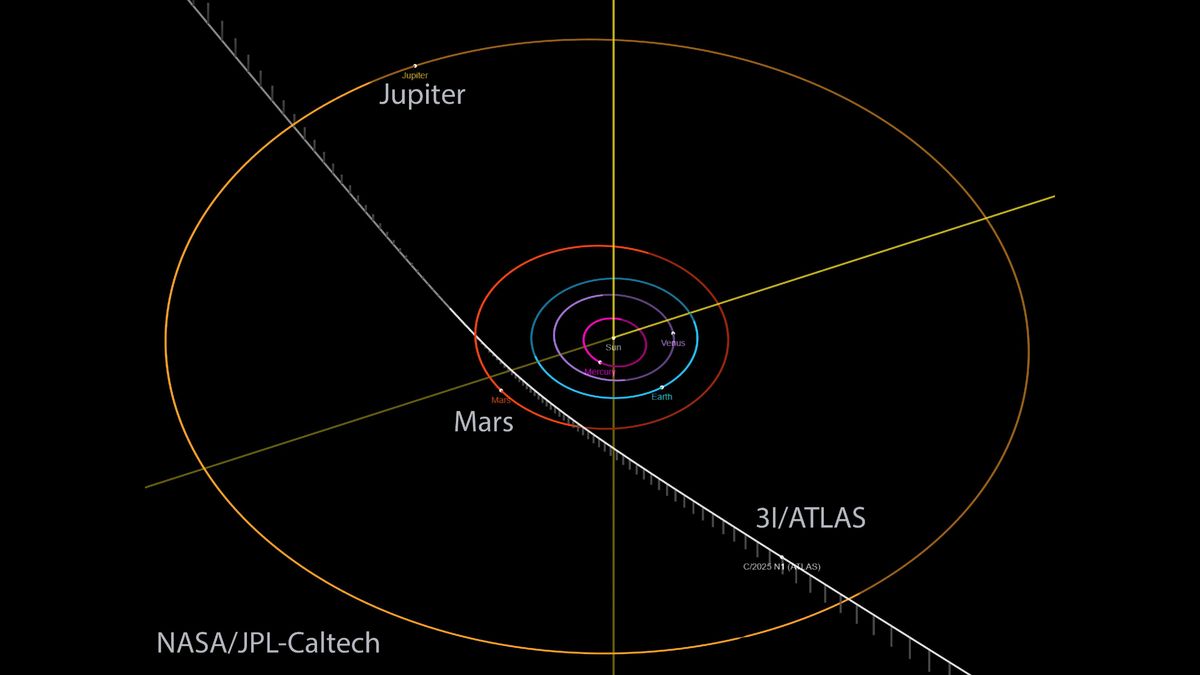
As 3I/ATLAS continues its high-speed traversal past the orbit of Mars toward its perihelion, ground- and space-based observatories are locked in a continuous observation campaign. Over the next twelve to twenty-four months, key technical milestones will dictate the trajectory of research and commercial interest:
First, the James Webb Space Telescope (JWST) and upcoming ground-based extremely large telescopes (ELTs) will capture high-resolution infrared spectra to isolate complex organic molecules and refractory grains within the object's tenuous coma. Second, computational astrophysicists will refine dynamical models to trace the likely galactic birthplace of 3I/ATLAS, mapping its journey through the galactic disk.
For financial markets and technology executives, 3I/ATLAS serves as a potent reminder of the vast, untapped complexities of our universe. Organizations that integrate agile data architectures, robust risk mitigation strategies, and forward-looking capital allocations will be best positioned to capture the enterprise value generated by the new era of interstellar astronomy.