Executive Takeaways
- Historic Precedent: Japan Aerospace Exploration Agency (JAXA) is preparing a world-first robotic sample-return mission targeting Phobos, the larger of Mars’ two moons.
- Capital Allocation & Industrial Impact: The mission highlights significant aerospace infrastructure scalability, driving multi-billion-dollar supply chain contracts across precision manufacturing and deep-space telemetry.
- Scientific Stakes: By capturing pristine regolith from Phobos, researchers aim to resolve long-standing debates regarding whether Martian moons are captured asteroids or remnants of a giant planetary impact.
- Geopolitical & Commercial Convergence: As global space agencies pivot toward resource utilization and planetary defense, JAXA’s capital deployment sets a new benchmark for risk mitigation and interplanetary exploration efficiency.
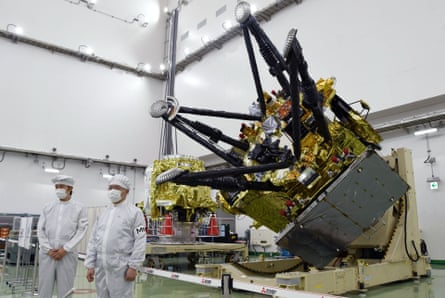
TOKYO — In the high-stakes theater of deep-space exploration, national prestige is increasingly tied to balance-sheet precision and technological resilience. While private-sector billionaires trade barbs over low-Earth orbit tourism and lunar landing flags, the Japan Aerospace Exploration Agency (JAXA) is quietly executing a more audacious maneuver. Scheduled for launch, the Martian Moons Exploration (MMX) mission represents the world’s first attempt to land on a moon of Mars, scoop up underground regolith, and successfully return those pristine samples to Earth.
For institutional investors, aerospace engineers, and geopolitical strategists, MMX is far more than an academic exercise. It is a masterclass in long-term capital allocation, technological risk mitigation, and infrastructure scalability. With a total projected budget running into the hundreds of billions of yen, the mission tests the limits of autonomous navigation, deep-space communication latency, and international aerospace supply chain integration. As global powers vie for dominance in the emerging space economy, the success of JAXA’s gamble will ripple far beyond astrophysics, influencing valuation multiples across the defense, aerospace, and advanced manufacturing sectors.
The Genesis of MMX: Unlocking the Martian Chronology
To understand the gravity of the MMX mission, one must look at the profound data gaps plaguing modern planetary science. Mars remains an enigma—a cold, desiccated world that once harbored liquid water and potentially conditions suitable for microbial life. Yet, understanding how Mars evolved requires context from its immediate cosmic neighborhood.
Phobos and Deimos, the twin moons of Mars, have baffled astronomers for decades. Are they primordial carbonaceous asteroids captured by Mars’ gravitational pull during the tumultuous early solar system, or are they chunks of planetary crust blasted into orbit by a colossal impact event, much like Earth’s own moon?
Answering this question is not merely an academic pursuit. Decoding the composition of Phobos provides a chronological baseline for the entire inner solar system. JAXA’s previous triumph, the Hayabusa2 mission, successfully returned subsurface samples from the asteroid Ryugu, proving that Japan’s engineering apparatus can execute complex round-trip maneuvers millions of kilometers from Earth. MMX scales this capability exponentially. The round-trip distance, communication delays exceeding 20 minutes one-way, and the complex gravitational dynamics of operating near a Martian body demand an entirely new class of autonomous cloud compute architecture onboard the spacecraft.
Engineering Under Extreme Constraints: The Technical Breakdown

Executing a mission of this magnitude requires absolute precision. Unlike lunar missions where abort options are measured in hours, a Mars-system trajectory operates on strict celestial mechanics. Miss the launch window, and the capital expenditure sits idle for years while orbital alignments reset.
JAXA has partnered with domestic heavyweights including Mitsubishi Heavy Industries (MHI), leveraging the H3 launch vehicle architecture to ensure reliable lift capacity. Furthermore, international collaboration is central to the mission’s risk-mitigation strategy. NASA and the Centre National d'Études Spatiales (CNES) of France are contributing critical scientific payloads, including sophisticated infrared spectrometers and pneumatic sampling mechanisms designed to extract material from both the surface and depths of up to two centimeters.
| Project Parameter | MMX Specifications | Strategic / Industrial Impact |
|---|---|---|
| Primary Target | Phobos (Larger Martian Moon) | Determines origin of Martian moons; assesses volatile organic compounds. |
| Launch Vehicle | H3 Launch Vehicle (MHI) | Validates Japan’s heavy-lift commercial viability and cost-per-kilogram metrics. |
| Sample Acquisition | Core drill & pneumatic sampler | Advances automated robotics for extraterrestrial resource harvesting (ISRU). |
| Return Timeline | Approx. 5-year round trip | Tests long-duration deep-space component durability and radiation hardening. |
Industry & Market Implications: Who Wins, Who Loses
While the headlines celebrate the scientific romance of exploring Mars, the underlying narrative is economic. The global space economy is transitioning from a government-funded science club into a multi-trillion-dollar commercial ecosystem. Missions like MMX serve as the R&D incubator for technologies that will eventually underpin commercial asteroid mining, orbital logistics, and deep-space habitation.
The Winners: Precision component manufacturers, advanced materials companies, and specialized robotics firms sitting within JAXA’s supply chain. Companies that can deliver radiation-hardened semiconductors, lightweight carbon-composite structural elements, and high-efficiency ion propulsion systems are seeing robust order books. Furthermore, defense contractors pivoting dual-use technologies into aerospace applications are experiencing expanded valuation multiples.
The Challengers: Legacy aerospace firms slow to adopt agile, software-defined spacecraft architecture risk falling behind. As autonomous operations replace manual ground control, the barrier to entry shifts from raw manufacturing capacity to software sophistication and artificial intelligence integration.
Frequently Asked Questions (People Also Ask)
What makes landing on Phobos more difficult than landing on the Moon?
Answer: Phobos has an extremely weak gravitational field (roughly 1/1,000th of Earth’s). Traditional landing techniques relying on heavy thrusters or gravitational pull are ineffective because a spacecraft could easily bounce off the surface and drift back into space. MMX must utilize specialized anchoring and hovering sampling mechanisms to successfully collect regolith without gravity to anchor it.
How long will the entire MMX mission take from launch to sample return?
Answer: The total mission lifecycle is engineered for approximately five years. This includes the transit phase to the Martian system, an extended orbital science campaign observing both Phobos and Deimos, the landing and sample extraction phase, and the return trajectory back to Earth's atmosphere for a high-velocity capsule drop.
What are the commercial applications of technologies developed for JAXA’s MMX?
Answer: Technologies honed during MMX—such as autonomous hazard detection, deep-space optical communication, and low-gravity surface anchoring—are directly transferable to commercial In-Situ Resource Utilization (ISRU), satellite servicing in geostationary orbit, and future crewed missions to Mars.
Future Outlook: Milestones to Watch
As the countdown to launch continues, institutional investors and aerospace analysts are closely monitoring key operational milestones. The primary hurdles will involve successful separation maneuvers, deep-space trajectory corrections, and the intricate orbital insertion phase around Mars—a notoriously unforgiving gravitational environment often referred to in the industry as the "Mars Curse."
If JAXA successfully executes this mission, Japan will solidify its position not merely as a regional technological power, but as an indispensable architect of humanity's deep-space infrastructure. For the global market, MMX serves as a timely reminder that while speculative ventures capture public attention, methodical, engineering-first capital allocation ultimately delivers the breakthroughs that rewrite the boundaries of human capability.