DeepSeek’s $38/GPU/Hour Reveal Shatters Silicon Economics: Inside the Open-Source DeepInfer Earthquake

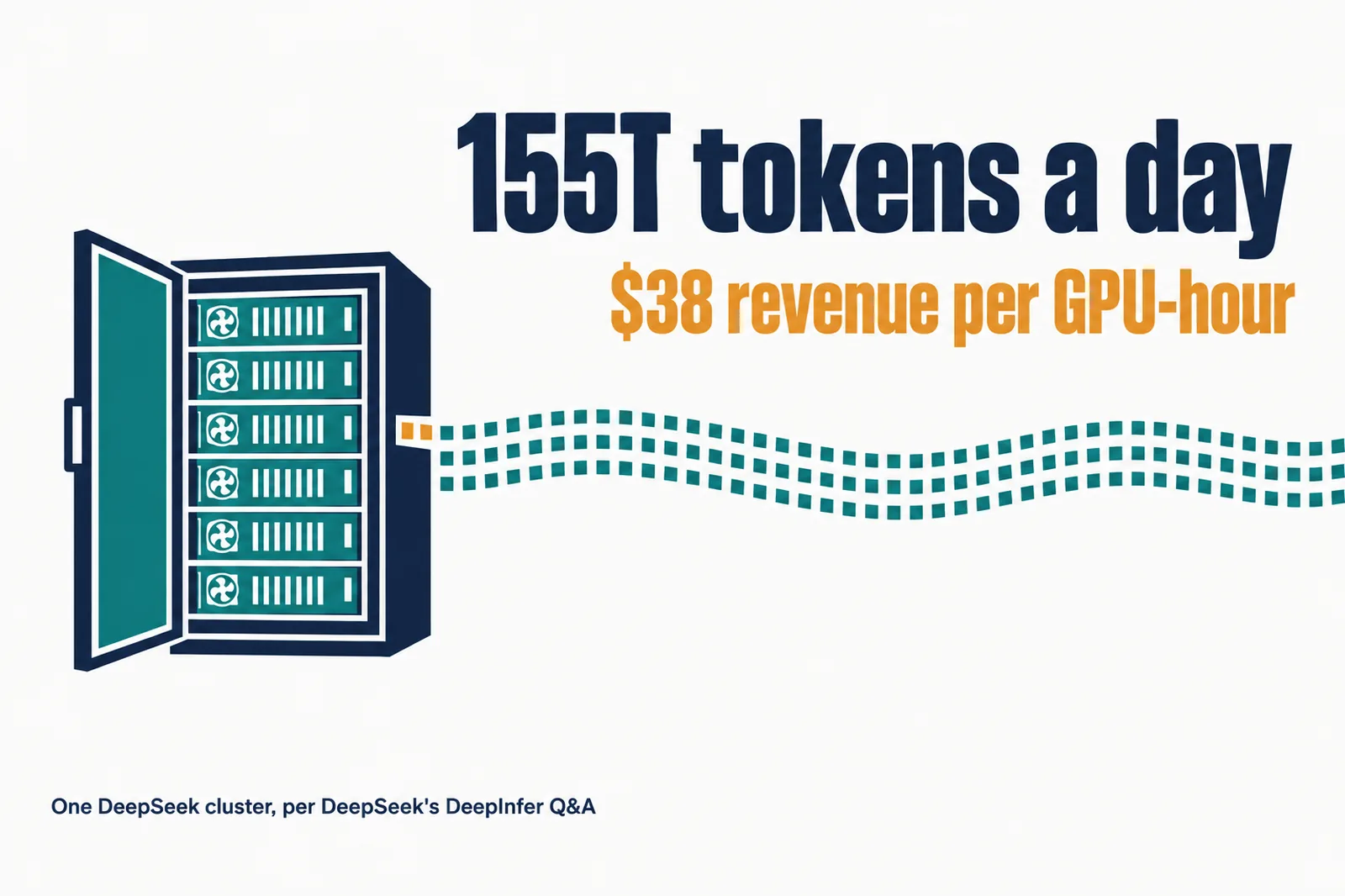
The global artificial intelligence infrastructure market is undergoing a seismic valuation reset following a landmark disclosure from elite Chinese AI laboratory DeepSeek. Sourced initially via BigGo Finance, DeepSeek has officially open-sourced its proprietary DeepInfer inference framework under the permissive Apache 2.0 license. Simultaneously, the company lifted the veil on its unit-economic metrics, disclosing a striking revenue generation rate of approximately $38 per GPU per hour. For Wall Street analysts, venture capitalists, and cloud compute architects, this revelation fundamentally alters the calculus of enterprise ROI, hardware amortization, and capital allocation across the generative AI ecosystem.
For over two years, hyperscale cloud providers and enterprise software giants have justified staggering capital expenditures—pouring hundreds of billions of dollars into NVIDIA H100 and upcoming B200 clusters—by relying on opaque utilization assumptions and high-margin API pricing models. DeepSeek’s transparency pierces this veil of complexity, offering a masterclass in infrastructure scalability and extreme cost efficiency. By pairing an open-source inference engine optimized for extreme throughput with transparent monetization metrics, DeepSeek is directly challenging Western hegemony in high-performance computing (HPC) and forcing a rapid re-evaluation of valuation multiples for both chipmakers and cloud service providers.
Executive Takeaways
- Disruptive Open-Sourcing: DeepSeek has released its internal DeepInfer inference framework under the Apache 2.0 license, providing developers global access to high-performance, production-grade model serving infrastructure.
- Stunning Unit Economics: The company disclosed an operational revenue benchmark of approximately $38 per GPU per hour, proving that high-density inference can yield extraordinary economic throughput.
- Ecosystem Pressures: The disclosure triggers intense risk mitigation strategies for Western hyperscalers, threatening proprietary software moats and compressing margins across traditional cloud compute architecture.
- Market Re-Rating: Investors must now weigh the deflationary impact of hyper-efficient inference frameworks against traditional software-as-a-service (SaaS) growth models and hardware demand forecasts.
The Catalytic Disclosure: Decoding DeepInfer and the $38 Metric
The release of DeepInfer on October 20 marks a watershed moment for the open-source AI community. Historically, tier-1 AI laboratories maintained strict proprietary control over their inference stacks—the specialized software layers that sit between raw GPUs and user-facing applications, managing memory allocation, request batching, token generation speed, and KV-cache optimization. By open-sourcing DeepInfer under the Apache 2.0 license, DeepSeek is inviting enterprise adoption without restrictive licensing fees, drastically lowering the barrier to entry for deploying massive Mixture-of-Experts (MoE) models.
However, the real shockwave rippling through financial markets is the accompanying financial disclosure: an estimated $38 in revenue per GPU per hour. In the context of modern data center economics, this figure is exceptionally high. Standard commercial cloud instances featuring high-end AI accelerators typically rent for $2 to $8 per hour depending on scale, spot availability, and reservation length. By extracting $38 per GPU hour through optimized software-hardware co-design and high-concurrency request handling, DeepSeek demonstrates a monetization efficiency that far outpaces legacy Infrastructure-as-a-Service (IaaS) providers.
This economic efficiency stems from DeepSeek’s rigorous optimization of memory bandwidth and computational utilization. In traditional LLM serving, GPU memory capacity and interconnect latency are the primary bottlenecks. DeepInfer bypasses these hurdles through advanced scheduling algorithms that maximize arithmetic intensity, ensuring that compute units remain saturated even under fluctuating enterprise workloads. For corporate treasuries and Chief Information Officers, this proves that AI infrastructure, when architected correctly, can transition from a massive capital sinkhole into a high-yield operating asset.
Verified Data & Metrics Breakdown
| Metric / Specification | DeepSeek DeepInfer Benchmark | Industry Standard Baseline | Strategic Implication |
|---|---|---|---|
| Licensing Framework | Apache 2.0 (Fully Open Source) | Proprietary / Restricted Commercial | Accelerates enterprise adoption and removes compliance friction. |
| Revenue Generation Rate | ~ $38 per GPU per hour | $2 – $8 per GPU per hour (Cloud Rental) | Demonstrates superior monetization via software-driven efficiency. |
| Primary Target Architecture | High-Throughput MoE & Dense LLMs | General-Purpose Tensor Processing | Maximizes hardware throughput and reduces cost-per-token. |
| Regulatory & Compliance Posture | Global Open Distribution | Geographically Restricted Export Controls | Challenges Western data center moats through borderless software leverage. |
Industry & Market Implications: Winners, Losers, and Economic Realities
The fallout from DeepSeek’s announcement reverberates across multiple asset classes, forcing institutional investors and corporate strategists to reassess market liquidity, competitive positioning, and long-term risk mitigation.
The Winners: Open-Source Advocates and Cost-Conscious Enterprises
Enterprise buyers emerge as immediate beneficiaries. Companies previously priced out of deploying custom, high-end large language models can now leverage DeepInfer to build sovereign AI capabilities at a fraction of previous capital outlays. Furthermore, hardware-agnostic optimization firms and independent cloud providers who integrate DeepInfer will see margin expansion, as they can offer high-performance inference services without paying exorbitant licensing rents to proprietary platform vendors.
The Losers: High-Margin Proprietary Cloud Providers and Vertical Moats
Conversely, hyperscalers and enterprise software vendors relying on closed-source, high-fee API models face immediate pricing pressure. If DeepSeek’s operational framework proves that top-tier inference can be delivered at scale with extraordinary economic return, corporate clients will aggressively demand price parity. This compression threatens the astronomical software margins that Wall Street has baked into current valuation multiples for major cloud giants.
Capital Allocation and Infrastructure Scalability
For semiconductor manufacturers like NVIDIA, AMD, and custom ASIC designers, the narrative is nuanced. On one hand, extreme inference efficiency reduces the *raw number* of chips required to serve a given volume of user queries—a deflationary signal for hardware demand. On the other hand, by making AI deployment economically viable for thousands of mid-market enterprises that were previously priced out, the total addressable market (TAM) for compute expands exponentially. Capital allocation strategies must now pivot away from brute-force cluster expansion toward intelligent, software-optimized infrastructure scaling.
Frequently Asked Questions (People Also Ask)
What is DeepSeek’s DeepInfer framework?
DeepInfer is an advanced, high-performance inference framework developed internally by DeepSeek to optimize the serving of large language models. Recently open-sourced under the Apache 2.0 license, it provides developers and enterprises with production-grade tools to maximize GPU throughput, reduce latency, and lower the overall cost per generated token.
How does DeepSeek achieve $38 in revenue per GPU per hour?
This figure reflects exceptional operational efficiency achieved through software-hardware co-design, advanced request batching, and intelligent memory management. Rather than merely renting raw compute capacity, DeepSeek’s framework maximizes the computational utility of every hardware cycle, capturing high-value transactional revenue through optimized model serving.
What does the Apache 2.0 license mean for enterprise adoption?
The Apache 2.0 license is a permissive open-source license that grants users broad rights to use, modify, distribute, and commercialize the software without incurring licensing fees or risking proprietary entanglements. This removes significant legal and compliance friction for enterprises looking to deploy DeepInfer within private cloud environments.
How does this disclosure impact the broader AI hardware market?
By demonstrating that sophisticated software optimization can dramatically increase the economic output of existing GPUs, DeepSeek’s disclosure introduces deflationary pressure on basic cloud compute pricing while simultaneously expanding the accessible market for enterprise AI deployment. It forces hardware buyers and cloud architects to prioritize software efficiency alongside raw silicon performance.
Future Outlook: What Comes Next
As the initial shockwaves of DeepSeek’s disclosures settle, industry observers are closely monitoring several critical milestones over the next 12 to 18 months:
- Enterprise Benchmarking and Adoption Rates: Watch for independent third-party benchmarks validating DeepInfer’s throughput claims in multi-tenant, western cloud environments.
- Competitive Responses from Hyperscalers: Anticipate defensive maneuvers from major U.S. cloud providers, potentially including counter-open-sourcing initiatives or aggressive price cuts on managed inference tiers.
- Regulatory Scrutiny: Monitor policy responses from Washington and Brussels regarding the proliferation of high-efficiency, open-source AI frameworks originating from Chinese laboratories, particularly concerning cybersecurity and data sovereignty.
Ultimately, DeepSeek’s open-sourcing of DeepInfer and its transparent disclosure of $38/GPU/hour unit economics signal the maturation of the artificial intelligence industry. The era of unchecked, capital-intensive infrastructure spending without rigorous unit-economic justification is drawing to a close. In its place rises a hyper-competitive, efficiency-driven market where software mastery—not just raw compute scale—determines the ultimate winners of the AI revolution.