Executive Takeaways
- Infrastructure Disruption: DeepSeek has officially open-sourced its proprietary DeepInfer inference framework under the permissive Apache 2.0 license, directly challenging Western cloud computing monopolies.
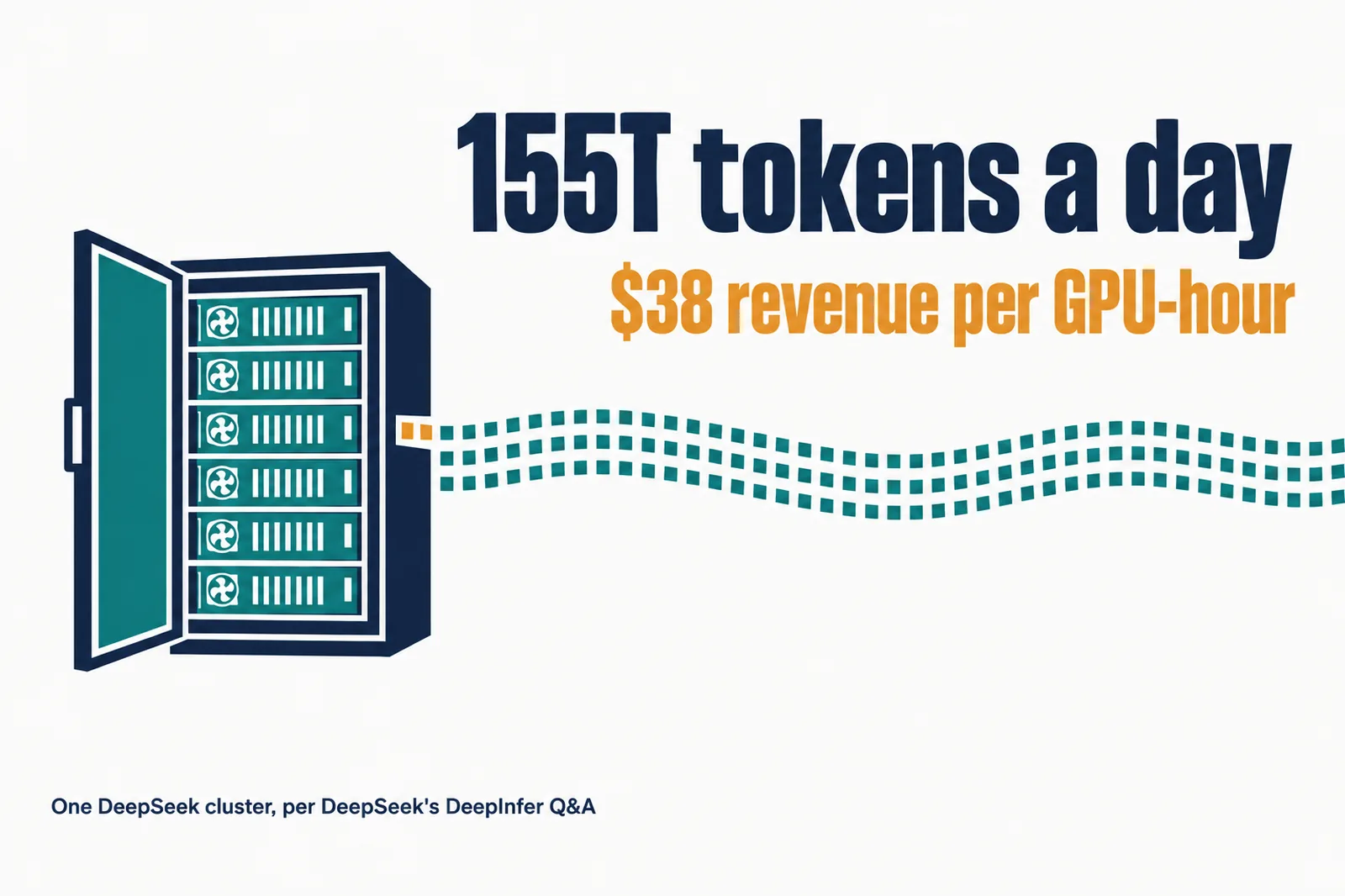
- The Economics Exposed: Disclosed unit-level metrics reveal an eye-opening revenue generation of approximately $38 per GPU per hour, fundamentally reshaping enterprise ROI models for AI infrastructure scalability.
- Capital Allocation Paradigm Shift: Wall Street and Silicon Valley must rapidly recalibrate venture capital deployment, enterprise infrastructure budgets, and valuation multiples in light of compressed inference costs.
- Geopolitical & Regulatory Pressures: The release accelerates the decoupling of global AI supply chains, forcing regulatory compliance frameworks to adapt to open-source algorithmic parity.
NEW YORK, LONDON, HONG KONG — In a development that has sent immediate shockwaves through global trading desks and enterprise boardroom tables, Chinese artificial intelligence pioneer DeepSeek has fundamentally altered the economics of generative AI. On October 20, the Hangzhou-based laboratory fully open-sourced its internal inference powerhouse, DeepInfer, under the highly permissive Apache 2.0 license. Simultaneously, the company disclosed granular unit-economics data revealing an unprecedented revenue generation rate of approximately $38 per GPU per hour.
For months, institutional investors, hedge funds, and cloud compute architecture teams have grappled with a singular, existential question: How sustainable are the staggering capital expenditure cycles championed by hyper-scalers like Microsoft, Google, Amazon, and Meta? DeepSeek’s latest transparency offensive not only provides a definitive answer but introduces a terrifying variable for Western infrastructure monopolists. By laying bare both its advanced execution framework and its underlying revenue-per-watt efficiency, DeepSeek has shifted the competitive battleground from raw compute accumulation to hyper-optimized algorithmic execution.
The Catalytic Unveiling: Decoding DeepInfer
To understand the magnitude of DeepSeek’s October 20 announcement, one must examine the operational bottlenecks that have plagued enterprise AI deployments since the launch of ChatGPT. As large language models (LLMs) scaled into hundreds of billions of parameters, the cost of token generation—known across the industry as inference—remained stubbornly high. Traditional inference frameworks often suffered from memory bandwidth starvation, sub-optimal KV-cache management, and poor hardware utilization across heterogeneous clusters.
Enter DeepInfer. Developed internally to power DeepSeek’s rapidly expanding suite of reasoning models, DeepInfer is a bespoke inference engine engineered from the silicon up to maximize throughput and minimize latency. By open-sourcing the framework under the Apache 2.0 license, DeepSeek is effectively handing enterprise developers a ready-to-deploy weapon for cost mitigation. The framework optimizes kernel execution, refines memory paging, and extracts maximum performance out of both domestic and restricted-access GPU architectures.
Industry analysts tracking cloud compute architecture note that DeepInfer’s arrival breaks the proprietary lock-in maintained by dominant cloud providers. Enterprises no longer need to rely on high-margin managed inference endpoints that extract exorbitant toll fees per million tokens. Instead, CTOs can deploy DeepInfer on bare-metal clusters, dramatically slashing operational expenditures and redefining their annual cloud compute budgets.
The $38-Per-GPU-Hour Revelation: A Masterclass in Unit Economics

Perhaps even more disruptive than the code itself is the financial disclosure accompanying the release. DeepSeek’s operational data indicates a revenue yield of approximately $38 per GPU per hour. In the rigid calculus of enterprise finance, this metric serves as a high-water mark for capital efficiency, leaving traditional Western SaaS and infrastructure providers scrambling to audit their own margins.
To contextualize this figure, consider the prevailing market rates for high-end AI accelerators, such as NVIDIA’s H100 and H200 clusters, rented via secondary cloud brokers or major hyper-scalers. While cloud providers often bill enterprise customers steep hourly rates for raw hardware access, DeepSeek’s integrated software-hardware stack demonstrates how intelligent batching, speculative decoding, and optimized scheduling can monetize underlying compute at staggering efficiency ratios.
This revelation triggers an immediate re-evaluation of valuation multiples across the AI ecosystem. Venture capitalists and private equity firms deploying capital into infrastructure startups must now factor in the deflationary impact of DeepSeek's innovations. If algorithmic ingenuity can extract $38/hour in value from standard hardware configurations, the market valuation of firms banking solely on raw compute scarcity faces severe downward pressure.
| Metric / Parameter | Traditional Western Cloud Inference | DeepSeek DeepInfer Benchmark | Strategic Enterprise Impact |
|---|---|---|---|
| Licensing Framework | Proprietary / Closed API | Open-Source (Apache 2.0) | Eliminates vendor lock-in; enables custom on-premise builds. |
| Revenue Efficiency | Variable / High Margin Extraction | ~ $38 per GPU / Hour | Forces margin compression across commercial API providers. |
| Hardware Dependency | Heavy reliance on unconstrained leading-edge silicon | Highly optimized for constrained hardware environments | Mitigates supply chain risks and export control bottlenecks. |
| Deployment Flexibility | SaaS-locked | Bare-metal, Hybrid, and Multi-Cloud | Enhances regulatory compliance and data sovereignty for enterprises. |
Industry & Market Implications: Winners, Losers, and Systemic Risk
The ripple effects of DeepInfer’s open-sourcing and the associated financial disclosures extend far beyond technical circles. Financial markets are already pricing in the consequences across several distinct sectors:
- The Winners — Global Enterprise Adopters: Corporations burdened by high AI operating costs are the immediate beneficiaries. Financial institutions, healthcare conglomerates, and retail giants can now integrate high-performance reasoning models into their proprietary stacks without incurring prohibitive API tolls. Risk mitigation strategies improve as companies retain absolute ownership over their data pipelines.
- The Losers — High-Margin Cloud API Providers: Proprietary model vendors and secondary cloud re-sellers face a brutal margin squeeze. When open-source frameworks like DeepInfer match or exceed proprietary execution speeds while dropping cost barriers, the justification for premium software markup evaporates.
- Semiconductor Capital Allocation: While hardware demand remains robust, chipmakers can no longer rely on brute-force scaling narratives. Investors are pivoting toward semiconductor firms that prioritize energy efficiency, memory bandwidth, and software-hardware co-design over raw transistor count.
Furthermore, regulatory compliance landscapes are shifting. With DeepInfer freely available, sovereign states and heavily regulated industries (such as European banking and defense contractors) can deploy state-of-the-art inference engines locally, bypassing extraterritorial data transfer concerns and satisfying stringent compliance mandates.
Frequently Asked Questions (People Also Ask)
What is DeepSeek’s DeepInfer framework, and why is its open-source release significant?
DeepInfer is an internal, highly optimized inference framework developed by DeepSeek to run advanced generative AI models with maximum computational efficiency. Its open-source release under the Apache 2.0 license is significant because it strips away proprietary licensing barriers, allowing global enterprises and developers to deploy production-grade inference engines on their own infrastructure without paying steep commercial API fees.
How does the disclosed $38-per-GPU-hour revenue metric impact enterprise ROI?
The $38/GPU/hour metric demonstrates an exceptionally high level of monetization efficiency relative to hardware operating costs. For enterprise buyers, this signals that modern AI architectures can achieve rapid payback periods, transforming generative AI from a high-burn research experiment into a high-margin, cash-generative operational asset.
Does DeepInfer require specialized hardware, or can it run on standard enterprise infrastructure?
DeepInfer is engineered for high performance across diverse hardware configurations. While it extracts maximum throughput from modern data-center accelerators, its algorithmic optimizations are specifically designed to maximize efficiency, making it highly adaptable for constrained environments and hybrid-cloud architectures.
What are the broader geopolitical and market consequences of this disclosure?
By democratizing high-efficiency inference technology, DeepSeek accelerates the commoditization of foundational AI plumbing. This puts downward pressure on Western cloud margins, challenges traditional capital expenditure models built on hardware scarcity, and empowers international enterprises to bypass restrictive trade-driven supply bottlenecks.
Future Outlook: Strategic Milestones to Watch
As the dust settles on this watershed announcement, executive leadership teams and investment committees must monitor several critical milestones over the next 12 to 18 months:
- Enterprise Adoption Velocity: Track the rate at which Fortune 500 and FTSE 100 corporations migrate their workloads from proprietary cloud APIs to self-hosted DeepInfer clusters.
- Competitor Response: Observe how Western hyper-scalers (Microsoft, AWS, Google) adjust their pricing tiers and licensing terms to counter the open-source cost deflation initiated by DeepSeek.
- Ecosystem Maturation: Monitor the emergence of third-party developer tooling, monitoring suites, and security wrappers built natively around the DeepInfer framework.
Regulatory Interventions: Keep a close watch on potential trade policy adjustments or compliance reviews regarding the adoption of Chinese-origin open-source infrastructure in Western critical infrastructure sectors.
Ultimately, DeepSeek’s open-sourcing of DeepInfer and the transparent disclosure of its $38/GPU/hour revenue benchmark mark the definitive end of AI’s early, unconstrained gold rush. The industry has entered a mature, highly competitive era where algorithmic efficiency and rigorous capital allocation dictate ultimate market survival.