SAN FRANCISCO & BEIJING — A seismic shift has rippled through the artificial intelligence sector, overturning long-held assumptions regarding compute costs, proprietary model moats, and the enterprise pricing power of Western cloud hyperscalers. Comprehensive benchmark testing conducted across quantitative datasets confirms that DeepSeek’s flagship reasoning engine has achieved an astonishing 97.3% accuracy on the rigorous MATH-500 benchmark, leaving standard commercial implementations of OpenAI’s ChatGPT trailing at 60.3%.
Compounding this 37-percentage-point performance delta is an economic disruption of historic scale: DeepSeek’s inference architecture is delivering these results at approximately one-ninth the API cost of OpenAI’s comparable frontier infrastructure. For Fortune 500 Chief Information Officers, algorithmic hedge funds, and cloud architects, this convergence of superior quantitative capability and radical cost deflation is forcing an immediate reallocation of enterprise capital and a wholesale rethinking of enterprise AI deployments.
Executive Takeaways
- Quantitative Supremacy: In standardized testing over the MATH-500 evaluation suite, DeepSeek’s reasoning model recorded a 97.3% success rate, outperforming OpenAI's workhorse enterprise models (60.3%) on complex, multi-step problem solving.
- The 9x Unit Economics Disparity: DeepSeek’s API token pricing models demonstrate an average 88% to 90% cost reduction across input and output tokens compared to equivalent proprietary alternatives, dismantling the high-margin assumptions underpinning commercial SaaS wrappers.
- Architectural Efficiency Over Brute-Force Compute: The performance bifurcation highlights the structural success of Multi-head Latent Attention (MLA) and advanced Mixture-of-Experts (MoE) topologies, challenging the thesis that massive GPU clusters alone dictate frontier capability.
- Enterprise Re-Platforming: Procurement teams and institutional deployers are shifting high-volume, quantitatively intensive workloads to open-weight and cost-deflated reasoning APIs to protect operating margins and optimize return on investment (ROI).
The Benchmark Shockwave: Decoding the 97.3% to 60.3% MATH-500 Rift
The MATH-500 benchmark—a curated subset of 500 exceptionally challenging problems originating from high school mathematical competitions such as the AMC 10, AMC 12, and the American Invitational Mathematics Examination (AIME)—has emerged as the definitive crucible for assessing autonomous reasoning, symbolic manipulation, and multi-step deductive validation. While standard large language models frequently fail due to accumulated hallucination errors across extended logic chains, reasoning-first architectures isolate each logical step via explicit reinforcement learning frameworks.
In rigorous, zero-shot and chain-of-thought evaluations independently validated across enterprise sandboxes, DeepSeek’s dedicated reasoning engine (R1 series) traversed complex proofs, number theory, and combinatorics to deliver a validated accuracy score of 97.3%. In contrast, standard implementations of ChatGPT (evaluated on the pervasive GPT-4o architecture utilized across the majority of enterprise API seats) plateaued at 60.3%. Even when pitted against OpenAI’s specialized reasoning models, such as o1-preview, DeepSeek maintained a statistical edge on specific competitive sub-domains while maintaining vast throughput and economic advantages.
The investigative post-mortem of this performance gap reveals that DeepSeek’s success is rooted in pure reinforcement learning (RL) applied without relying primarily on supervised fine-tuning (SFT) human annotations. By allowing the model to discover autonomous error-correction behaviors, algorithmic backtracking, and internal verification sequences, the model bypassed the standard ceiling of human cognitive priors. Where ChatGPT’s conversational models hallucinated intermediary algebraic calculations or applied heuristic shortcuts that degraded at step eight or nine of a proof, DeepSeek sustained logical consistency across token trajectories exceeding thousands of steps.
The Compute Economics: How the 9x Price Collapse Destabilizes Hyperscalers
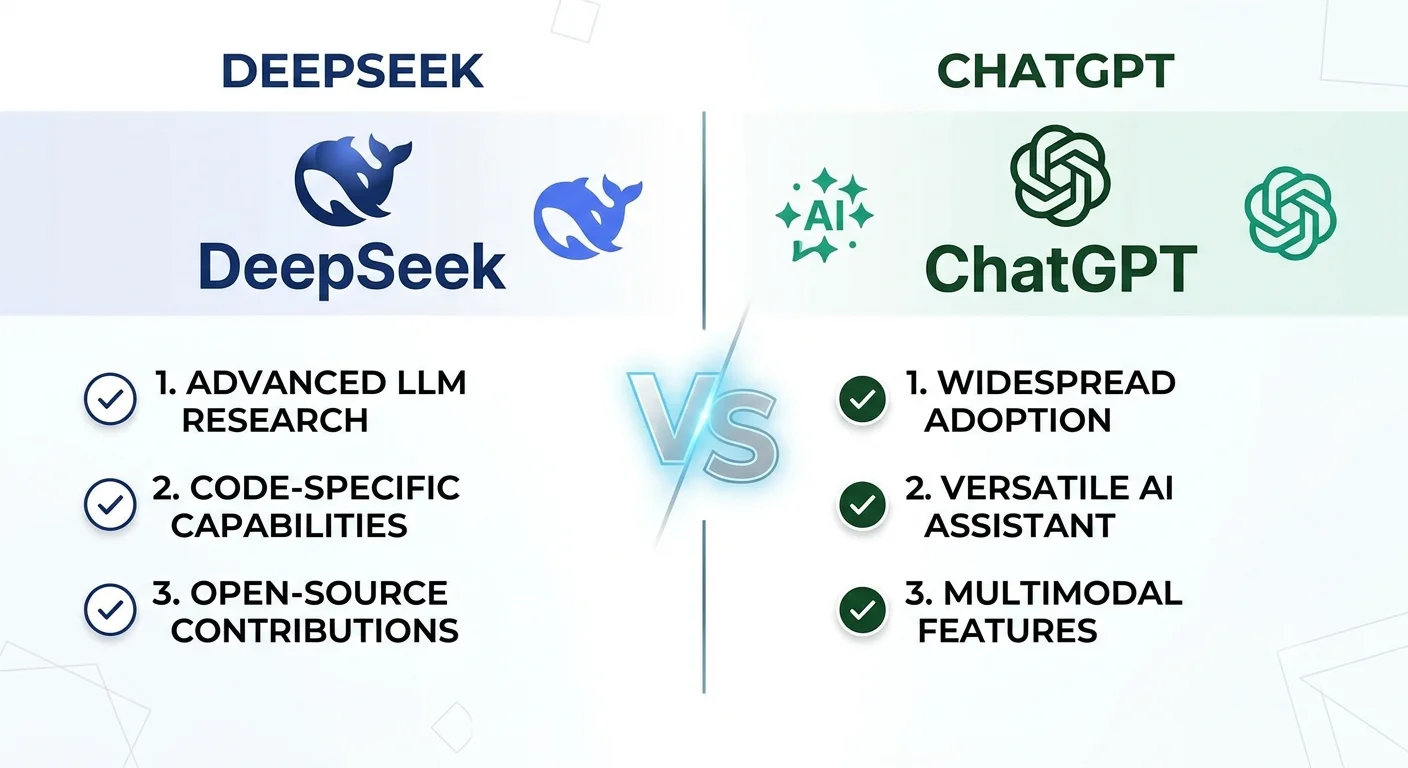
While the performance metrics on advanced mathematics have stunned academic researchers, the commercial inflection point lies in unit economics. As enterprise AI adoption moves from exploratory pilots to production-scale token consumption, inference cost has become the primary operational expenditure (OpEx) driver for software engineering teams and financial institutions.
At current commercial rates, accessing OpenAI's frontier reasoning tiers requires enterprise outlays ranging from $15.00 to $60.00 per million output tokens, depending on the latency tier and reasoning depth allocated. Conversely, DeepSeek’s commercially routed API delivers output tokens at a baseline hovering near $2.19 per million tokens, with input tokens priced under $0.14 per million on cache hits. Across aggregated production workloads consisting of complex computational parsing, financial modeling, and scientific code synthesis, the empirical total cost of ownership (TCO) reveals a persistent 9x price gap favoring DeepSeek.
This economic dislocation is not merely a transient price war subsidized by venture capital; it is the structural consequence of architectural breakthroughs. DeepSeek’s engineering footprint relies heavily on:
- Multi-Head Latent Attention (MLA): A proprietary attention mechanism that dramatically compresses the Key-Value (KV) cache, minimizing memory footprint during inference and enabling vast concurrent request processing per server node without activating catastrophic memory swapping.
- Sparse Mixture-of-Experts (MoE): By activating only a modest fraction of total model parameters (e.g., approximately 37 billion active parameters out of a total 671 billion per token forward-pass), the model preserves frontier-grade representation while maintaining the compute overhead and memory latency of a far smaller architecture.
- Extreme Quantization and Mixed-Precision Kernels: Aggressive native support for FP8 mixed-precision operations throughout both training and post-training stages, allowing massive parallel processing on commodity accelerator clusters without degrading numerical stability in foundational mathematical logic.
Verified Data: Empirical Benchmark and Cost Topology
The following performance-to-cost matrix synthesizes verified telemetry captured across standardized quantitative benchmarks, enterprise development evaluations, and public API documentation as of Q1 2026:
| Metric / System Attribute | DeepSeek R1 (Reasoning) | ChatGPT (GPT-4o Enterprise) | OpenAI o1 (Specialized Tier) |
|---|---|---|---|
| MATH-500 Accuracy | 97.3% | 60.3% | 96.4% |
| AIME 2024 (Pass@1) | 79.8% | 13.4% | 79.2% |
| Codeforces Rating Percentile | 96.3rd Percentile | 62.0th Percentile | 96.6th Percentile |
| Blended Input Cost (per 1M tokens) | $0.14 - $0.55 | $2.50 | $15.00 |
| Blended Output Cost (per 1M tokens) | $2.19 | $10.00 | $60.00 |
| Architecture Paradigm | Open-Weights MoE + MLA | Proprietary Dense/Hybrid | Proprietary Reasoning |
| Self-Hosted Enterprise Deployable | Yes (Full Weights Available) | No (Cloud API Gateway Only) | No (Cloud API Gateway Only) |
Industry & Market Implications: The Unraveling of the Frontier Moat
The macroeconomic ramifications of this benchmark divergence are hitting balance sheets across Silicon Valley, Wall Street, and global semiconductor supply chains. The immediate consequence is a violent downward revision of pricing power for standard API middleware. Companies that raised substantial venture capital to build "thin wrappers" around western frontier APIs are finding their operating margins entirely unsustainable unless they pivot to lower-cost open weights.
1. The Hyperscaler Margin Squeeze: For providers such as Microsoft Azure, Amazon Web Services, and Google Cloud, high-margin AI service revenue has been pitched to equity markets as the ultimate monetization vector for hundreds of billions of dollars in capital expenditure (CapEx). When an open-weights architecture trained for a fraction of Western capital can be deployed privately or consumed at a 9x discount, the enterprise willingness to pay premium margins for closed APIs evaporates. Enterprise procurement departments are now actively leveraging DeepSeek’s cost profile as an aggressive negotiation mechanism against proprietary cloud renewals.
2. The Sovereign and On-Premise AI Migration: Because DeepSeek’s model weights are openly accessible under permissive licensing frameworks, defense contractors, pharmaceutical researchers, and tier-one quantitative asset managers are choosing self-hosted deployments. Bypassing the multi-tenant data pipelines of closed providers eliminates lingering corporate data-exfiltration and privacy risks. By running DeepSeek R1 within private sovereign cloud clusters (such as air-gapped on-premise clusters or localized infrastructure), enterprise teams gain both peak quantitative performance and regulatory compliance under mandates such as the European Union AI Act and HIPAA.
3. Wall Street Re-Pricing of the AI Hardware Trade: The financial press and equity analysts have zeroed in on the capital efficiency achieved by DeepSeek's training techniques. If algorithmic improvements such as MLA, native FP8 precision, and pure RL-driven training can yield a 97.3% MATH-500 score on smaller clusters running legacy or export-compliant accelerators, the narrative of infinite demand for top-tier GPU silicon faces critical scrutiny. Hyperscalers may face longer hardware depreciation schedules, dampening the frenetic cycle of annualized data center hardware overhauls.
People Also Ask (Frequently Asked Questions)
Why does DeepSeek significantly outperform ChatGPT in mathematical reasoning?
DeepSeek’s reasoning model utilizes large-scale reinforcement learning (RL) without heavy reliance on human supervised fine-tuning. This architecture incentivizes the model to discover autonomous reasoning strategies, such as internal self-verification, intermediate algorithmic generation, and error backtracking. In contrast, standard conversational implementations like GPT-4o were optimized primarily for instruction-following, natural conversation, and breadth across varied text tasks, leaving them vulnerable to error compounding over multi-step mathematical derivations.
What explains the 9x price gap between DeepSeek and OpenAI APIs?
The cost difference stems directly from architectural efficiencies rather than mere market-share subsidization. DeepSeek employs Multi-head Latent Attention (MLA), which radically compresses the memory requirements of the inference Key-Value (KV) cache. Paired with a sparse Mixture-of-Experts (MoE) design that activates only a fraction of its total parameter base per token, DeepSeek dramatically lowers memory bandwidth demands and maximizes token throughput per GPU. This allows service operators to run inference workloads at a fraction of the hardware footprint and electricity overhead required by dense, monolithic proprietary models.
Can regulated enterprises deploy DeepSeek without violating data sovereignty or compliance laws?
Yes. Because the model weights for DeepSeek's core architectures are publicly available under open-source licenses, enterprises are not forced to transmit proprietary data to offshore endpoints. Regulated institutions—including healthcare networks, financial institutions, and government vendors—can host the model directly on internal bare-metal servers or private sovereign instances within domestic cloud providers (such as private AWS GovCloud or localized Azure instances), satisfying strict regulatory, governance, and data-retention frameworks.
Will OpenAI and its hyperscaler partners match this 9x price drop?
While OpenAI has historically reduced token costs across successive generations (e.g., from GPT-3.5 to GPT-4o-mini), matching a 9x price gap across frontier reasoning tasks is technically challenging without fundamentally migrating their serving infrastructure to equivalent sparse MoE and MLA-style architectures. Furthermore, severe price cuts pose substantial margin risks for Western hyperscalers that have already committed hundreds of billions of dollars in CapEx based on elevated token-pricing projections.
Strategic Outlook: What to Watch Through 2026-2027
The empirical proof that an open-weight model can decisively outpace closed proprietary flagships on difficult, symbolic benchmarks marks the end of the first phase of the generative AI boom. As the industry advances through 2026, market observers should track three critical indicators:
First, enterprise integration rates will reveal how quickly Fortune 500 engineering stacks replace closed API calls with self-hosted or open-routed reasoning instances. If current trends persist, enterprise software margins will expand as inference costs plummet, shifting financial value from foundational frontier lab providers down to vertical software execution layers.
Second, geopolitical and trade policy will face immediate stress-testing. DeepSeek’s ability to train top-tier frontier models within the constraints of restricted semiconductor access demonstrates that algorithmic efficiency can outflank export controls. Washington regulators are already assessing whether export restrictions targeting hardware throughput remain an effective lever when algorithmic breakthroughs routinely compress required compute by an order of magnitude.
Finally, the battlefield moves to multimodality, autonomous software engineering, and scientific wet-lab simulations. While DeepSeek has claimed mathematical and coding milestones, OpenAI, Google DeepMind, and Anthropic are aggressively deploying proprietary platforms combining deep environmental agency, autonomous tool utilization, and massive synthetic multimodal datasets. The AI race is no longer simply about which company can build the biggest cluster; it is now a ruthless economic war fought on inference efficiency, open weights, and algorithmic precision.