Executive Takeaways
- The Critical Juncture: NASA and private-sector partners are evaluating the operational feasibility of a private commercial crew servicing mission versus initiating a controlled deorbit sequence for the aging Hubble Space Telescope.
- Commercial Space Innovation: Spearheaded by private space infrastructure pioneers like SpaceX and Jared Isaacman's Polaris Dawn initiative, the proposed re-boost mission leverages Dragon capsule capabilities to extend deep-space asset valuation.
- Fiscal & Strategic Calculus: Agency officials must weigh the capital allocation and risk mitigation of extending a 34-year-old scientific monopoly against the multi-billion-dollar infrastructure replacement cost of modern space-based observatories.
- Regulatory Compliance: Orbital debris mitigation frameworks mandate meticulous end-of-life protocols, turning Hubble's impending descent into a high-stakes masterclass in aerospace governance and traffic management.
WASHINGTON — For more than three decades, the Hubble Space Telescope has served as the undisputed crown jewel of observational astrophysics, capturing the imagination of humanity while fundamentally reshaping our understanding of cosmic expansion, dark energy, and stellar genesis. Yet, the gleaming titanium-and-aluminum monolith now faces an existential crossroads that transcends pure astronomy, morphing into a complex calculus of capital allocation, aerospace engineering limits, and enterprise-grade orbital risk mitigation.
As orbital decay inexorably pulls the legendary observatory deeper into Earth’s upper atmosphere, decision-makers at the National Aeronautics and Space Administration (NASA), alongside private-sector visionaries, are locked in a high-stakes strategic review. The core dilemma before the agency is stark: authorize an unprecedented commercial servicing mission to breathe new life into the aging asset, or orchestrate a safe, controlled deorbit, burning up decades of irreplaceable orbital infrastructure in the fiery friction of Earth's atmosphere.
The Catalytic Shift: Private Capital Meets Public Legacy
Test Our Free AI & Tech Utilities Suite
Calculate LLM API token costs, analyze article dwell-time, or simulate tech DCA returns.
For decades, the operational lifespan of low-Earth orbit (LEO) assets was dictated strictly by government budgets and Space Shuttle availability. The final Space Shuttle servicing mission, STS-125 in 2009, left Hubble with new gyroscopes, wide-field cameras, and repaired spectrographs, guaranteeing its scientific productivity well into the 2020s. However, without human intervention to raise its orbital altitude—currently hovering near 510 kilometers—atmospheric drag is an unyielding adversary.
The paradigm shifted dramatically when billionaire-astronaut Jared Isaacman, in collaboration with SpaceX, approached NASA with an unsolicited proposal under the agency’s unfunded Space Act Agreement framework. The proposition was audacious yet technically grounded: utilize a commercially procured Crew Dragon spacecraft to rendezvous with Hubble, attach a specialized propulsion kit, and boost the telescope into a higher, safer orbit while executing minor mechanical repairs.
This initiative represents a watershed moment for modern space infrastructure scalability. By demonstrating that heavy-lift commercial architecture can service legacy assets, NASA and private aerospace players are effectively rewriting the playbook on asset management in orbit. Rather than writing off multi-billion-dollar scientific investments as write-offs upon fuel exhaustion, commercial servicing opens the door to maximizing enterprise ROI on government-funded space hardware.
Engineering Realities and Risk Mitigation
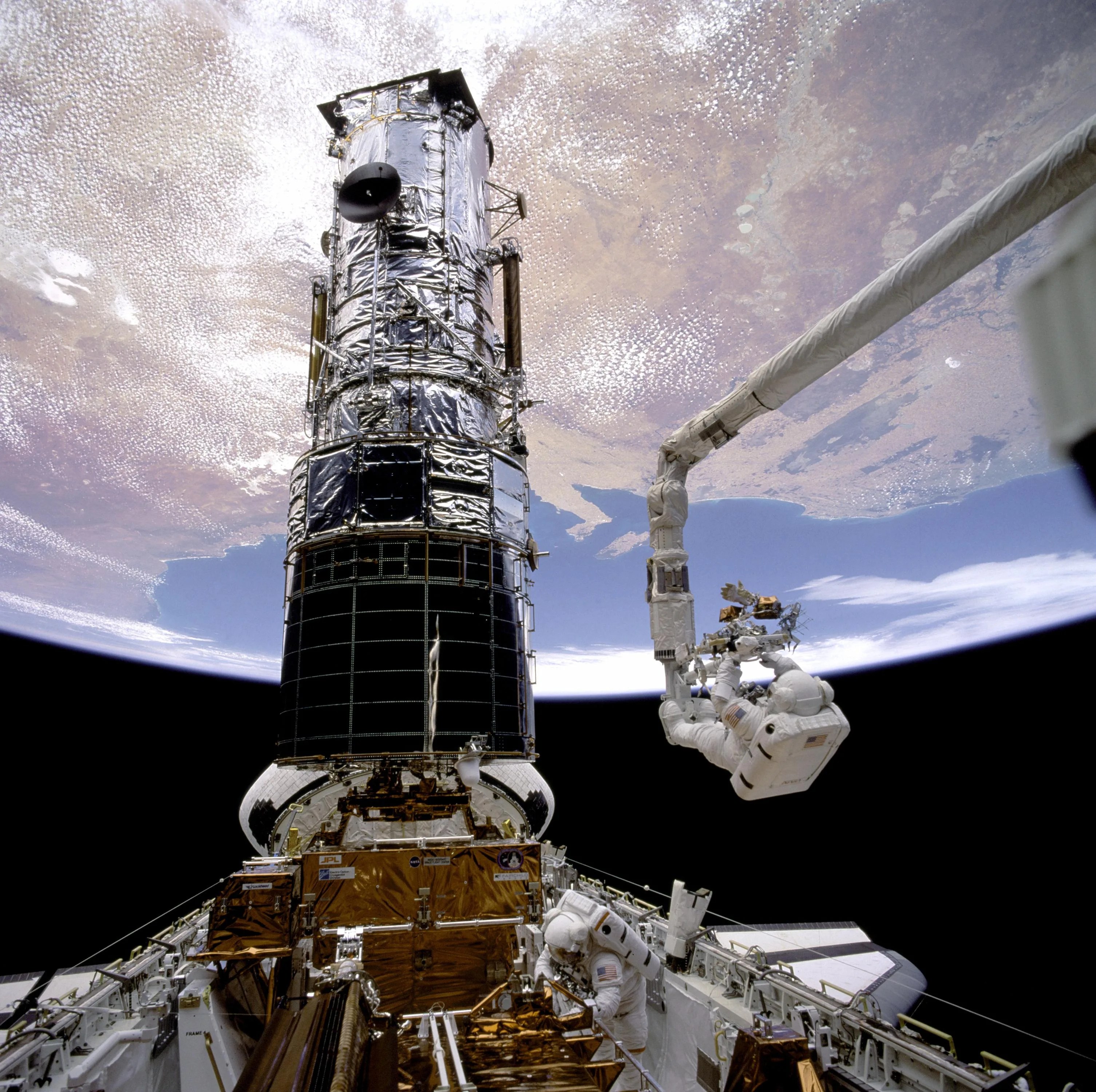
To understand the gravity of NASA’s deliberation, one must examine the extreme engineering tolerances involved. Hubble was never designed to be grappled autonomously; its grapple fixtures were engineered specifically for the mechanical arms of NASA's retired Space Shuttle orbiters and the calibrated inputs of space-suited astronauts.
A modern commercial servicing mission would require navigating unprecedented technical hurdles:
- Autonomous Rendezvous and Docking (ARD): Developing software and sensor suites capable of safely approaching a delicate, non-cooperative target spinning in an unlubricated orbit.
- Extravehicular Activity (EVA): Potentially deploying commercial astronauts from a Dragon capsule using newly developed private spacesuits to manually install docking rings or re-boost hardware.
- Dynamic Stability: Managing Hubble’s sensitive reaction wheels and delicate solar arrays during the physical attachment of a propulsion module, ensuring structural integrity is preserved under high-torque maneuvers.
From a risk mitigation perspective, NASA's Office of Safety and Mission Assurance faces a profound dilemma. The risk of a botched commercial rendezvous—potentially resulting in a catastrophic collision that fragments Hubble into thousands of high-velocity space debris items—must be weighed against the guaranteed scientific loss of letting the telescope naturally re-enter the atmosphere uncontrolled.
Verified Data: Hubble Operational Metrics vs. Replacement Horizons
A rigorous examination of the quantitative realities facing agency planners highlights the tight margins governing this decision-making process:
| Metric / Parameter | Hubble Space Telescope (HST) | James Webb Space Telescope (JWST) | Commercial Servicing Proposal |
|---|---|---|---|
| Launch Date | April 24, 1990 | December 25, 2021 | Projected 2025–2026 (Pending) |
| Orbital Regime | Low-Earth Orbit (~510 km) | Sun-Earth Lagrange Point 2 (1.5M km) | Target Boost: 600+ km |
| Primary Spectrum | Optical, Ultraviolet, Near-Infrared | Infrared Operations | Extension of Legacy Spectrum |
| Estimated Fiscal Exposure | >$16 Billion (Cumulative) | ~$10 Billion (Development) | Privately Financed / Cost-Shared |
Industry & Market Implications: Who Wins, Who Loses
The ultimate determination regarding Hubble’s fate extends far beyond pure astrophysics; it carries significant ripple effects across the global aerospace and defense complex. The financial stakes involve valuation multiples for emerging commercial space enterprises, regulatory compliance frameworks, and government procurement strategies.
- Winners — Commercial Space Infrastructure Providers: Companies specializing in orbital logistics, autonomous docking software, and commercial crew transportation stand to gain immense market validation. A successful mission proves that private capital can maintain public mega-assets, unlocking a lucrative new B2G (business-to-government) market sector.
- Winners — Multi-Wavelength Astronomers: While JWST dominates deep-infrared discovery, Hubble remains the premier facility for simultaneous ultraviolet observations—a capability absent on newer platforms. Keeping Hubble operational preserves crucial synergy for multi-messenger astronomy.
- Losers — Legacy Aerospace Bureaucracy: Traditional, risk-averse procurement models that rely exclusively on cost-plus government contracts face mounting pressure. The agility demonstrated by private-sector proposals exposes the friction within legacy government timelines.
- Broader Economic Impact: As regulatory compliance surrounding space debris tightens globally, establishing a precedent for safe, commercial deorbit or orbital rescue sets a high-water mark for future satellite constellations and orbital manufacturing hubs.
Frequently Asked Questions (People Also Ask)
Why can't NASA simply use the Space Shuttle to service Hubble again?
The NASA Space Shuttle fleet was permanently retired in July 2011. Without the unique heavy-lift capacity, robotic arm dexterity, and pressurized cabin environment of the Shuttle orbiters, NASA lost its direct, human-tended servicing capability, necessitating the pivot toward modern commercial spacecraft like SpaceX's Crew Dragon.
What is a controlled deorbit, and why is it necessary?
A controlled deorbit is a calculated propulsion maneuver designed to guide a dead or retiring spacecraft into an unpopulated ocean sector—typically the South Pacific Ocean uninhabited area known as Point Nemo. Because Hubble weighs over 12 tons and features heavy primary mirrors that could survive atmospheric friction, leaving its descent to chance is unacceptable under modern orbital debris mitigation guidelines.
How much would a commercial servicing mission cost taxpayers?
Under the initial proposals evaluated by NASA and driven by private partnerships, the mission would be primarily financed through private capital, significantly minimizing direct federal outlays. However, NASA must still invest internal engineering hours and safety review resources to vet the architectural viability.
Does Hubble still provide unique scientific value compared to the James Webb Space Telescope?
Yes. While JWST is optimized for infrared astronomy, Hubble operates primarily in the ultraviolet and optical spectra. These wavelengths are essential for studying young stars, planetary atmospheres within our solar system, and the ultraviolet light from distant galaxies, making the two observatories highly complementary rather than redundant.
Future Outlook: Critical Milestones and Decision Gates
As NASA continues its technical evaluation, stakeholders are closely monitoring key decision gates. The agency’s internal technical interchange meetings are weighing the comprehensive data yielded by the initial Space Act Agreement study. If safety thresholds are validated without imposing unacceptable risks to Hubble’s delicate subsystems, NASA may issue a formal Request for Proposals (RFP) to formalize a public-private partnership.
Conversely, should the engineering risks associated with grappling a 34-year-old spaceframe prove insurmountable, engineers will pivot entirely toward designing a specialized robotic deorbit module. This hardware would attach to Hubble during its final months, ensuring that when the plug is finally pulled, the descent is mathematically precise and environmentally secure.
Ultimately, Hubble's final chapter will establish a historic benchmark for how modern civilization manages its technological artifacts in the orbital commons. Whether through an audacious commercial resurrection or a dignified, fiery plunge into the Pacific, the legacy of the Hubble Space Telescope remains inextricably linked to the ongoing evolution of human ingenuity in space.