Executive Takeaways
- The Invisible Flood: Over 65 billion solar neutrinos pass through every square centimeter of Earth every second, carrying untapped astrophysical intelligence.
- Infrastructure Scalability: Multi-billion-dollar underground detector arrays—such as the Deep Underground Neutrino Experiment (DUNE)—are shifting from pure academic theory to commercial-grade infrastructure.
- National Security & Compliance: Advanced neutrino detectors are emerging as critical assets for nuclear non-proliferation monitoring, bypassing traditional regulatory verification bottlenecks.
- Enterprise Capital Allocation: Venture and institutional capital is increasingly flowing into foundational physics R&D, driven by long-term disruptive potential in secure communications and quantum computing architectures.
For centuries, humanity viewed the universe through the narrow prism of the electromagnetic spectrum—light, radio waves, X-rays, and gamma rays. But light can be blocked, scattered, and absorbed by cosmic dust, planetary atmospheres, and dense stellar interiors. Enter the neutrino: the subatomic ghost particle that interacts so weakly with ordinary matter that light-years of lead would fail to stop a single one. For decades, they were treated as academic curiosities—mathematical anomalies necessary to balance equations in particle decay.
Today, that paradigm is experiencing a violent inversion. Driven by breakthroughs in ultra-pure liquid argon technologies, deep-underground cavern excavation, and cryogenic cooling systems, the global scientific and industrial complex is asking a trillion-dollar question: Neutrinos are everywhere. Now what? From real-time core-collapse supernova early-warning networks to autonomous nuclear reactor safeguards, the mastery of the neutrino is no longer confined to theoretical blackboards. It is rapidly evolving into a foundational pillar of modern deep-tech infrastructure.
The Catalytic Shift: Moving from Detection to Utilization
Test Our Free AI & Tech Utilities Suite
Calculate LLM API token costs, analyze article dwell-time, or simulate tech DCA returns.
To understand the current surge in capital allocation and geopolitical interest, one must examine the technological inflection point. For generations, detecting neutrinos was akin to capturing a whisper inside a hurricane. Because these particles possess nearly zero rest mass and carry no electrical charge, they pass through human bodies, skyscrapers, and entire planets without a single collision.
The turning point arrived with the engineering of massive subterranean detectors. Facilities such as the IceCube Neutrino Observatory at the South Pole—which converted a cubic kilometer of pristine Antarctic ice into a Cherenkov radiation sensor—and the upcoming DUNE project in Lead, South Dakota, have transformed the impossible into the measurable. By scaling detector volumes to unprecedented magnitudes, physicists can now capture thousands of high-energy neutrino interactions annually.
This leap in infrastructure scalability has immediate commercial and strategic repercussions. As enterprises in the quantum computing and secure communications sectors search for unhackable data transmission mediums, theoretical physicists are modeling neutrino beams as the ultimate line-of-sight communication channel. Unlike radio frequencies or fiber optics, neutrino beams cannot be jammed, intercepted, or shielded by physical barriers, presenting a paradigm-shifting frontier for sovereign defense networks.
Data & Metrics Breakdown: Global Neutrino Infrastructure
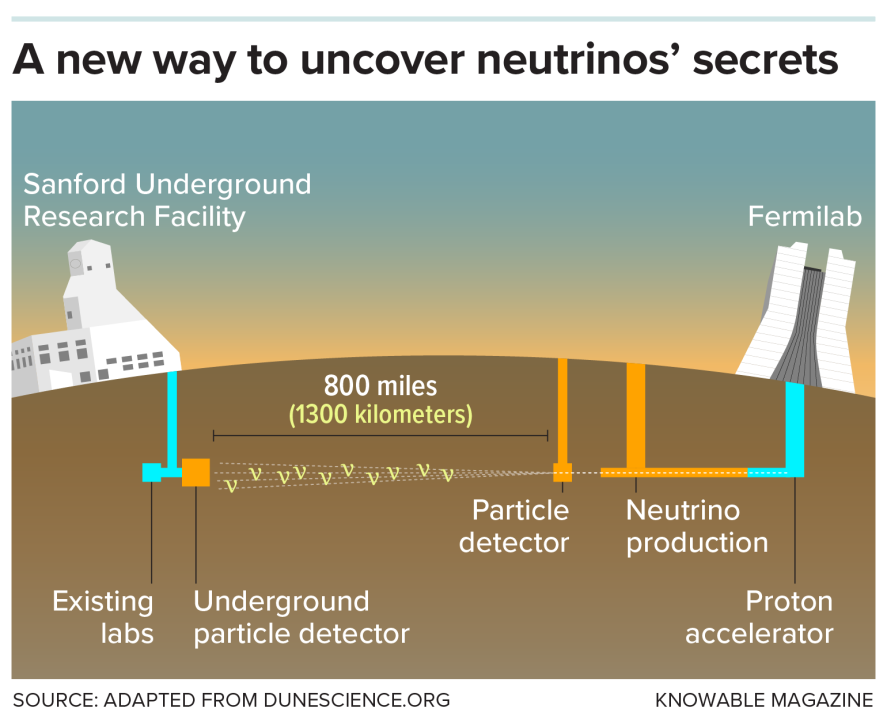
The following metrics outline the scale, investment profile, and operational parameters of the world's leading neutrino research and monitoring facilities, highlighting the immense capital expenditure and engineering prowess required in this sector.
| Facility / Project | Location | Active / Target Date | Primary Technology / Medium | Capital Investment / Scale |
|---|---|---|---|---|
| IceCube | Amundsen-Scott South Pole Station | 2010 (Upgrades ongoing) | 1 Cubic Kilometer of Antarctic Ice | ~$275 Million (Initial build + upgrades) |
| DUNE (Deep Underground Neutrino Experiment) | Fermilab (IL) to Sanford Lab (SD) | Target: 2031 (Phased rollout) | Liquid Argon Time Projection Chambers | ~$3 Billion+ (Global consortium) |
| Super-Kamiokande | Kamioka, Japan | 1996 (Hyper-K expansion by 2027) | 50,000 Tons of Ultrapure Water | ~$600 Million (Hyper-Kamiokande phase) |
| KM3NeT | Mediterranean Sea (Multiple sites) | Under construction (2026 completion) | Deep-sea optical sensor arrays | ~$150 Million |
Industry & Market Implications: Who Wins, Who Loses
As the commercial and geopolitical stakes surrounding particle physics escalate, market analysts are mapping out clear macroeconomic vectors. The transition from pure science to applied neutrino utility creates distinct winners and losers across global industries.
The Winners
Cryogenic Engineering and Advanced Materials Firms: Companies specializing in ultra-pure liquid argon purification, extreme low-temperature refrigeration, and photodetector manufacturing are seeing unprecedented demand. As mega-science projects scale up, supply chain contractors are securing long-term, high-margin government and institutional contracts.
National Security and Nuclear Regulatory Agencies: Compact neutrino detectors are currently being tested to monitor nuclear reactor cores in real-time. By measuring anti-neutrino output, inspectors can verify fissile material inventories without entering containment structures, drastically reducing regulatory compliance friction and auditing costs for the civil nuclear energy sector.
Deep-Tech Venture Capitalists: Early-stage investors willing to back high-risk, high-reward quantum sensing and particle telemetry startups are positioning themselves for outsized valuation multiples as commercial spin-offs emerge from academic labs.
The Losers
Legacy Surveillance and Telecommunications Infrastructure: While long-term threat models suggest neutrino communication could disrupt traditional satellite and subsea cable networks, incumbent telecom operators face severe obsolescence risks if sovereign states pivot to directional neutrino channels for impenetrable military communications.
Traditional Fossil Fuel and Mineral Exploration Outdated Methods: Cosmogenic neutrino tomography—using atmospheric neutrino absorption patterns to image the Earth's inner core and mantle—threatens to render conventional seismic surveying methodologies obsolete for deep-earth resource mapping, forcing legacy exploration firms to pivot or write down capital assets.
Frequently Asked Questions (People Also Ask)
What is a neutrino, and why are they so difficult to detect?
A neutrino is an elementary subatomic particle with a minuscule, non-zero mass and no electrical charge. Because they belong to the lepton family and only interact via the weak nuclear force and gravity, they pass through matter almost entirely unhindered. Detecting them requires colossal volumes of ultra-pure sensing material—such as tens of thousands of tons of water or liquid argon—coupled with sensitive photomultiplier tubes to capture the rare flashes of Cherenkov radiation produced when a neutrino occasionally collides with an atomic nucleus.
How can neutrinos be used for practical applications outside of theoretical physics?
While foundational research remains primary, applied neutrino science currently yields major breakthroughs in two core domains: non-proliferation monitoring and geotomography. By placing portable detectors near nuclear reactors, agencies can track reactor power output and plutonium production autonomously. Furthermore, high-energy neutrino astronomy allows researchers to peer inside active galactic nuclei, gamma-ray bursts, and stellar interiors with a clarity impossible using standard electromagnetic telescopes.
What is the cost and timeline for next-generation neutrino facilities like DUNE?
Mega-projects like the Deep Underground Neutrino Experiment (DUNE) represent multi-billion-dollar international consortia involving thousands of scientists across dozens of nations. With construction phased through the late 2020s and primary operations slated for the 2030s, capital allocation is distributed across federal science budgets (such as the U.S. Department of Energy and CERN), private engineering firms, and international research grants.
Can neutrinos ever be harnessed for everyday commercial telecommunications?
In the near term, no. Generating and detecting directional neutrino beams requires particle accelerators the size of small towns and multi-ton detector arrays. However, proof-of-concept experiments have successfully transmitted encoded messages through solid rock using neutrino beams. While impractical for consumer use, sovereign defense networks and secure financial institutions may eventually leverage neutrino telemetry for ultra-secure, un-jammable long-range links.
Future Outlook: Milestones and Executive Watchlist
The trajectory of neutrino science over the next decade will be defined by three critical milestones. First, the commissioning of the DUNE far detectors at the Sanford Underground Research Facility will establish unprecedented precision in measuring matter-antimatter asymmetry (CP violation), potentially explaining why the universe is composed almost entirely of matter today.
Second, advancements in miniaturized coherent elastic neutrino-nucleus scattering ($\text{CE}\nu\text{NS}$) detectors will determine whether deployable, truck-mounted neutrino monitors become standard operational equipment for international nuclear inspectors by the early 2030s.
Finally, institutional investors must monitor how public-private partnerships evolve in the quantum sensing space. As deep-underground laboratories transition from pure physics to multi-disciplinary user facilities hosting dark matter searches, neutrino telemetry, and geodynamic monitoring, the economic ripple effects will touch aerospace, defense, energy, and advanced computing. The ghost particle has stepped out of the shadows; capital allocation strategies must adapt accordingly.