Executive Takeaways
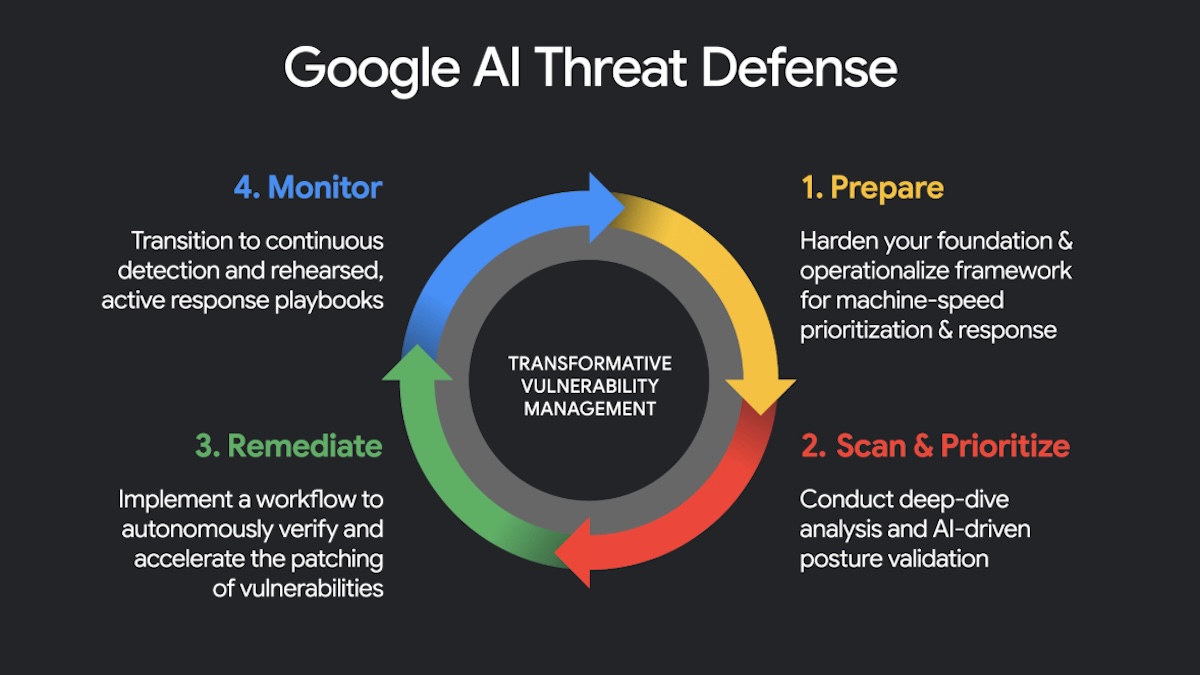
- Next-Generation Defense: Google Cloud has rolled out a comprehensive, AI-driven threat defense ecosystem designed to autonomously mitigate sophisticated enterprise cyberattacks in real-time.
- Capital Allocation & ROI: The initiative addresses escalating boardroom anxieties over digital infrastructure vulnerability, promising compressed incident response times and lower total cost of ownership (TCO) for risk mitigation.
- Competitive Pressure: This release escalates the high-stakes cloud security war against market incumbents Microsoft Azure and Amazon Web Services (AWS), setting a new baseline for autonomous infrastructure scalability.
- Regulatory Compliance: Engineered to align with stringent global compliance frameworks, the tool automates audit-ready reporting to protect institutions from mounting regulatory penalties.
NEW YORK & SAN FRANCISCO — In a decisive maneuver set to reshape the enterprise software landscape, Google Cloud announced the global rollout of its advanced AI-driven threat defense architecture. Unveiled against a backdrop of escalating state-sponsored intrusions, ransomware epidemics, and mounting regulatory scrutiny, the new security suite integrates generative and predictive artificial intelligence directly into the core fabric of enterprise cloud compute architecture.
According to primary disclosures from The Indian Express and corroborated by industry briefings, this strategic expansion moves beyond traditional signature-based detection. Instead, it deploys autonomous machine learning models capable of reasoning across petabytes of telemetry data in milliseconds. For Chief Information Security Officers (CISOs) and enterprise risk committees, the launch represents a pivotal shift from reactive containment to proactive, machine-speed neutralization.
The Catalytic Shift: Why Enterprises Are Demanding Autonomous Defense
Test Our Free AI & Tech Utilities Suite
Calculate LLM API token costs, analyze article dwell-time, or simulate tech DCA returns.
The modern enterprise attack surface has expanded exponentially. The accelerated migration of legacy workloads to hybrid and multi-cloud environments, compounded by remote workforces and distributed API endpoints, has created unprecedented infrastructure vulnerabilities. Traditional security operations centers (SOCs) are drowning in alert fatigue, routinely processing tens of thousands of false positives daily while stealthy adversaries dwell undetected within networks for months.
Google Cloud’s strategic response is rooted in leveraging its proprietary TPU (Tensor Processing Unit) infrastructure to process security telemetry at unprecedented scale. By synthesizing threat intelligence from Google’s vast visibility ecosystem—including Mandiant’s frontline incident response data and VirusTotal’s crowdsourced repository—the new AI engine correlates seemingly unrelated anomalies into high-fidelity incident graphs before human intervention is even required.
"We are crossing a structural Rubicon in enterprise cybersecurity," noted a senior technology equity research analyst based in New York. "For years, CISOs have fought asymmetric warfare where attackers use automation and AI while defenders rely on human analysts clicking through disparate dashboards. Google Cloud's new architecture bridges this operational asymmetry, directly addressing enterprise ROI by neutralizing threats before they impact revenue-generating operations."
Deep-Dive Breakdown: Inside the Technology

The newly introduced defense suite incorporates several distinct technical pillars engineered for high-availability environments:
- Autonomous Triage and Remediation: Leveraging large-scale language models fine-tuned on security operations data, the system automatically investigates alerts, executes containment protocols on compromised virtual machines, and generates forensic root-cause analysis reports.
- Predictive Attack Path Modeling: Rather than waiting for a breach, the AI simulates adversarial lateral movement across the enterprise network, identifying hidden privilege escalation routes and proactively hardening configurations.
- Native Integration with Zero Trust Frameworks: The defense mechanisms operate seamlessly within Google Cloud's BeyondCorp enterprise security model, enforcing continuous, context-aware authorization across all user sessions and microservices.
- Reduced False Positives: By employing advanced neural networks that understand normal business behavior versus anomalous execution patterns, the suite slashes alert noise by up to 75%, allowing security teams to redirect capital toward strategic risk mitigation.
Verified Data & Metrics Breakdown
To evaluate the market impact and operational efficacy of Google Cloud's latest offering, industry analysts have contrasted key parameters against legacy security operations models:
| Operational Metric | Traditional SOC / Legacy Tools | Google Cloud AI Threat Defense |
|---|---|---|
| Average Mean Time to Detect (MTTD) | Hours to Days | Milliseconds to Seconds |
| False Positive Alert Rate | 60% – 80% of daily volume | Under 10% via contextual neural filtering |
| Incident Containment Speed | Hours (Requires manual script execution) | Autonomous instant quarantine |
| Regulatory Audit Readiness | Manual log aggregation & synthesis | Automated, continuous compliance mapping |
Industry & Market Implications
The release is expected to trigger significant capital reallocation across the enterprise software sector. Financial markets are closely monitoring valuation multiples for pure-play cybersecurity vendors, many of which now face intense pressure to integrate generative AI capabilities deeper into their product roadmaps or risk commoditization.
Who Wins: Enterprise CFOs and CISOs stand out as primary beneficiaries. By consolidating disparate security point solutions into an AI-native cloud fabric, organizations can drive down total cost of ownership (TCO) while elevating their security posture. Furthermore, global financial institutions, healthcare conglomerates, and e-commerce giants operating under rigorous regulatory compliance mandates will benefit from automated audit trails.
Who Loses: Legacy security vendors reliant on rigid, manual rule-writing and high professional services fees face an existential threat. Additionally, cloud competitors—specifically Microsoft Azure and Amazon Web Services—must accelerate their own autonomous defense roadmaps to prevent Google from capturing enterprise mindshare in high-value, security-conscious sectors.
Frequently Asked Questions (People Also Ask)
How does Google Cloud's AI-driven threat defense differ from traditional SIEM tools?
Traditional Security Information and Event Management (SIEM) tools rely heavily on static, human-written rules and keyword alerts, which often result in overwhelming false positives and sluggish detection times. Google Cloud’s AI defense suite utilizes machine learning models trained on global telemetry and Mandiant intelligence to autonomously predict, detect, and neutralize sophisticated threat vectors in real time without requiring constant human tuning.
Will implementing this AI security suite disrupt existing enterprise cloud workloads?
No. The defense architecture is designed as a non-invasive, out-of-band telemetry analysis engine paired with granular, policy-driven automation. It observes network traffic and operational logs seamlessly, only executing automated containment actions when policy thresholds and high-confidence threat triggers are met.
How does the new tool assist with regulatory compliance and data governance?
The platform continuously maps security telemetry against major regulatory frameworks—including GDPR, HIPAA, PCI-DSS, and SOC 2. By generating automated, auditor-ready compliance reports and real-time posture assessments, it significantly reduces the administrative overhead associated with regulatory compliance.
What impact will this have on enterprise cybersecurity budgets?
While initial software licensing adjustments may occur, enterprise ROI is optimized by reducing the costly reliance on outsourced manual SOC staffing, mitigating the financial fallout of data breaches, and lowering insurance premiums through demonstrable, advanced risk mitigation.
Future Outlook & Key Milestones
As cyber threats evolve into automated, machine-speed campaigns powered by malicious AI, perimeter-based defenses are obsolete. Google Cloud’s integration of autonomous threat defense marks a foundational milestone in the evolution of enterprise computing.
Industry observers and institutional investors should monitor the following key milestones over the next 12 to 18 months:
- Adoption Metrics in Regulated Sectors: The speed at which Fortune 500 banks and healthcare providers migrate core workloads to this AI-defended architecture.
- Ecosystem Extensibility: The rollout of third-party API integrations, allowing enterprises to feed telemetry from on-premises data centers and competing cloud environments into Google’s AI core.
- Regulatory Benchmarking: How international data protection authorities evaluate autonomous AI containment actions against data privacy and sovereignty statutes.
Ultimately, Google Cloud has set a new high-water mark for cloud security. Companies that fail to modernize their security infrastructure with autonomous AI capabilities risk not only financial loss but existential obsolescence in an increasingly hostile digital economy.