Executive Takeaways
- Federal Reserve Stance: The Federal Open Market Committee (FOMC) kept the benchmark federal funds rate unchanged while deliberately omitting clear guidance on potential December tightening.
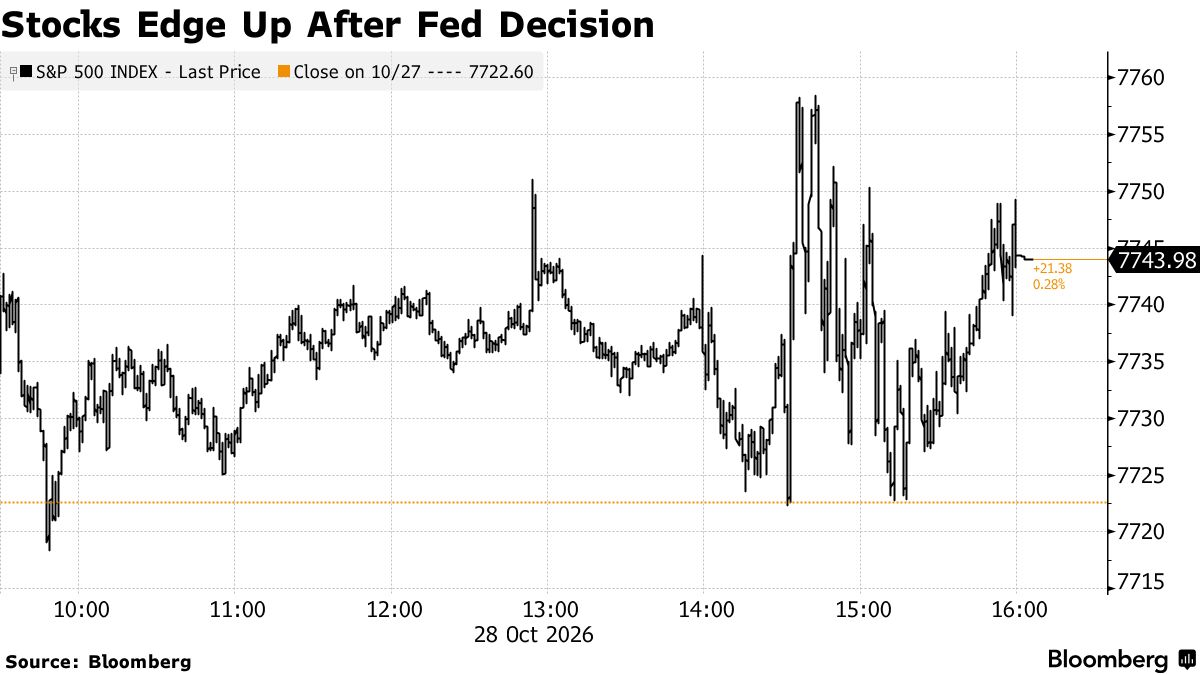
- Equities Movement: Major Wall Street indices drifted sideways as institutional investors parsed conflicting signals regarding inflation persistence and labor market resilience.
- Tech Sector Divergence: Oracle Corp. (NYSE: ORCL) staged a massive rally, defying broader market stagnation on the back of explosive enterprise cloud infrastructure demand.
- Portfolio Strategy: Asset managers are reassessing capital allocation, balancing high-beta growth equities against strict risk mitigation amid ongoing monetary policy ambiguity.
Global financial markets found themselves suspended in a state of suspended animation this week as Wall Street digested a pivotal policy announcement from the Federal Reserve, juxtaposed against a blockbuster corporate earnings beat from enterprise technology titan Oracle. While macroeconomic benchmarks drifted within a remarkably narrow band, underlying asset flows revealed a fierce reallocation of capital toward enterprise-grade software and cloud infrastructure plays that can command pricing power regardless of the macroeconomic weather.
Speaking from the journalistic vantage point of financial desks tracking both the Eccles Building and Silicon Valley, this dual-narrative session underscores a broader structural shift. The era of cheap money is firmly in the rearview mirror, replaced by an environment where execution, infrastructure scalability, and robust enterprise ROI dictate valuations. As portfolio managers recalibrate their models, the intersection of monetary policy uncertainty and hyper-growth cloud adoption has created a fascinating case study in market mechanics.
The Federal Reserve’s Calculated Ambiguity
Test Our Free AI & Tech Utilities Suite
Calculate LLM API token costs, analyze article dwell-time, or simulate tech DCA returns.
In a widely anticipated move that nonetheless left bond traders and equity strategists dissecting every syllable of the accompanying statement, the Federal Reserve opted to hold its benchmark interest rate steady. More importantly, the central bank’s policy committee refrained from signaling whether a resumption of rate hikes remains on the table for the December meeting. This calculated ambiguity is designed to preserve maximum operational flexibility for Federal Reserve Chair Jerome Powell and his colleagues as they navigate sticky core inflation readings alongside moderating labor market indicators.
For institutional investors, the lack of a definitive forward guidance roadmap has heightened market volatility metrics, even as headline indices appear calm. Fixed-income desks immediately adjusted their yield curve projections, pricing in a prolonged plateau rather than an imminent pivot toward monetary easing. This environment of higher-for-longer interest rates forces corporate treasurers to re-evaluate debt servicing costs, capital expenditure budgets, and balance sheet leverage. Consequently, companies lacking robust cash generation are finding their equity valuations severely compressed, while capital-rich balance sheets continue to command a premium.
Market liquidity has mirrored this cautious posture. Daily trading volumes in benchmark exchange-traded funds (ETFs) tapered off following the policy release, as algorithmic and discretionary traders alike waited for secondary macroeconomic data points—such as the upcoming Consumer Price Index (CPI) and non-farm payroll reports—to confirm whether the U.S. economy is indeed tracking toward a soft landing or teetering on the edge of policy-induced slowdown.
Oracle’s Surge: The Enterprise Cloud Catalyst
While macro traders parsed central bank semantics, the equity spotlight shifted sharply to the technology sector, where Oracle delivered a masterclass in enterprise momentum. Oracle shares surged following an earnings report that blew past consensus Wall Street estimates, driven by astronomical demand for its cloud compute architecture and artificial intelligence (AI) infrastructure.
The stellar performance highlights a critical divergence in the modern tech ecosystem: general consumer-facing tech is facing saturation, while mission-critical enterprise software and cloud infrastructure scalability are seeing insatiable demand. Enterprise clients are aggressively upgrading their legacy systems to harness advanced data analytics and generative AI workloads. Oracle’s ability to capture these high-margin enterprise contracts demonstrates that corporate buyers are willing to prioritize digital transformation spending even when macroeconomic headwinds threaten discretionary budgets.
Furthermore, Oracle’s strategic positioning within database management and multi-cloud integration has yielded impressive operating margins. Wall Street analysts have rapidly revised their valuation multiples upward for the firm, noting that its aggressive capital expenditure in next-generation data centers is generating tangible, near-term revenue acceleration. This narrative provided a much-needed psychological boost to the broader tech sector, preventing a wider market pullback in the wake of the Fed’s non-committal stance.
Verified Data & Market Metrics Breakdown
| Market Indicator / Asset | Current Status / Level | Period / Date Context | Strategic Implication |
|---|---|---|---|
| Federal Funds Rate | Maintained steady range | Recent FOMC Meeting | Preserves optionality; keeps borrowing costs elevated. |
| December Rate Hike Odds | Balanced / Uncommitted | Post-Decision Swaps Data | Drives short-term bond yield volatility. |
| Oracle Corp. (NYSE: ORCL) | Significant Outperformance | Latest Earnings Release | Validates robust enterprise cloud & AI infrastructure demand. |
| Broader Equity Indices | Sideways Drift / Modest Edge | Weekly Trading Close | Reflects investor hesitation and macro asset consolidation. |
Industry & Market Implications
The interplay between central bank policy paralysis and idiosyncratic corporate outperformance creates distinct winners and losers across the global financial landscape. Understanding these dynamics is essential for institutional risk mitigation and asset allocation.
Who Wins
- Enterprise Tech & Cloud Providers: Companies with defensible moats in cloud architecture, data warehousing, and artificial intelligence integration (exemplified by Oracle) are capturing outsized corporate budgets.
- Cash-Rich Balance Sheets: Firms operating with minimal debt burdens and high organic free cash flow are insulated from elevated interest rates, successfully attracting yield-seeking institutional capital.
- Active Portfolio Managers: Sideways-drifting, headline-driven markets reward bottom-up stock pickers who can identify structural growth stories detached from macro noise.
Who Loses
- High-Leverage, Pre-Profit Growth Equities: Speculative technology and biotech firms relying on continuous external financing face severe valuation compression as capital costs remain high.
- Commercial Real Estate & Debt-Heavy Sectors: Industries dependent on constant refinancing cycles continue to struggle with tightening credit standards and elevated loan-servicing expenses.
- Passive Indexers (Short-Term): Range-bound indices generate choppy, directionless returns, challenging buy-and-hold strategies that lack sector rotation discipline.
Frequently Asked Questions (People Also Ask)
Why did the stock market only drift after the Federal Reserve decision?
The market drifted because the Federal Open Market Committee (FOMC) held interest rates steady as widely expected, but deliberately avoided giving clear guidance on whether a rate hike will occur in December. This data-dependent ambiguity left institutional investors without a firm directional catalyst, prompting a period of portfolio consolidation and cautious trading.
What fueled Oracle’s massive stock surge amidst flat market conditions?
Oracle’s rally was driven by an exceptionally strong earnings report highlighting explosive demand for its enterprise cloud infrastructure and artificial intelligence data center services. Corporate clients continue to prioritize mission-critical digital transformation and cloud compute scaling, allowing Oracle to defy broader macroeconomic headwinds.
How are higher interest rates impacting enterprise technology valuations?
Higher interest rates elevate the discount rate applied to future corporate cash flows, compressing valuation multiples for long-duration growth assets. However, enterprise tech leaders with immediate profitability, strong pricing power, and high-margin cloud revenue streams—such as Oracle—are successfully decoupling from this broader multiple contraction.
Related Newsroom Intelligence & Analysis
Inside Andy Jassy’s $10B Blueprint: Why Amazon’s Prime Video Bet Is Wall Street’s Most Dangerous Gamble →
Future Outlook & Strategic Milestones
As the fourth-quarter earnings season approaches and the Federal Reserve navigates its delicate balancing act, market participants must maintain a high degree of tactical agility. The overarching regime has permanently shifted away from passive beta exposure toward rigorous fundamental analysis, operational efficiency, and balance sheet resilience.
Key milestones to monitor in the weeks ahead include incoming labor market prints, core inflation metrics, and upcoming guidance revisions from major enterprise software providers. While macroeconomic uncertainty will likely induce bouts of volatility, secular growth engines like cloud computing and AI infrastructure will continue to attract premium institutional capital. For asset managers and corporate strategists alike, navigating this environment requires a steadfast focus on execution, risk mitigation, and sustainable enterprise ROI.