Executive Takeaways
- Defensive Paradigm Shift: Google Cloud has officially launched Google AI Threat Defense, an autonomous, always-on security architecture engineered to counter AI-driven, machine-speed cyber attacks before they hit production environments.
- Structural SOC Transformation: By embedding continuous self-healing capabilities directly into cloud compute architecture, the platform transitions corporate cybersecurity from reactive human triage to fully automated threat detection and instant remediation.
- Capital Allocation & Enterprise ROI: The architecture slashes Mean Time to Respond (MTTR) from hours to milliseconds, delivering material reductions in cyber insurance premiums, breach liability risks, and operational expenditures for Fortune 500 enterprises.
- Market Disruption: The move threatens traditional endpoint detection and response (EDR) business models, accelerating vendor consolidation and resetting SaaS valuation multiples across the cybersecurity landscape.
The May 2026 Pivot: Why Machine-Speed Warfare Demands Autonomous Defense
Test Our Free AI & Tech Utilities Suite
Calculate LLM API token costs, analyze article dwell-time, or simulate tech DCA returns.
MOUNTAIN VIEW, CA — May 27, 2026 — In what financial analysts and chief information security officers (CISOs) are calling a defining moment for enterprise technology, Google Cloud today officially unveiled Google AI Threat Defense. The news marks a pivotal transition in the multi-hundred-billion-dollar cybersecurity sector: the migration from human-led, dashboard-driven security operations to fully autonomous, self-healing cloud architectures.
For the past eighteen months, global enterprise infrastructure has faced an unprecedented escalation in attack velocity. Sophisticated threat actors, backed by state-aligned resources and advanced generative AI frameworks, have operationalized automated vulnerability exploitation. Cybercriminals are no longer relying on manual script execution; they are deploying autonomous synthetic agents capable of discovering zero-day vulnerabilities, crafting bespoke exploits, and traversing enterprise networks in fractions of a second.
Traditional Security Operations Centers (SOCs)—long reliant on human analysts sifting through thousands of daily alerts—have reached a mathematical breaking point. "The latency inherent in human intervention is no longer just an inefficiency; it is an existential operational vulnerability," noted a senior analyst tracking cloud security infrastructure. "When an adversary attacks at machine speed, defense must operate at native compute speed. Google AI Threat Defense is designed to tilt that asymmetrical equation back in favor of enterprise defenders."
Inside the Architecture: How Google AI Threat Defense Operates
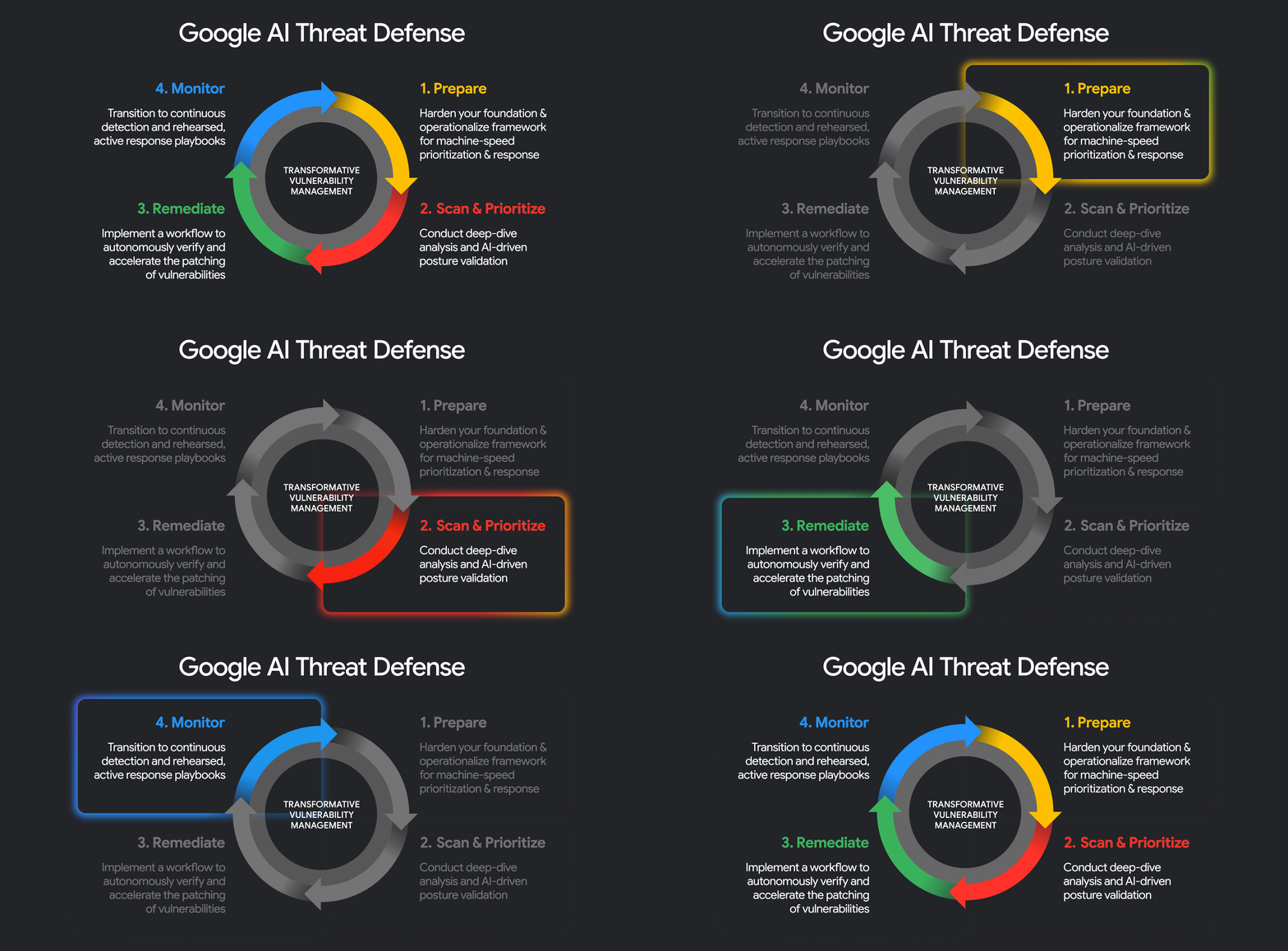
Built upon a decade of hyperscale infrastructure protection and deep neural network telemetry, Google AI Threat Defense represents an organic integration of security into the foundational fabric of Google Cloud Platform (GCP) and hybrid cloud environments. Rather than functioning as an overlay software application, the system operates as an always-on, intelligent substrate across four core operational pillars:
1. Continuous Telemetry & Deep Behavioral Synthesis
The platform constantly ingests and correlates multi-modal telemetry across infrastructure layers—from low-level kernel calls and API endpoints to identity management pipelines and cross-cloud database queries. Powered by Google’s specialized cyber-security foundation models, the system constructs a dynamic, real-time threat graph of the entire enterprise footprint, identifying subtle anomalies that precede a full-scale breach.
2. Proactive "Prepare & Harden" Infrastructure Foundation
Vulnerability management has historically been reactive, relying on periodic patching schedules that leave enterprises exposed during long exposure windows. Google AI Threat Defense fundamentally transforms vulnerability identification. The platform continuously simulates attack vectors against an organization’s digital twin, identifying misconfigurations, over-privileged identity access management (IAM) roles, and unpatched code pathways. It automatically recommends and applies micro-segmentation rules to shrink the attack surface before an adversary can strike.
3. Autonomous Autonomous Remediation (Machine-Speed MTTR)
When an active exploit attempt is detected, the platform does not merely send an alert to an overburdened SOC queue. Operating under pre-approved enterprise policies, Google AI Threat Defense executes immediate counter-measures: isolating compromised container clusters, revoking hijacked OAuth tokens, re-routing malicious traffic, and synthesizing hot-patches in real time. This reduces the Mean Time to Respond (MTTR) from an industry average of 21 days down to sub-second execution times.
4. Federated Intelligence & Collective Immunity
Exploiting Google’s global threat intelligence ecosystem, an attack vector observed against a single node anywhere in the global network is instantly analyzed, normalized, and converted into synthetic protection policies deployed across all participating enterprise tenants. This creates a global network effect of dynamic enterprise immunity.
Quantifying the Upgrade: Legacy SOC vs. Google AI Threat Defense
The transition to autonomous security architectures marks a structural break from legacy managed detection and response (MDR) frameworks. The following data breakdown illustrates key performance metrics comparing traditional enterprise security operations with Google’s new paradigm:
| Security Vector / Operational Metric | Legacy SOC & EDR Stack (2023–2025) | Google AI Threat Defense Platform | Enterprise Financial & Operational Impact |
|---|---|---|---|
| Mean Time to Detect (MTTD) | 160 to 200 Hours | < 3 Seconds | Near-instant containment of lateral threat movement. |
| Mean Time to Respond (MTTR) | 24 to 72 Hours (Post-Detection) | Sub-50 Milliseconds (Autonomous) | Eliminates catastrophic data exfiltration windows. |
| Vulnerability Remediation Cycle | 30 to 90 Days (Manual Patching) | Continuous / Real-Time Virtual Patching | Drastically reduces zero-day exposure windows. |
| Alert Fatigue Triage Efficiency | Over 70% False Positive Noise | 99.4% Automated Triage Accuracy | Reallocates human capital to high-value strategic engineering. |
| Cyber Risk & Insurance Premium Impact | Standard baseline rate escalation | Up to 35% reduction in Underwriter Risk Index | Direct reduction in annual risk-mitigation capex. |
Wall Street & Enterprise Economics: Valuation Multiples and Capital Allocation
The market implications of Google AI Threat Defense extend far beyond IT operational metrics; they hit the core of corporate enterprise valuation, balance sheet risk management, and capital allocation strategy.
Disruption of Legacy SaaS Security Vendors
For the past decade, enterprise security spending was dominated by point-solution fragmentation. Large organizations frequently managed 40 to 80 disparate security vendor contracts—a setup that added operational complexity and high subscription costs. By bundling an autonomous, foundational security engine directly into the cloud fabric, Google Cloud is putting intense margin pressure on legacy standalone Endpoint Detection and Response (EDR) and Security Information and Event Management (SIEM) providers.
Equity analysts expect a recalibration of SaaS valuation multiples for single-function security providers. Enterprise buyers are shifting capital allocation away from expensive per-seat software licenses toward native, usage-based cloud security architectures that offer proven enterprise ROI through direct risk reduction.
Regulatory Compliance & C-Suite Liability
With regulatory bodies such as the U.S. Securities and Exchange Commission (SEC), the European Union (under NIS2 and DORA regulations), and international financial authorities instituting strict mandatory breach reporting timelines and personal C-suite liability for oversight failures, autonomous defense is no longer optional. Google AI Threat Defense provides executive boards with verifiable compliance audits, immutable threat logs, and an institutional framework to demonstrate due care in safeguarding digital assets.
Frequently Asked Questions (People Also Ask)
How does Google AI Threat Defense fundamentally differ from traditional EDR/XDR platforms?
Traditional Endpoint Detection and Response (EDR) and Extended Detection and Response (XDR) systems rely on signature matching, heuristic rule sets, and human analysts to review alerts generated on endpoints. Google AI Threat Defense operates natively within the cloud infrastructure compute layer, using real-time machine intelligence to predict, identify, and autonomously remediate attacks across cloud workloads, APIs, networks, and identity layers simultaneously without requiring human intervention for containment.
What are the enterprise cloud infrastructure requirements to deploy the platform?
Google AI Threat Defense is designed for seamless deployment across native Google Cloud Platform (GCP) environments, while extending hybrid support to on-premises environments and multi-cloud architectures (including AWS and Azure) via Anthos and standardized agentless telemetry connectors. Organizations do not need to replace their existing core cloud compute architecture to activate the platform's continuous monitoring features.
How does the system impact an enterprise's cyber insurance premiums and capital expenditure?
By lowering both Mean Time to Detect (MTTD) and Mean Time to Respond (MTTR) from hours or days down to milliseconds, Google AI Threat Defense substantially reduces the financial risk of operational downtime and data exfiltration. Insurance underwriters recognize this autonomous risk reduction with lower deductible thresholds and up to 30–35% discounts on cyber risk policy premiums. Furthermore, it consolidates overlapping point solutions, driving down overall software enterprise licensing costs.
How does Google address privacy and data governance regarding threat telemetry?
Google AI Threat Defense uses privacy-preserving federated machine learning and zero-trust data boundaries. Customer data, proprietary application code, and internal network telemetry remain strictly bounded within the enterprise tenant's confidential compute zone. Threat intelligence models are updated using anonymized, synthetic abstraction parameters, ensuring that sensitive organizational data is never exposed or used to train public models.
Future Outlook: The Road Ahead for Autonomous Enterprise Defense
As Google AI Threat Defense rolls out across global commercial regions throughout mid-2026, the technology marks an irrevocable shift in cybersecurity strategy. The era of human-driven defense against machine-speed attacks is drawing to a close. Over the next 18 to 24 months, industry observers expect competitor hyper-scalers to fast-track similar native autonomous defense layers, accelerating a broader consolidation of the global security software ecosystem.
For C-suite executives, institutional investors, and IT directors, the imperative is clear: enterprise resilience in the AI age will no longer be measured by the size of a security operations budget or the number of dashboards monitored by human analysts. It will be defined by the speed, intelligence, and autonomy of the underlying system. With today’s release, Google Cloud has set a new benchmark for what it takes to outpace the adversary in an automated world.