WASHINGTON & DARMSTADT — In a watershed moment for international space cooperation and planetary risk mitigation, the European Space Agency’s (ESA) Hera spacecraft has captured its inaugural optical images of Dimorphos. This is the very moonlet that was intentionally battered by NASA’s Double Asteroid Redirection Test (DART) kinetic impactor more than two years ago. The newly released imagery, beamed back across millions of kilometers of interplanetary space, marks the transition of Hera from an ambitious engineering blueprint into an operational reconnaissance flagship. As institutional capital allocation increasingly flows into advanced aerospace infrastructure and defensive technologies, this milestone provides critical validation for space-based risk mitigation protocols and long-term asset protection strategies.
The acquisition of the first target image validates the spacecraft’s sophisticated navigation architecture, proving that its optical payload can isolate a low-albedo celestial body against the high-noise background of deep space. For aerospace prime contractors, avionics developers, and institutional investors monitoring the space economy, Hera represents a benchmark in deep-space autonomous navigation and precise telemetry. As governments worldwide re-evaluate national security vulnerabilities posed by Near-Earth Objects (NEOs), the data returned by Hera will serve as the foundational dataset for future planetary defense architectures, insurance risk-modeling, and regulatory frameworks governing orbital safety.
Executive Takeaways
Test Our Free AI & Tech Utilities Suite
Calculate LLM API token costs, analyze article dwell-time, or simulate tech DCA returns.
- First Visual Confirmation: ESA's Hera probe has successfully captured its first optical image of Dimorphos, the asteroid moonlet altered by NASA’s 2022 DART kinetic impact.
- Autonomous Navigation Milestone: The successful targeting and imaging demonstrate advanced optical navigation capabilities essential for deep-space missions and commercial infrastructure scalability.
- Post-Impact Forensic Analysis: Hera will spend months conducting high-resolution spectral and structural analyses to quantify the exact internal composition and crater morphology resulting from the DART impact.
- Economic & Strategic Implications: The mission establishes baseline metrics for planetary defense, directly influencing aerospace risk mitigation strategies, valuation multiples for defense tech contractors, and future public-private space resource initiatives.
The Catalytic Event: From DART’s Kinetic Strike to Hera’s Forensic Examination
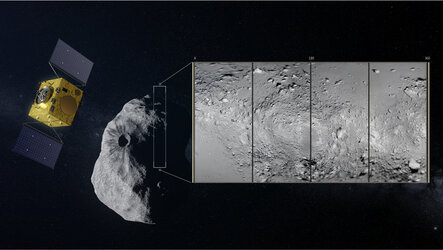
The narrative of modern planetary defense shifted irrevocably on September 26, 2002, when NASA’s DART spacecraft slammed into Dimorphos—the smaller companion of the near-Earth binary asteroid system Didymos—at roughly 6.1 kilometers per second. While the primary mission objective was an unqualified success, proving that a kinetic impactor could measurably alter an asteroid's orbital period, the physical consequences of the collision left fundamental scientific questions unanswered. DART’s terminal imagery captured a massive plume of ejecta, but scientists have since debated whether Dimorphos is a monolithic rock or a loosely bound "rubble pile" held together merely by weak gravitational forces.
Enter Hera. Developed under ESA’s Directorate of Human and Robotic Exploration, the Hera mission is designed to perform a comprehensive, post-mortem forensic investigation of the impact site. By closing the distance to the Didymos system, Hera aims to measure the exact mass of Dimorphos, characterize the crater morphology, and map the surface distribution of boulders and dust. This level of granular data is non-negotiable for engineers tasked with designing future deflection systems. Without accurate measurements of momentum transfer efficiency—known scientifically as the beta factor—calculating the enterprise ROI of a multi-billion-dollar planetary defense constellation remains speculative.
The recent acquisition of the first sighting confirms that Hera’s optical systems are operating within strict tolerance parameters. As the probe maneuvers closer over the coming months, it will deploy two shoebox-sized CubeSats—Milani and Juventas—to conduct ultra-close-range radar sounding and surface mineralogy mapping. This multi-layered approach ensures that mission controllers can maximize data acquisition efficiency, minimizing cloud-compute latency during processing and optimizing the telemetry bandwidth available for transmission back to the European Space Operations Centre (ESOC) in Darmstadt, Germany.
Verified Data & Metrics Breakdown
| Mission Parameter | NASA DART (2022) | ESA Hera (Current Mission) |
|---|---|---|
| Primary Objective | Kinetic impact demonstration & orbital deflection | Detailed post-impact forensic analysis & mass determination |
| Target Body | Dimorphos (160-meter moonlet of Didymos) | Didymos & Dimorphos binary asteroid system |
| Launch Date | November 24, 2021 | October 7, 2024 |
| Arrival Timeline | September 26, 2022 (Impact) | Late 2026 (Operational Insertion) |
| Key Payload Instruments | DRACO (Didymos Reconnaissance and Asteroid Camera for Optical navigation) | Asteroid Framing Cameras, Thermal Infrared Imager, Juventas & Milani CubeSats |
Industry & Market Implications: Capital Allocation and Aerospace Valuation
While framed as a pure scientific endeavor, the Hera mission carries profound financial and strategic implications for the global aerospace sector. For decades, planetary defense was viewed as an academic curiosity with negligible commercial applicability. However, the commercialization of low-Earth orbit (LEO), the emergence of private space stations, and the long-term horizon of asteroid mining have transformed orbital safety into a critical balance-sheet metric for institutional investors.
Corporations specializing in cloud-compute architecture, autonomous guidance systems, and advanced propulsion are seeing a surge in addressable market size. Defense contractors and venture capital funds are increasingly directing capital allocation toward technologies that ensure space domain awareness (SDA) and orbital risk mitigation. A failure to accurately map and categorize hazardous asteroids introduces systemic tail risks to multi-billion-dollar satellite constellations and upcoming lunar-industrial infrastructure.
Furthermore, the successful execution of the Hera mission strengthens transatlantic industrial cooperation between NASA and ESA. By sharing telemetry data and joint analytical frameworks, aerospace firms on both sides of the Atlantic are establishing interoperable standards. This regulatory compliance and technological standardization lower entry barriers for emerging commercial space ventures, driving valuation multiples upward for agile hardware startups that can integrate seamlessly with government-led deep-space networks.
Frequently Asked Questions (People Also Ask)
What is the primary mission of ESA’s Hera probe?
Hera is Europe’s first planetary defense mission. Its primary objective is to conduct a detailed, post-impact survey of the asteroid Dimorphos—the moonlet struck by NASA's DART spacecraft in 2022—to measure the crater size, mass, and internal structure, thereby validating kinetic impact technology for future asteroid deflection.
How does Hera communicate with Earth over such vast distances?
Hera utilizes high-gain deep-space communication antennas operating in X-band and Ka-band frequencies. These systems interface directly with the European Space Tracking (ESTRACK) network of large ground stations, ensuring high-bandwidth data transmission and precise Doppler tracking across millions of kilometers.
Why is studying Dimorphos important for commercial space industries?
Understanding the exact physical composition and mechanical strength of asteroids provides critical data for mitigating risks to orbital satellite constellations, commercial space stations, and future space resource extraction initiatives. Accurate impact modeling is essential for safeguarding long-term capital investments in the space economy.
When will Hera arrive at the Didymos asteroid system?
Following its launch in October 2024 and a gravity-assist flyby of Mars in 2025, Hera is scheduled to arrive at the Didymos and Dimorphos binary system in late 2026, where it will begin its intensive operational phase.
Future Outlook and Strategic Milestones
As Hera continues its interplanetary trajectory toward the Didymos system, aerospace analysts and mission scientists are closely monitoring several critical milestones. The upcoming trajectory correction maneuvers, scheduled over the next twelve months, will test the spacecraft’s propulsion reliability and autonomous optical guidance software under deep-space thermal conditions.
Upon arrival in late 2026, the deployment of the Milani and Juventas CubeSats will mark a technological first: the deployment of autonomous sub-spacecraft to perform internal radar tomography of a celestial body. The resulting data will not only finalize humanity’s understanding of the DART impact but will also establish a gold standard for international planetary defense protocols.
For institutional investors and enterprise leaders, the success of Hera underscores the viability of high-complexity public-private space initiatives. As global policymakers draft stricter regulatory compliance frameworks for orbital asset protection, the technologies proven by Hera—ranging from fault-tolerant cloud computing architectures in space to hyper-precise optical tracking—will form the bedrock of the 21st-century space economy. The eyes of the global scientific and financial communities remain firmly locked on Europe's pathfinder as it charts a safer course through the cosmos.