BOCA CHICA, Texas — In a watershed moment that redraws the competitive landscape of the global aerospace industry, SpaceX has successfully launched Starship into Earth orbit for the first time. The monumental achievement by the largest and most powerful rocket ever engineered represents far more than an audacious mechanical spectacle; it signals a fundamental disruption in the commercial, civil, and defense space economies, positioning Elon Musk’s venture to cement an unprecedented monopoly over deep-space logistics.
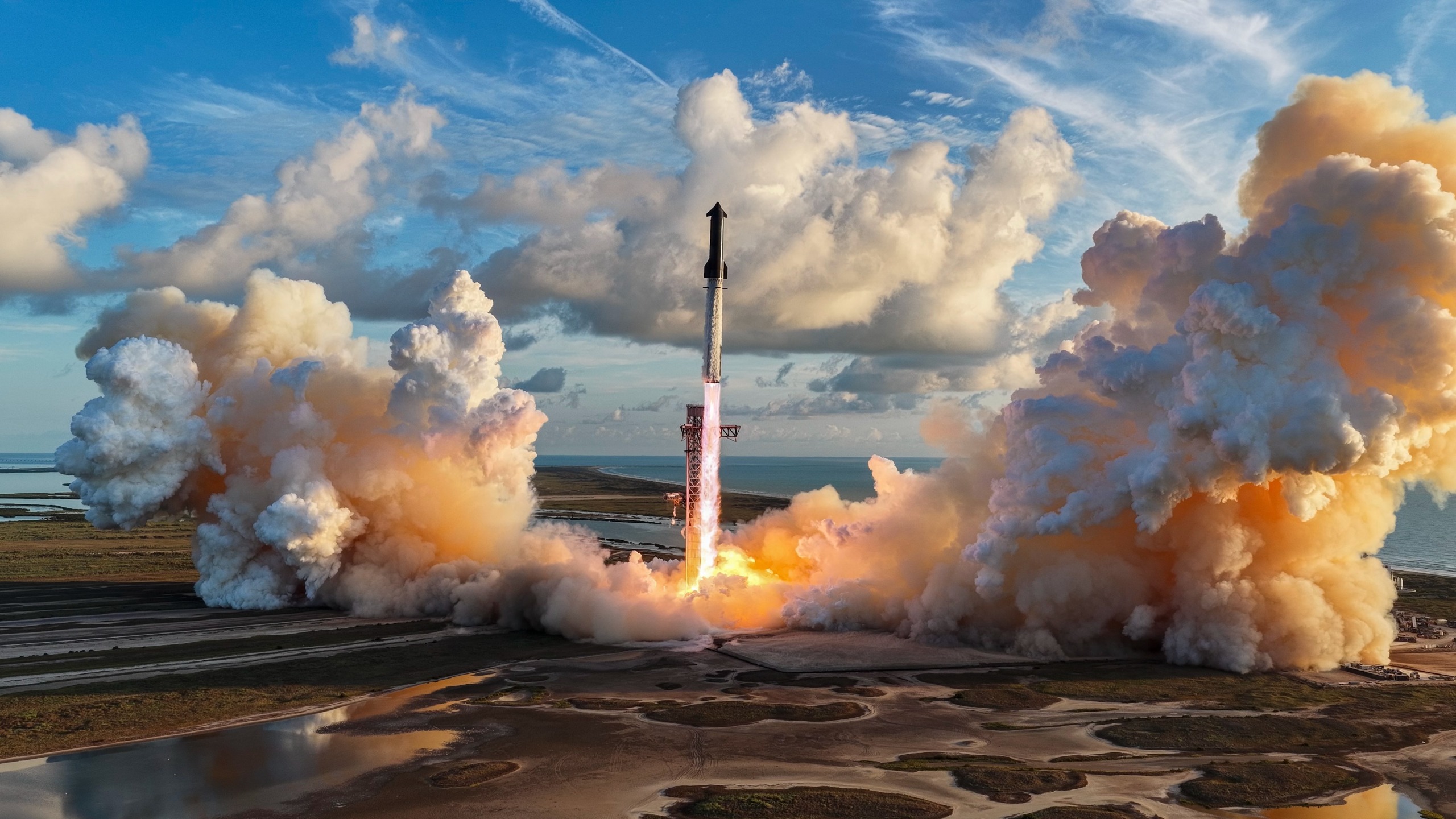
Thundering off the orbital launch pad at Starbase along the South Texas coastline, the 397-foot-tall (121-meter) stainless-steel behemoth ignited all 33 Raptor engines on its Super Heavy booster, producing an unprecedented 16.7 million pounds of thrust. The mission successfully cleared stage separation, propelled the upper-stage Starship to nominal orbital velocity, and demonstrated operational engine restarts in the vacuum of space. The flight marks the crossing of the technical chasm between experimental prototypes and an operational heavy-lift platform capable of transforming interplanetary travel from science fiction into commercial infrastructure.
Executive Summary: The Strategic Takeaways
- First Confirmed Orbital Insertion: SpaceX’s integrated Starship vehicle achieved targeted orbital velocity for the first time in program history, proving the viability of its methane-fueled, multi-engine architecture.
- Total Payload Superiority: Designed to carry up to 150 metric tons to low-Earth orbit (LEO) in fully reusable configuration, Starship dwarfs the payload capacity of any active launch vehicle on Earth, including NASA’s Space Launch System (SLS) and United Launch Alliance’s Vulcan Centaur.
- Crushing the Cost Curve: Analysts estimate that operational Starship flights could slash launch costs from approximately $1,500–$2,500 per kilogram on Falcon 9 down to under $100 per kilogram, triggering a massive deflationary shock for commercial satellite deployment and space manufacturing.
- Artemis Program De-risked: The milestone offers profound relief to NASA leadership, which has committed over $4 billion to Starship as the foundation for the Artemis III and IV Human Landing Systems (HLS) tasked with returning American astronauts to the lunar surface.
The Flight Profile: Overcoming the Thermal and Orbital Crucible
The successful test flight showcased textbook execution across critical flight regimes that had challenged earlier development models. Rising through the maximum aerodynamic pressure window (Max-Q), the Super Heavy booster completed its full-duration burn before executing a high-precision hot-staging maneuver—firing the upper stage's Raptor engines while still joined to the booster to maximize payload efficiency.
While the Super Heavy performed its boostback burn targeting a controlled descent profile, Starship’s ship-level six Raptor engines fired cleanly to propel the vehicle into a stable orbital trajectory. Telemetry monitored at Starbase headquarters confirmed zero significant engine dropouts during the ascent phase, validating recent thermal management and fuel-feed turbopump redesigns introduced following previous suborbital tests.
"This milestone proves out the most complex rocketry architecture ever conceptualized," an engineering director familiar with the flight operations observed. "Orbital velocity was the critical hurdle. Everything from this point onward is optimization, reusability, and flight tempo."
Wall Street and Commercial Ramifications: Disrupting Launch Markets
The successful orbital delivery will send shockwaves through sovereign launch programs and legacy defense primes. SpaceX already commands an estimated 60% to 70% share of commercial orbital launches globally through its workhorse Falcon 9 fleet. Starship’s ascent to operational capability threatens to render traditional expendable rockets commercially unviable overnight.
For satellite mega-constellations, the calculus changes entirely. Starship is slated to deploy SpaceX's next-generation Starlink V2 satellites in bulk—spacecraft too heavy and physically large for Falcon 9 fairings. A single Starship launch will be capable of deploying hundreds of high-throughput communication nodes in one mission, multiplying Starlink’s global broadband bandwidth while lowering orbital maintenance overhead.
Defense departments and intelligence agencies are equally attentive. The U.S. Space Force has pursued Starship integration studies through its "Rocket Cargo" initiative, analyzing the vehicle’s ability to deliver up to 100 tons of humanitarian or tactical supplies anywhere on Earth within 90 minutes.
Key Metrics: Starship vs. Active Heavy-Lift Rockets
| Launch Vehicle | Liftoff Thrust (lbf) | Payload to LEO (Metric Tons) | Architecture Reusability | Estimated Launch Cost |
|---|---|---|---|---|
| SpaceX Starship | 16.7 Million | 100–150 (Reusable) / 250 (Expendable) | Fully Reusable (Ship + Booster) | ~$10M–$20M (Long-term target) |
| NASA SLS (Block 1) | 8.8 Million | 95 | Expendable | ~$2.0 Billion+ per launch |
| Falcon Heavy | 5.1 Million | 64 | Partially Reusable | ~$90 Million–$150 Million |
| ULA Vulcan Centaur | 2.1 Million | 27 | Expendable | ~$110 Million–$130 Million |
The Horizon: Orbital Refueling and the Mars Imperative
Despite the historic success, the flight path toward commercial readiness remains technically rigorous. The immediate subsequent hurdles for SpaceX revolve around two critical bottlenecks: atmospheric re-entry thermal survivability and ship-to-ship orbital cryogenic propellant transfer.
Because Starship must return through atmospheric entry at orbital velocities exceeding Mach 25, the ceramic heat shield tiles protecting its windward belly remain subject to extreme aerodynamic stress. Perfection of this thermal protection system without extensive refurbishing downtime is paramount to achieving the commercial aircraft-like flight cadence envisioned by Musk.
Furthermore, lunar and Martian missions will necessitate orbital refueling depots. Reaching the Moon under NASA’s Artemis contract will require several consecutive tanker Starships to launch in rapid succession, refueling the primary Human Landing System in LEO before its trans-lunar injection. With orbital insertion now unlocked, SpaceX is expected to shift rapid prototyping resources toward in-orbit fuel transfer trials within the next twelve months.
Frequently Asked Questions
Why is reaching orbit such a critical milestone for Starship?
Achieving orbital velocity (roughly 17,500 mph or 28,000 km/h) demonstrates that the rocket can deliver operational satellites, defense assets, and crew modules to space without falling back along a suborbital arc. It proves that the vehicle's structural weight, engine thrust, and propellant capacity match orbital mechanical requirements, moving Starship out of prototype testing into operational qualification.
What does this mean for NASA's Artemis Moon missions?
This success drastically de-risks NASA’s timetable for Artemis III, which depends entirely on a modified Starship vehicle to carry astronauts from lunar orbit down to the South Pole of the Moon. Had Starship failed to demonstrate reliable orbital insertion, NASA would have faced significant domestic and congressional pressure to postpone target lunar landing dates or alter mission architectures.