Executive Takeaways
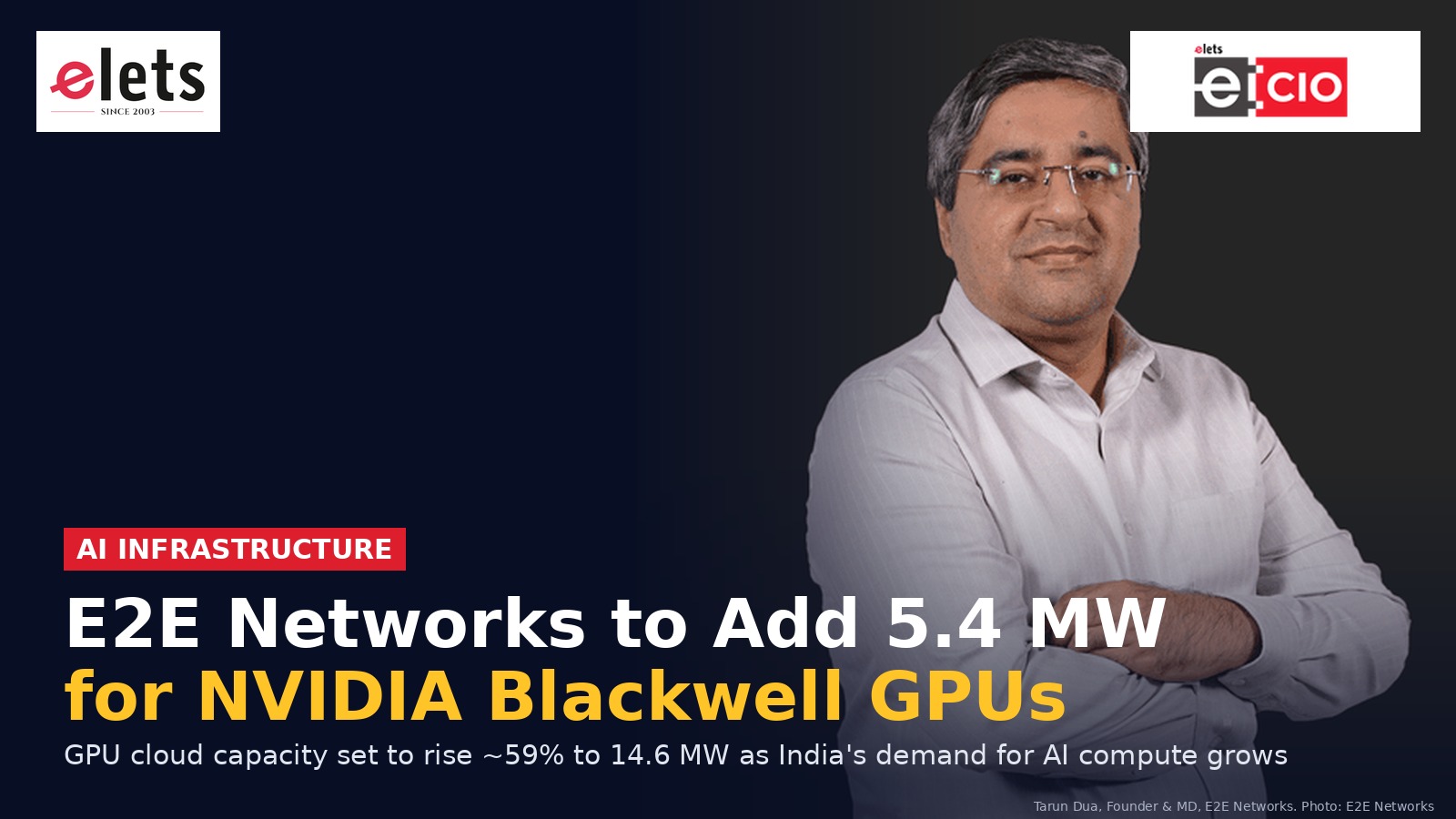
- Aggressive Scale: E2E Networks is injecting an additional 5.4 MW of state-of-the-art NVIDIA Blackwell GPU architecture into its domestic cloud grid, pushing total active AI infrastructure capacity to an unprecedented 14.6 MW.
- Enterprise ROI & High-Performance Compute: The strategic capital allocation targets surging domestic and regional demand for sovereign enterprise generative AI training, ultra-low latency inference, and complex large language model (LLM) deployments.
- Competitive Positioning: By securing early enterprise-grade access to NVIDIA’s next-generation Blackwell platforms, E2E solidifies its moat against hyperscale cloud providers entering the South Asian emerging tech corridor.
- Valuation & Liquidity Catalyst: The infrastructure expansion underpins structural shifts in enterprise cloud compute architecture, driving revenue quality expansion and shifting margin profiles higher for specialized AI cloud providers.
NEW DELHI & MUMBAI — In a definitive move that underscores the relentless corporate race for sovereign artificial intelligence infrastructure, home-grown hyperscale cloud provider E2E Networks has announced a major capital expenditure program to integrate 5.4 megawatts (MW) of cutting-edge NVIDIA Blackwell AI capacity. Revealed earlier today via primary wire sources at ET Datacenters, this aggressive expansion lifts the firm’s total dedicated AI computational infrastructure to 14.6 MW.
For institutional investors, venture capital syndicates, and enterprise chief technology officers, this announcement marks a watershed moment in the monetization of generative AI workloads across emerging markets. As global supply chains for advanced silicon remain heavily constrained, E2E Networks’ ability to secure and deploy NVIDIA's flagship Blackwell architecture signals a profound maturation in regional cloud compute architecture—shifting the competitive paradigm away from legacy hyper-scalers toward nimble, specialized AI-first utilities.
The Catalytic Shift: Decoding the 5.4 MW NVIDIA Blackwell Deployment
Test Our Free AI & Tech Utilities Suite
Calculate LLM API token costs, analyze article dwell-time, or simulate tech DCA returns.
To understand the magnitude of this infrastructure acceleration, one must examine the baseline mechanics of modern enterprise AI deployment. Training foundational large language models (LLMs) and running real-time, high-concurrency enterprise inference workloads demand power densities and parallel processing capabilities that legacy data centers simply cannot support. Standard rack densities hovering around 5kW to 10kW are entirely obsolete in the era of accelerated computing, where next-generation server nodes routinely demand 40kW to over 100kW per rack.
E2E Networks’ infusion of 5.4 MW of NVIDIA Blackwell infrastructure is not merely a quantitative addition; it is a qualitative leap in cloud compute architecture. The NVIDIA Blackwell platform—engineered specifically to slash the cost and energy footprint of building and running real-time generative AI at scale—delivers up to 25x lower TCO (Total Cost of Ownership) and energy consumption compared to its predecessor, the Hopper architecture.
By scaling its aggregate AI compute footprint to 14.6 MW, E2E Networks is systematically positioning itself as the premier infrastructure layer for digital-native enterprises, financial institutions, healthcare giants, and government bodies requiring localized data residency coupled with tier-one computational horsepower. This strategic maneuver directly addresses enterprise risk mitigation, ensuring that local firms are insulated from cross-border latency issues, data sovereignty regulations, and escalating geopolitical export controls on advanced semiconductors.
Financial Engineering, Capital Allocation, and Valuation Multiples
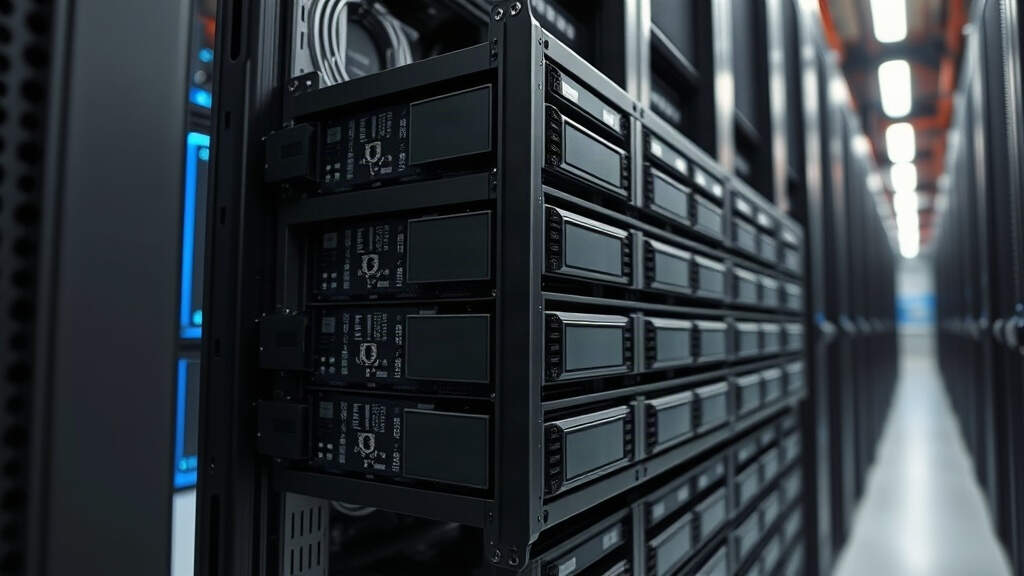
In the domain of specialized cloud computing, capital expenditure (CapEx) dictates market valuation multiples. Building and maintaining high-density AI data centers requires robust capital allocation strategies, careful debt-to-equity balancing, and optimized asset lifecycle management. E2E Networks’ latest capacity expansion reflects a calculated bet on expanding enterprise margins through high-utilization, mission-critical GPU-as-a-Service (GPUaaS) offerings.
Traditional cloud providers often experience margin compression due to the commoditization of standard CPU instances. Conversely, specialized AI infrastructure providers command premium pricing power driven by acute, structural supply deficits in global GPU availability. By embedding NVIDIA Blackwell architecture directly into its ecosystem, E2E Networks unlocks high-margin revenue streams derived from enterprise AI model training, fine-tuning, and vector-database operations.
| Infrastructure Metric | Pre-Expansion Baseline | Post-Expansion Target (Current) | Strategic Impact |
|---|---|---|---|
| Total AI Capacity (MW) | 9.2 MW | 14.6 MW | +58.7% surge in high-performance compute bandwidth |
| Primary GPU Architecture | NVIDIA Hopper & Legacy | NVIDIA Blackwell Integration | Exponential leap in generative AI training speeds & inference throughput |
| Target Market Segment | Mid-market & Startup AI | Enterprise, BFSI, & Sovereign AI | Higher contract values, stickier enterprise retention, improved unit economics |
| Cooling & Power Density | Standard Air Cooling | Advanced Liquid-Assisted Cooling | Optimized Power Usage Effectiveness (PUE) and thermal management |
Financial analysts tracking the transaction note that this infrastructure expansion directly enhances the company’s enterprise ROI profile. By deploying Blackwell GPUs—renowned for their second-generation transformer engines and secure confidentiality features—E2E Networks can capture high-value enterprise contracts that previously would have leaked to foreign hyper-scalers operating via offshore data availability zones.
Industry & Market Implications: The Battle for Sovereign AI Infrastructure
The broader economic ramifications of E2E Networks’ scaling initiative extend well beyond corporate balance sheets. Across emerging digital economies, the concept of "Sovereign AI"—the ability of a nation and its domestic enterprises to produce artificial intelligence using local infrastructure, data, workforce, and business networks—has transitioned from a geopolitical talking point into an urgent board-level imperative.
Who Wins:
- Enterprise Consumers: Domestic banking, financial services, insurance (BFSI), and e-commerce giants gain immediate access to world-class computational power without incurring punitive international data transfer fees or breaching strict regulatory compliance mandates.
- E2E Networks Shareholders: Scaled infrastructure unlocks operational leverage, driving higher EBITDA margins as utilization rates across the 14.6 MW grid mature.
- NVIDIA’s Ecosystem Partners: Validates the rapid regional adoption of the Blackwell architecture, reinforcing NVIDIA’s undisputed dominance in accelerated computing hardware.
Who Loses:
- Legacy Local Data Center Operators: Competitors slow to retrofit their facilities for high-density liquid cooling and advanced GPU racks face terminal obsolescence as enterprise clients migrate en masse to specialized AI clouds.
- Offshore Hyperscalers Lacking Local Zones: Global cloud giants burdened by higher latency and regulatory friction find it increasingly difficult to compete with agile, localized players embedded directly within domestic regulatory frameworks.
Frequently Asked Questions (People Also Ask)
What is the significance of E2E Networks adding 5.4 MW of NVIDIA Blackwell capacity?
The addition of 5.4 MW increases E2E Networks' total AI infrastructure capacity to 14.6 MW. Integrating NVIDIA's next-generation Blackwell architecture enables the company to deliver vastly superior generative AI training speeds, ultra-low latency inference, and enterprise-grade security, positioning it as a leading provider of sovereign AI infrastructure.
How does NVIDIA Blackwell differ from previous GPU architectures in cloud deployment?
NVIDIA Blackwell introduces breakthrough innovations, including a second-generation transformer engine and native support for massive trillion-parameter LLMs. It delivers up to 25x lower TCO and energy consumption compared to previous architectures, making it radically more efficient for high-density enterprise cloud environments.
What are the primary financial and valuation implications for E2E Networks?
By expanding into high-margin GPU-as-a-Service (GPUaaS) offerings powered by Blackwell, E2E Networks shifts its revenue mix away from commoditized CPU hosting. This strategic capital allocation supports expanding EBITDA margins, attracts institutional capital, and justifies premium valuation multiples.
What regulatory and compliance advantages does this local infrastructure expansion provide?
Hosting advanced AI infrastructure domestically ensures full compliance with strict data residency laws, financial regulatory frameworks, and enterprise data governance standards. It mitigates cross-border data transfer risks and shields domestic corporations from international supply chain disruptions.
Future Outlook: Milestones and Strategic Horizons to Watch
As E2E Networks operationalizes its expanded 14.6 MW AI cloud grid, market observers and equity research analysts will closely monitor several key execution milestones over the next twelve to eighteen months:
- Grid Utilization Rates: Tracking how rapidly the newly commissioned 5.4 MW Blackwell capacity achieves optimal commercial utilization rates across enterprise client pipelines.
- Power and Cooling Efficiency (PUE): Evaluating the performance metrics of advanced liquid-cooling systems deployed to handle the extreme thermal loads generated by Blackwell server nodes.
- Software Ecosystem Integration: Assessing the depth of proprietary orchestration tooling, containerization layers, and developer APIs offered by E2E Networks to simplify complex multi-node GPU training workflows.
- Subsequent CapEx Announcements: Monitoring whether market demand catalysts prompt management to announce secondary expansion phases, pushing total capacity toward the 20 MW threshold and beyond.
Ultimately, E2E Networks’ calculated deployment of NVIDIA Blackwell capacity is a testament to the high-stakes evolution of enterprise cloud computing. In an economy where artificial intelligence serves as the primary engine of corporate productivity and national competitiveness, securing high-density, sovereign silicon infrastructure is no longer an experimental luxury—it is the ultimate determinant of commercial survival and market leadership.