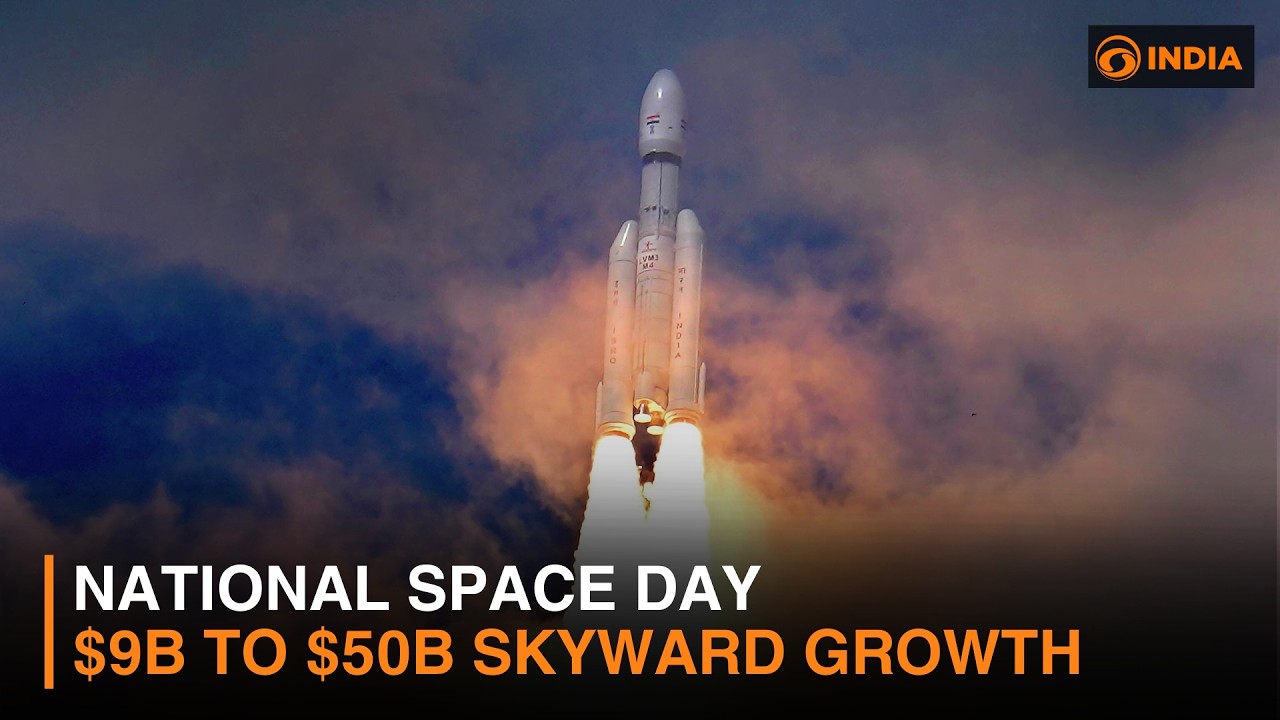
For decades, the global aerospace narrative was dominated by high-cost state monopolies and venture-backed Western billionaires. Today, that hegemony is being systematically dismantled from the ground up in Bengaluru and Sriharikota. On India’s National Space Day, the financial and geopolitical spotlight rests squarely on the Indian Space Research Organisation (ISRO) and a burgeoning private ecosystem that has propelled the nation's space economy to a robust $9 billion valuation. As capital allocation shifts and global enterprise clients seek resilient, cost-effective launch infrastructure, India’s strategic roadmap—anchored by a permanent space station by 2035—offers a masterclass in infrastructure scalability, engineering discipline, and long-term risk mitigation.
Drawing from exclusive wire reporting by NDTV Profit and deep-dive financial analyses, this investigative report dissects the catalysts behind India’s meteoric rise, evaluates the valuation multiples and market liquidity driving private space tech startups, and examines the long flight plan that will cement ISRO as a premier anchor of the 21st-century cosmic economy.
Executive Takeaways
- Market Valuation: India’s current space economy stands at $9 billion, representing approximately 2% to 3% of the global market, with aggressive projections targeting a $44 billion valuation by 2033.
- Capital Efficiency & ROI: ISRO’s legendary cost-to-capability ratio—exemplified by the historic Mars Orbiter Mission (Mangalyaan) operating on a fraction of Hollywood blockbuster budgets—has redefined enterprise ROI in deep-tech aerospace.
- Private Sector Integration: The establishment of IN-SPACe (Indian National Space Promotion and Authorization Centre) has unlocked venture capital liquidity, transforming over 200 deep-tech startups into viable commercial entities.
- The 2035 Horizon: ISRO’s long flight plan explicitly charts the deployment of an indigenous Bharatiya Antariksha Station by 2035 and a crewed lunar landing by 2040, creating massive supply chain opportunities for global manufacturing and software partners.
The Catalytic Shift: From State Monopoly to Commercial Ecosystem

To understand the mechanics of India's $9 billion space economy, one must examine the fundamental structural pivot executed by New Delhi over the past four years. Historically, ISRO operated as a closed, vertically integrated state agency. While this model yielded astonishing technological milestones—including the recent, flawless Chandrayaan-3 lunar south pole landing—it severely constrained market liquidity and private sector participation.
The turning point arrived with the 2020 space sector reforms. By opening the floodgates to private enterprise, the government effectively unbundled ISRO's monopoly. This paved the way for the creation of IN-SPACe, a single-window regulatory agency designed to streamline compliance, facilitate technology transfers, and grant private entities access to state-owned launch facilities at Sriharikota. NewSpace India Limited (NSIL), the commercial arm of ISRO, subsequently stepped up its monetization efforts, transforming scientific breakthroughs into high-margin global export services.
This institutional restructuring altered the risk profile for domestic and international institutional investors. Venture capital firms and private equity funds, once wary of the capital-intensive and high-failure nature of aerospace, recognized that partnering with ISRO offered immediate risk mitigation. Startups could leverage decades of proven flight-tested hardware, bypassing the treacherous and expensive trial-and-error phase that plagues Western upstarts.
Financial Architecture and Valuation Multiples in Indian NewSpace
The influx of private capital into India’s aerospace sector is no longer speculative; it is grounded in tangible enterprise metrics. Companies like Skyroot Aerospace and Agnikul Cosmos are pioneering modular, carbon-composite launch vehicles designed to capture the booming small-satellite (SmallSat) deployment market. These firms are securing substantial funding rounds, driven by predictable revenue models rooted in contract-based payload delivery.
In the realm of Earth Observation (EO) and cloud compute architecture, startups such as Pixxel are deploying hyperspectral imaging constellations. These data streams provide institutional clients in agriculture, mining, and urban planning with granular analytics, translating raw orbital data into recurring SaaS-style revenue streams. Consequently, valuation multiples for top-tier Indian space-tech firms are decoupling from traditional manufacturing benchmarks, aligning more closely with high-growth enterprise software and deep-tech SaaS multiples.
Furthermore, India's cost advantage remains an unassailable economic moat. While Western launch providers grapple with soaring labor costs and stringent regulatory overheads, Indian aerospace engineers deliver world-class propulsion systems, avionics, and software solutions at a fraction of the cost. This structural labor arbitrage, combined with rigorous engineering standards, has turned India into the preferred outsourcing and co-development hub for global satellite operators seeking to optimize their capital allocation.
Verified Data: India's Space Sector Trajectory
| Metric / Milestone | Current Status (Baseline) | Projected Target | Strategic Implication |
|---|---|---|---|
| Total Space Economy Size | $9 Billion | $44 Billion (by 2033) | Quadrupling of market share, capturing ~8% of the global space economy. |
| Active Private Startups | 200+ Registered Entities | 500+ by 2030 | Deepening market liquidity and expanding the domestic supply chain. |
| Launch Vehicle Capabilities | PSLV, GSLV, LVM3, SSLV | Reusable Launch Vehicles (RLV) | Drastic reduction in cost-per-kilogram to orbit, boosting export competitiveness. |
| Human Spaceflight & Infrastructure | Gaganyaan Test Flights | Bharatiya Antariksha Station (2035) | Establishing sovereign orbital habitat and long-duration life support capabilities. |
Industry & Market Implications: Who Wins, Who Loses?
The rapid maturation of India's space economy sends distinct shockwaves across the global competitive landscape. The definitive winners are agile private aerospace manufacturers, downstream data analytics providers, and global telecommunications giants seeking reliable, low-cost launch services. Additionally, traditional engineering institutions and specialized component suppliers across tier-2 Indian cities are experiencing a massive windfall as supply chains localize.
Conversely, legacy state-backed agencies and high-cost private launchers in Western markets face severe competitive pressure. As ISRO and its commercial partners demonstrate the ability to launch multi-satellite constellations with high reliability and ultra-low pricing, pricing power in the commercial SmallSat launch market is shifting eastward. Traditional providers that fail to optimize their cloud-native telemetry, manufacturing workflows, and capital structures risk losing vital market share in the lucrative equatorial launch segment.
Frequently Asked Questions (People Also Ask)
1. What is the current size of India’s space economy, and what are the growth projections?
India’s space economy is currently valued at approximately $9 billion, accounting for a modest yet rapidly expanding share of the global market. According to government roadmaps and industry estimates endorsed by bodies like IN-SPACe, this valuation is projected to scale exponentially to $44 billion by 2033, driven by commercial downstream services, satellite manufacturing, and increased launch frequencies.
2. How has the role of ISRO changed with the 2020 space reforms?
Historically, ISRO functioned as both the regulator and the sole executor of all space activities in India. Following the 2020 structural reforms, ISRO has transitioned into a research-and-development powerhouse and technology enabler. Regulatory oversight and promotion of private enterprise have been delegated to IN-SPACe, while commercialization and marketing of ISRO's technological spin-offs are managed by NewSpace India Limited (NSIL).
3. What are the key milestones in ISRO's long flight plan leading up to 2035?
ISRO’s long-term roadmap features several critical milestones. These include the uncrewed and crewed test flights of the Gaganyaan human spaceflight mission, the operationalization of reusable launch vehicles (RLV), the establishment of an indigenous space station—the Bharatiya Antariksha Station—by 2035, and a targeted crewed lunar landing mission by 2040.
4. How can international investors participate in India’s booming space sector?
Foreign Direct Investment (FDI) guidelines have been liberalized significantly, allowing up to 100% FDI in certain segments of the space sector (such as satellite manufacturing, data systems, and ground segment components) under specific automatic routes. Global venture capitalists, private equity funds, and aerospace conglomerates are increasingly forming joint ventures with Indian deep-tech startups to capitalize on local engineering talent and manufacturing scalability.
Future Outlook: Navigating the 2035 Horizon
As National Space Day celebrations underscore India's profound technical achievements, the strategic horizon points toward unprecedented complexity. The coming decade will test the operational synergy between ISRO and India’s private sector. Success will hinge on sustained capital allocation, the successful deployment of heavy-lift reusable launch systems, and the seamless integration of AI-driven satellite constellations into global enterprise workflows.
For institutional investors, corporate strategists, and geopolitical analysts, the message is unambiguous: India’s space economy is no longer a localized regional initiative. It is a highly disciplined, rapidly scaling commercial powerhouse destined to anchor the architecture of the global space economy for the next half-century.