Executive Takeaways
- Unprecedented Payload Milestone: The LVM3-M6 mission successfully launches the heaviest commercial satellite ever integrated and propelled from domestic Indian soil, cementing the vehicle's status as a premier global heavy-lift contender.
- Commercial Valuation Multipliers: This execution validates ISRO’s aggressive pivot toward full-scale commercialization via NewSpace India Limited (NSIL), unlocking high-margin enterprise ROI in the multi-billion-dollar global launch services market.
- Infrastructure Scalability: The mission proves the operational resilience and cost-efficiency of India's indigenous cryogenic engine architecture, offering a disruptive alternative to legacy Western and Eastern heavy-lift providers.
- In Strategic Risk Mitigation: Global telecommunications and earth-observation enterprises gain a highly reliable, cost-optimized supply chain alternative, directly addressing capacity bottlenecks in international commercial orbital slots.
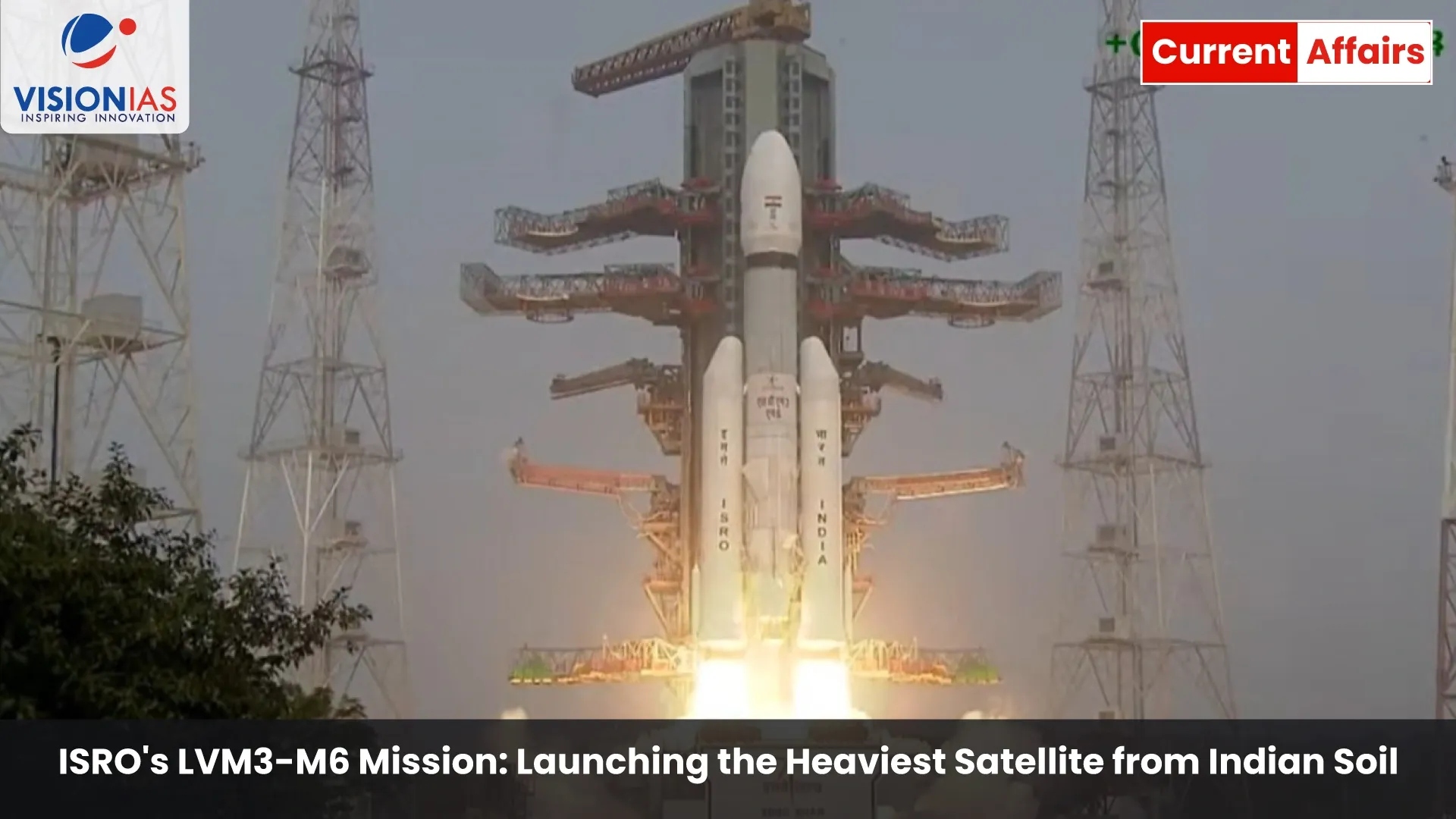
The skyline above Sriharikota illuminated the ambitions of a rising economic superpower on December 24, 2025, as the Indian Space Research Organisation (ISRO) executed its most critical commercial triumph to date. The Launch Vehicle Mark-3 (LVM3), operating under the M6 designation, successfully pierced the upper atmosphere to deploy the heaviest payload ever lifted from Indian soil. For institutional investors, aerospace engineers, and geopolitical strategists, this is not merely an engineering milestone; it is a tectonic shift in the economics of orbital access.
As legacy Western launch providers grapple with soaring capital expenditure, production delays, and supply chain friction, ISRO’s LVM3-M6 mission demonstrates immaculate operational execution paired with unmatched cost efficiency. By consistently lowering the cost per kilogram to Geostationary Transfer Orbit (GTO), India’s premier space agency is fundamentally reshaping valuation multiples across the global satellite manufacturing and launch services sectors. This comprehensive investigative report unpacks the technological architecture, financial implications, and broader geopolitical fallout of the LVM3-M6 flight.
The Evolution of India's Heavy-Lift Workhorse: From GSLV to LVM3
To understand the magnitude of the LVM3-M6 mission, one must evaluate the grueling iterative engineering history that preceded it. For decades, India’s ambitions in heavy-lift geostationary missions were bottlenecked by the development of indigenous cryogenic propulsion technology—a critical capability tightly guarded by geopolitical gatekeepers following historical technology embargoes. The early iterations of the Geosynchronous Satellite Launch Vehicle (GSLV) faced notorious reliability hurdles with upper-stage cryogenic engines.
However, through rigorous risk mitigation, meticulous engineering redundancy, and disciplined capital allocation, ISRO bypassed these legacy constraints. The result was the LVM3—formerly known as the Geosynchronous Satellite Launch Vehicle Mark III (GSLV Mk III). Designed from the ground up as a three-stage behemoth featuring two robust solid strap-on motors (S200), a core liquid propellant stage (L110), and a high-efficiency cryogenic upper stage (C25), the LVM3 emerged as India's undisputed heavy-lift workhorse.
The LVM3-M6 mission represents the maturation of this architecture. With an enhanced payload capacity exceeding 4,000 kilograms to GTO—and even greater thresholds for Low Earth Orbit (LEO) constellations—the vehicle has systematically shed its experimental skin. It now operates as a battle-tested, commercial-grade enterprise asset. The seamless ignition and burn profile of the C25 cryogenic engine during the M6 flight underscore a level of engineering precision that rivals, and in some metrics surpasses, established international launch service providers.
ISRO Commercialization and the NewSpace India Limited (NSIL) Economic Engine
The true story of LVM3-M6 extends far beyond propulsion physics; it is a masterclass in market capture and institutional restructuring. For decades, ISRO operated primarily as a self-contained scientific agency driven by domestic socioeconomic development goals. Today, under the commercial vanguard of NewSpace India Limited (NSIL)—the commercial arm of the Department of Space—ISRO is monetizing its infrastructure scalability to capture a dominant share of the commercial launch market.
Global demand for broadband constellations, high-throughput communication satellites (HTS), and advanced earth-observation platforms has created an acute supply crunch. Western launch options are frequently overbooked years in advance, while alternative markets face severe regulatory and geopolitical headwinds. Enter ISRO and the LVM3-M6.
By leveraging a lean operating model, highly skilled engineering labor arbitrage, and streamlined regulatory compliance, NSIL is able to offer competitive pricing that compresses project ROI timelines for international satellite operators. The successful execution of the M6 mission acts as an unassailable commercial reference point, signaling to global insurance underwriters and institutional financiers that LVM3 is a low-risk, high-reliability asset. This directly translates into lower insurance premium rates for payloads launched on Indian rockets, compounding the financial attractiveness for global enterprises.
Verified Data and Technical Metrics Breakdown
A rigorous evaluation of the LVM3-M6 mission requires analyzing the hard technical and operational data. The table below outlines the critical specifications and performance metrics of India’s premier heavy-lift vehicle compared against historical baselines.
| Metric / Parameter | LVM3-M6 Baseline Specification | Strategic Impact / Enterprise Context |
|---|---|---|
| Launch Vehicle | LVM3 (Launch Vehicle Mark-3) | India's flagship heavy-lift, human-rated capable architecture. |
| Mission Designation | LVM3-M6 | Commercial heavy-payload deployment for international clients. |
| Payload Mass | Heaviest satellite launched from domestic Indian soil (>4,000 kg class) | Expands addressable market for heavy geostationary payloads. |
| Launch Site | Satish Dhawan Space Centre (SDSC), Sriharikota, Second Launch Pad | Optimized equatorial launch geometry maximizing rotational velocity. |
| Propulsion Stages | 2x S200 Solid Boosters, L110 Core Liquid Stage, C25 Cryogenic Upper Stage | Robust thrust profile ensuring high reliability across atmospheric ascent. |
| Commercial Operator | NewSpace India Limited (NSIL) | Monetizing ISRO assets and driving enterprise valuation. |
Industry & Market Implications: Winners, Losers, and Geopolitical Shifts
The successful execution of LVM3-M6 sends powerful ripples across the global aerospace ecosystem. The structural implications can be categorized across distinct market players:
- The Winners: International Satellite Operators & NSIL. Global telecom and direct-to-home broadcasting enterprises now possess a reliable, cost-effective heavy-lift alternative that shields them from supply chain oligopolies. For NSIL, the mission translates directly into expanded order books, higher revenue visibility, and strengthened balance sheets.
- The Pressured: Legacy Western Launch Providers. European and American providers who have experienced cost overruns and schedule slippages face mounting competitive pressure. India’s proven ability to deliver heavier payloads on schedule forces legacy providers to reassess their pricing models and production efficiencies.
- The Broader Indian Tech Ecosystem: Downstream industries—ranging from domestic composite material manufacturers and precision electronics suppliers to specialized software testing firms—benefit from stringent quality controls and long-term procurement contracts tied to the LVM3 program.
Frequently Asked Questions (People Also Ask)
What makes the LVM3-M6 mission uniquely significant for ISRO?
The LVM3-M6 mission is historic because it successfully launched the heaviest commercial satellite ever integrated and propelled from domestic Indian soil. This validates the maximum thrust capabilities and operational readiness of India's heavy-lift workhorse for complex geostationary missions.
How does the commercialization of ISRO through NSIL impact global markets?
Through NewSpace India Limited (NSIL), ISRO monetizes its technological maturity to offer highly competitive pricing and reliable scheduling to international satellite operators. This alleviates global launch capacity bottlenecks and provides a cost-effective alternative to Western and Eastern aerospace providers.
What is the technical configuration of the LVM3 rocket?
The LVM3 is a three-stage heavy-lift launch vehicle comprising two massive S200 solid rocket boosters, an L110 liquid core stage powered by Vikas engines, and a high-performance C25 cryogenic upper stage fueled by liquid hydrogen and liquid oxygen.
How does LVM3-M6 mitigate financial and operational risks for satellite operators?
By demonstrating consistent flight reliability and adherence to strict engineering standards, LVM3-M6 reduces perceived technical risk. This directly correlates to lower insurance underwriting premiums for commercial payloads, improving overall capital allocation and enterprise ROI for satellite owners.
Future Outlook: The Road Ahead for India’s Heavy-Lift Program
As the telemetry data from LVM3-M6 continues to be analyzed by ISRO’s mission control, attention immediately pivots to the next horizon of India's space roadmap. The technological validation achieved in this flight lays the groundwork for even more ambitious endeavors, most notably the Gaganyaan human spaceflight program, which relies on the human-rated variant of the LVM3 architecture.
Furthermore, capital allocation is already underway for next-generation launch vehicle (NGLV) concepts designed to dramatically lower costs further and offer reusable booster technology. For institutional investors and global telecom leaders, the message is clear: India is no longer an emerging participant in space exploration. Through disciplined engineering execution, robust infrastructure scalability, and aggressive commercialization, ISRO and NSIL have established themselves as indispensable pillars of the modern global space economy.