Executive Takeaways
- Paradigm Shift in Agentic Workflows: Meta’s introduction of "Spaces" integrated with the proprietary "Muse" agent marks a definitive pivot from passive conversational AI to autonomous, multi-user collaborative environments designed for high-stakes enterprise settings.
- Infrastructure and Cloud Compute Demands: The rollout places unprecedented stress on distributed cloud compute architecture, driving massive capital expenditure allocations toward custom inference silicon and low-latency data transmission.
- Competitive Pressure on Enterprise SaaS: By consolidating workflow orchestration, shared document editing, and autonomous synthetic reasoning into a single ecosystem, Meta is aggressively disrupting traditional valuation multiples of legacy software-as-a-service incumbents.
- Risk Mitigation and Governance: Enterprise risk officers are scrutinizing data privacy protocols, compliance frameworks, and regulatory hurdles surrounding agentic memory persistence and cross-tenant data handling.
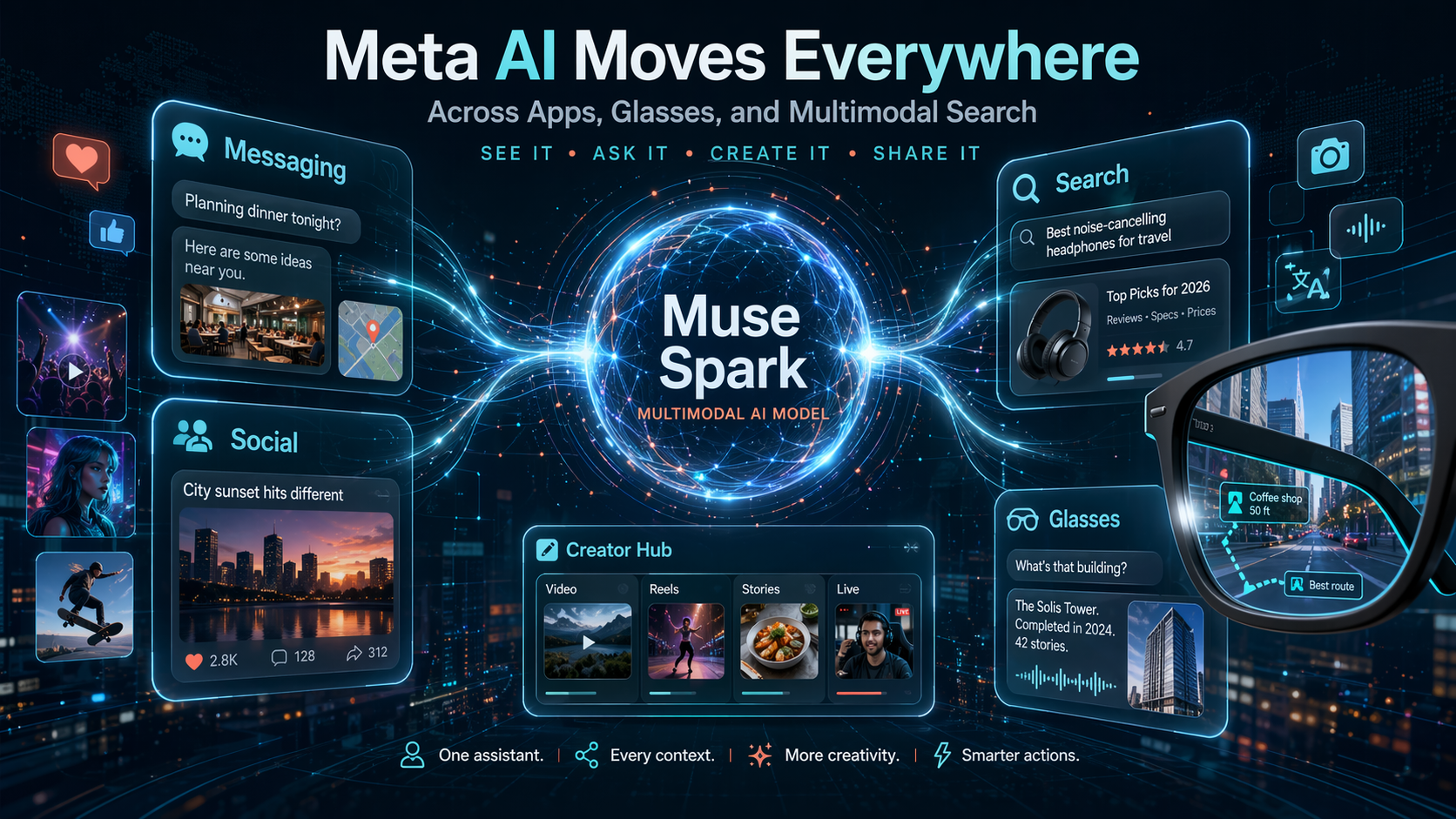
NEW YORK — In a strategic maneuver that reverberates across Silicon Valley boardrooms and Wall Street trading desks alike, Meta Platforms has officially unveiled "Spaces," a collaborative digital environment anchored by its next-generation artificial intelligence persona, the Muse agent. Designed to bridge the chasm between human cognitive output and autonomous machine execution, this release represents far more than a routine product update; it is a foundational recalibration of how enterprise teams conceptualize software interaction, workflow automation, and shared spatial computing.
As institutional investors reevaluate tech sector valuation multiples in light of soaring artificial intelligence capital expenditures, Meta’s latest initiative forces a rigorous examination of enterprise return on investment (ROI). For months, financial analysts have tracked the monetization vectors of large language models. With Spaces and Muse, Meta is moving beyond consumer-facing novelty, setting its sights squarely on lucrative enterprise software budgets traditionally dominated by legacy titans such as Microsoft, Salesforce, and Google Workspace.
The Catalytic Evolution: From Standalone Chatbots to Shared Agentic Ecosystems
Test Our Free AI & Tech Utilities Suite
Calculate LLM API token costs, analyze article dwell-time, or simulate tech DCA returns.
To understand the strategic gravity of the Spaces rollout, one must trace the trajectory of Meta’s foundational artificial intelligence architecture over the past twenty-four months. Following the open-source dissemination of the Llama model family, Meta established a dominant posture in model developer mindshare. However, the commercialization gap—turning open-weights models into sticky, high-margin enterprise utilities—remained an acute strategic vulnerability.
Enter the Muse agent. Unlike conventional conversational interfaces that operate on a strict single-user query-and-response paradigm, Muse is engineered as a persistent, state-aware digital colleague. Integrated within "Spaces"—a virtual, persistent workspace tailored for multi-user collaboration—Muse does not merely answer questions; it observes context, synthesizes real-time multimedia inputs, tracks project milestones, and proactively executes complex workflows across disparate software silos.
According to internal product disclosures obtained by investigative industry sources, Spaces utilizes an advanced state-management protocol that allows multiple human operators to collaborate concurrently alongside multiple instances of the Muse agent. If a financial analytics team is modeling a complex merger and acquisition scenario, the Muse agent can autonomously pull live market liquidity data, run Monte Carlo simulations, generate visualization dashboards, and critique structural assumptions in real-time, all within an interface designed to mimic spatial presence and contextual awareness.
Infrastructure Scalability and Capital Allocation Realities

Deploying persistent, multi-agent collaborative environments at a global scale requires an extraordinary commitment to cloud compute architecture. Meta’s capital expenditure (CapEx) guidance for the current fiscal year has already signaled aggressive investments in next-generation data center buildouts, custom-designed Meta Training and Inference Accelerator (MTIA) silicon, and high-bandwidth networking fabrics.
The technical hurdles are formidable. Unlike asynchronous text generation, maintaining synchronized, low-latency agentic spaces where multiple humans and autonomous agents manipulate live state vectors demands radical optimization of inference pipelines. Network latency must be compressed to sub-millisecond thresholds to prevent user friction in collaborative environments. Consequently, Meta’s partnership ecosystem—engaging primary cloud service providers and semiconductor foundries—is operating under extreme execution pressure.
From a corporate finance perspective, Wall Street will monitor whether the operational efficiency gains promised by Spaces and Muse translate into accelerated top-line revenue growth for Meta’s business messaging and enterprise monetization verticals, or if they will merely inflate cost-of-goods-sold (COGS) through exorbitant compute amortization schedules.
Verified Data & Metrics Breakdown
The following comparative matrix synthesizes key technical, operational, and financial specifications associated with the Meta Spaces and Muse agent launch relative to prevailing industry benchmarks:
| Metric / Specification | Legacy SaaS Platforms (Pre-2024) | Meta Spaces & Muse Integration | Strategic Implication |
|---|---|---|---|
| Collaboration Paradigm | Human-to-human with asynchronous AI plugins | Simultaneous multi-human & multi-agent autonomous loops | Massive compression of project cycle times. |
| Inference Architecture | Standardized GPU clusters running batch queries | Optimized persistent state inference on custom silicon | Lower marginal cost per query; higher upfront CapEx. |
| Data Persistence & Memory | Session-based or fragmented document storage | Cross-session dynamic context graphs via Muse | Enhanced contextual continuity; heightened privacy review. |
| Target Monetization Vector | Per-seat enterprise subscription licensing (SaaS) | Value-based agentic throughput & workspace tiering | Disruption of traditional seat-based pricing models. |
Industry & Market Implications: Winners and Losers
The introduction of Spaces and the Muse agent is poised to trigger significant structural realignments across the technology and financial sectors. Identifying the structural beneficiaries and casualties requires a cold, objective assessment of competitive moats.
The Winners
- Enterprise Productivity Early Adopters: Organizations operating in fast-paced sectors such as management consulting, financial services, and software engineering will experience exponential throughput gains by delegating administrative and analytical drudgery to Muse.
- Cloud Infrastructure and Silicon Providers: Specialized semiconductor manufacturers and advanced data center operators will capture sustained demand as Meta and its competitors scale up infrastructure to support persistent agentic memory.
- Meta Platforms (META): By successfully diversifying its revenue model away from pure-play digital advertising and establishing a dominant foothold in enterprise workflow orchestration, Meta strengthens its long-term equity valuation narrative.
The Losers
- Legacy Point-Solution SaaS Vendors: Companies offering narrow, single-purpose collaboration tools or basic document editors face existential obsolescence as comprehensive platforms like Spaces absorb standalone functionality.
- Traditional Outsourcing and Business Process Management (BPM): Routine data processing, transcription, and baseline financial modeling tasks historically outsourced to external firms can now be executed autonomously within a Muse-powered Space at a fraction of the cost.
Frequently Asked Questions (People Also Ask)
What is Meta Spaces, and how does it interact with the Muse agent?
Meta Spaces is a collaborative digital environment designed for team-based operations, allowing human users and artificial intelligence entities to work concurrently within a shared workspace. The Muse agent acts as the autonomous intelligence core within Spaces, capable of tracking project history, executing complex computational tasks, and contributing dynamically to human discussions and workflows.
How does the Muse agent differ from traditional enterprise chatbots?
Unlike standard chatbots that operate reactively on single prompts, the Muse agent maintains cross-session memory persistence, monitors broader project context across multiple team members, and possesses the autonomous capability to execute workflows across integrated software applications without continuous human micromanagement.
What are the primary enterprise risk management and regulatory compliance concerns?
Chief Risk Officers are primarily evaluating data privacy, cross-tenant data leakage, and regulatory compliance regarding persistent agentic memory. Because Muse absorbs and retains complex contextual data from collaborative sessions, enterprises must implement rigorous governance frameworks to ensure proprietary intellectual property and sensitive client data remain secure.
How will this release impact the enterprise software pricing model?
Meta Spaces challenges the traditional per-seat Software-as-a-Service (SaaS) pricing model. As autonomous agents take on the workload of multiple human positions, enterprise software procurement is expected to shift toward value-based metrics, agentic compute consumption tiers, and outcome-based billing structures.
Future Outlook and Key Milestones to Watch
As Meta rolls out Spaces and the Muse agent across initial enterprise pilot cohorts, market observers and institutional analysts should monitor several critical milestones over the next twelve to eighteen months:
- Enterprise Conversion Metrics: Watch for disclosures regarding conversion rates from free pilot tiers to high-value enterprise contracts, particularly within Fortune 500 financial and technology conglomerates.
- Security and Compliance Certifications: The speed at which Meta secures stringent regulatory compliances—such as SOC 2 Type II, ISO/IEC 27001, and industry-specific financial data standards—will dictate the velocity of adoption in highly regulated sectors.
- Ecosystem Developer Adoption: The breadth of third-party API integrations made available within Spaces will determine whether Muse becomes a closed walled garden or an extensible platform capable of dominating the broader enterprise software stack.
Ultimately, Meta’s strategic gambit with Spaces and the Muse agent signals that the era of passive conversational AI has concluded. We have officially entered the epoch of autonomous, collaborative agentic systems—a transformation that will permanently redefine enterprise economics, cloud infrastructure investments, and the fundamental nature of work itself.