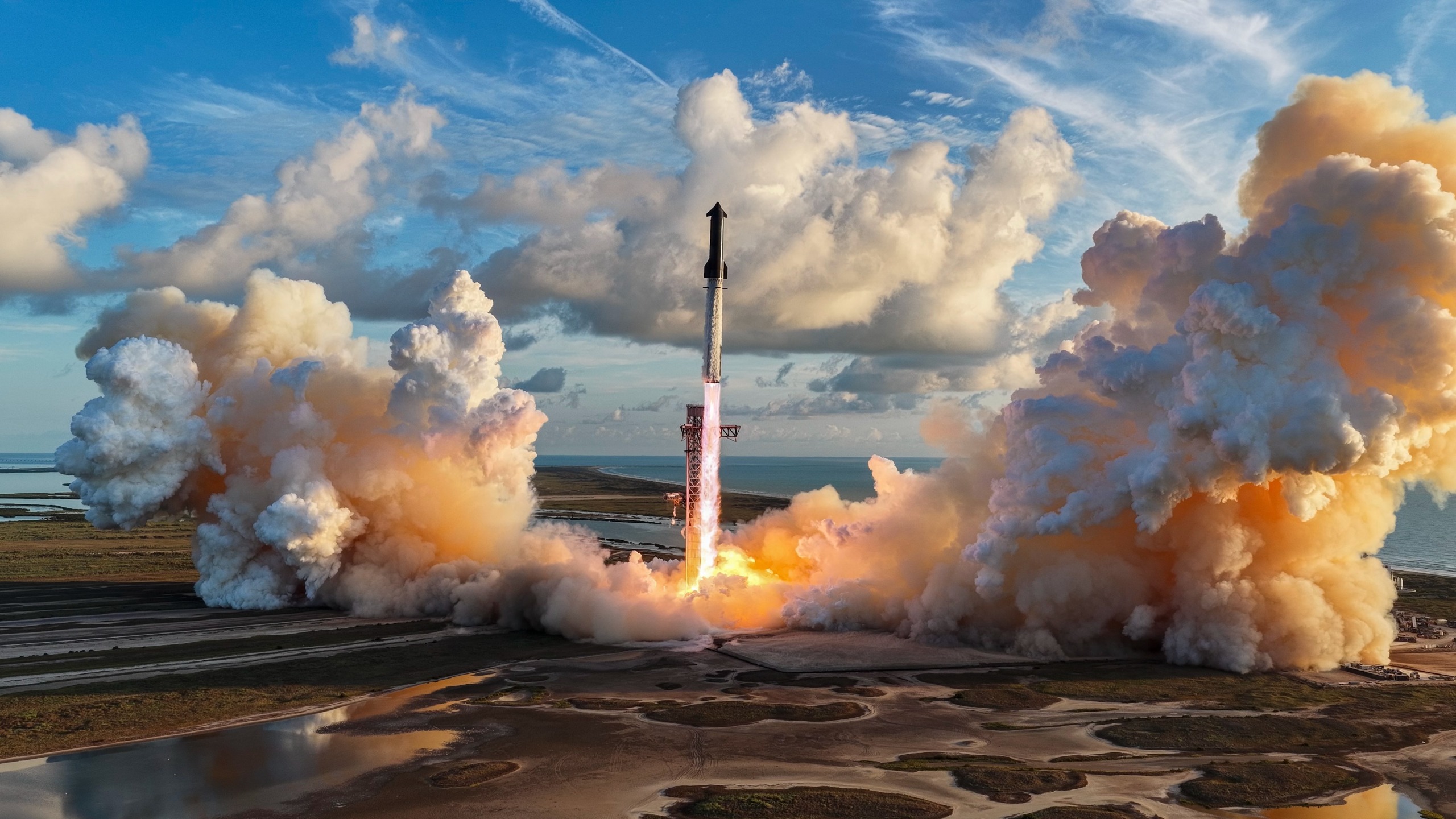
BOCA CHICA, Texas — In a watershed moment for commercial aerospace and interplanetary exploration, SpaceX successfully launched its massive Starship rocket into Earth orbit for the first time during a dramatic Flight 14 test. The milestone marks a monumental turning point for Elon Musk’s private space corporation, instantly transforming theoretical space colonization logistics into an operational reality.
The successful orbital insertion of the largest, most powerful rocket ever built not only validates years of iterative, high-risk prototype testing but also fundamentally shifts the global aerospace paradigm. Wall Street analysts and industry veterans alike are already recalibrating valuations and timelines for lunar landings, orbital manufacturing, and deep-space logistics.
Executive Summary: Key Takeaways
- Historic First: Starship successfully achieved orbital insertion on its 14th integrated flight test, validating the spacecraft's core architecture.
- Engineering Triumph: The towering 400-foot stainless-steel vehicle cleared its historic launch hurdles, proving the viability of full reusability at scale.
- Economic Shift: Drastically lowered payload-to-orbit costs open lucrative new avenues for satellite mega-constellations, orbital infrastructure, and commercial space tourism.
- Global Markets React: Aerospace competitors face mounting pressure as SpaceX accelerates its timeline for NASA’s Artemis lunar missions and eventual Martian transport.
The Anatomy of Flight 14: Overcoming the Crucible of Iterative Design
Liftoff from SpaceX’s Starbase facility in Boca Chica, Texas, unfolded under intense global scrutiny. Previous test flights, while providing invaluable telemetry, frequently ended in fiery mid-air anomalies. However, Flight 14 demonstrated the fruit of relentless engineering iterations, successfully navigating Max-Q (maximum aerodynamic pressure), stage separation, and orbital burn execution.
The Super Heavy booster—equipped with 33 Raptor engines—generated an unprecedented 16.5 million pounds of thrust, pushing the integrated stack past the Karman line. By successfully executing its orbital trajectory, Starship proved it can carry massive payloads—up to 150 metric tons fully reusable—into low-Earth orbit and beyond.
On social platforms like Reddit's r/space, enthusiasm reached fever pitch, with the primary discussion thread surging past 3,700 upvotes and hundreds of detailed technical breakdowns within hours. Industry watchers noted that the sheer scale of the vehicle makes every successful milestone a psychological victory for the commercial space sector.
| Metric / Specification | Starship Details |
|---|---|
| Total Height | 121 meters (397 feet) |
| Payload Capacity (Reusable) | 100–150 metric tons |
| Propulsion (Super Heavy) | 33 Raptor Engines |
| Key Milestone Reached | First Successful Orbital Insertion (Flight 14) |
Economic and Geopolitical Implications
For institutional investors and macroeconomic forecasters, Starship’s orbital breakthrough represents a profound deflationary shock to the space economy. Historically, launching heavy cargo into orbit carried prohibitive cost structures per kilogram. Starship’s fully reusable architecture is engineered to slash launch costs by orders of magnitude.
This dramatic cost reduction acts as a powerful catalyst for multiple sectors:
1. National Security and Defense
Pentagon officials have closely monitored Starship's development. The capability to rapidly deploy heavy national security payloads, tactical communication grids, and logistics hardware anywhere on Earth within an hour presents a paradigm shift in global defense readiness.
2. Commercial Infrastructure
Telecommunications giants and Earth-observation firms can now plan massive, next-generation satellite architectures that were previously economically unfeasible. The barrier to entry for space-based manufacturing and solar energy collection has dropped precipitously.
3. NASA’s Artemis Campaign
NASA relies heavily on a modified Starship as the Human Landing System (HLS) to return American astronauts to the lunar surface. Today's successful orbital test provides crucial risk-reduction data, boosting confidence that the agency's timeline for lunar return remains achievable.
What Lies Ahead for Starship?
Despite the historic triumph of Flight 14, SpaceX’s engineering teams face a rigorous slate of subsequent challenges. The immediate focus will shift to perfecting rapid booster catch maneuvers using the "Mechazilla" launch tower arms, followed by orbital refilling tests—a critical prerequisite for deep-space missions to Mars.
As commercial space travel transitions from speculative frontier to high-throughput industrial corridor, today's successful launch will be remembered as the moment the heavy-lift bottleneck finally broke.
Frequently Asked Questions
Why is reaching orbit such a significant milestone for Starship?
While previous flights tested sub-orbital trajectories, atmospheric re-entry, and controlled descents, achieving orbit proves that Starship's propulsion, thermal protection, and guidance systems can sustain the extreme velocities and thermal environments required for long-duration space travel.
How does Starship impact the commercial satellite market?
By drastically increasing payload capacity while lowering per-kilogram launch costs, Starship enables companies to deploy larger, more sophisticated space stations, deep-space probes, and massive orbital constellations with fewer launches.