The Next Giant Leap: Inside NASA’s Artemis II Deep-Space Gamble and the Crew Pioneering Our Return to the Moon
WASHINGTON — For the first time in more than half a century, humanity is on the precipice of sending astronauts back into deep space. NASA’s Artemis II mission represents a historic, high-stakes bridge to the future—an audacious dry run designed to pave the way for sustainable lunar exploration and, ultimately, a crewed landing on the Moon by 2028 during the Artemis IV mission.
As geopolitical rivalries heat up and the commercial space economy surges, Artemis II is not merely a scientific endeavor; it is a profound demonstration of strategic aerospace dominance. With the mission drawing closer, global eyes are fixed on the four-member crew tasked with testing the absolute limits of NASA's Space Launch System (SLS) rocket and the Orion spacecraft.
The Mission Blueprint: What is Artemis II?
Unlike the Apollo missions of the late 1960s and 70s, which focused on rapid geopolitical point-scoring, the Artemis program is built around long-term infrastructure, safety, and international collaboration. Artemis II is the first crewed flight test in this campaign.
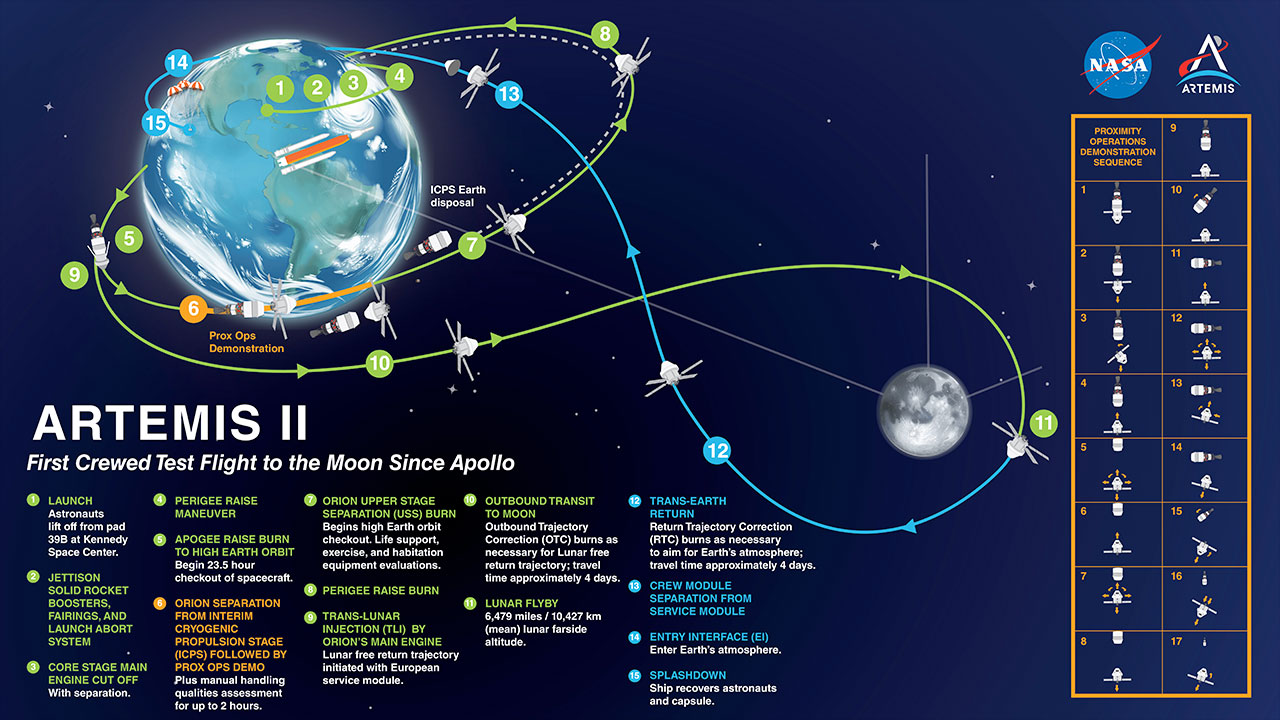
The 10-day mission will not land on the lunar surface. Instead, it will perform a high-altitude flyby, taking the crew further into deep space than any human has ever traveled. Using a "hybrid free-return trajectory," the Orion spacecraft will utilize the Earth’s gravity to catapult the crew around the far side of the Moon and pull them safely back home without requiring a massive engine burn for the return trip.
The overarching goal is simple yet incredibly demanding: prove that Orion’s life-support systems, communication arrays, and radiation shielding can keep astronauts alive and healthy in the harsh environment of deep space. Successfully executing Artemis II is the mandatory gatekeeper for Artemis III (the first surface landing) and Artemis IV, the 2028 mission slated to establish permanent infrastructure via the Lunar Gateway.
The Critical Mission Profile at a Glance
| Mission Element | Key Specification / Milestone |
|---|---|
| Spacecraft | NASA Orion (Crew Module) & ESA European Service Module |
| Launch Vehicle | Space Launch System (SLS) Block 1 |
| Mission Duration | Approximately 10 days |
| Maximum Distance | Over 4,600 miles (7,400 km) beyond the far side of the Moon |
| Primary Objective | Validate crew life-support, communication, and manual piloting systems |
| Ultimate Target | Lay foundation for the Artemis IV lunar landing in 2028 |
Meet the Crew: The Pioneers of the New Space Age
The four astronauts selected for Artemis II represent a modern, diverse, and highly experienced roster. Their backgrounds reflect a deliberate mix of military flight testing, long-duration orbital science, and international partnership.
- Reid Wiseman (Commander, NASA): A veteran U.S. Navy Captain who previously spent 165 days aboard the International Space Station (ISS). Wiseman will command the flight, bringing seasoned leadership to the critical testing phases of the mission.
- Victor Glover (Pilot, NASA): An experienced naval aviator who piloted the SpaceX Crew-1 mission. Glover will make history as the first person of color to fly to the vicinity of the Moon. His primary task is to pilot Orion and execute precision manual maneuvers.
- Christina Koch (Mission Specialist, NASA): The record-holder for the longest single spaceflight by a woman (328 days). An electrical engineer by trade, Koch will focus on navigating the complex scientific payloads and monitoring the spacecraft’s life-support vital signs.
- Jeremy Hansen (Mission Specialist, Canadian Space Agency): A fighter pilot in the Royal Canadian Air Force, Hansen is making his first journey into space. His inclusion underscores the deep geopolitical alliance between the U.S. and Canada in the modern space race.
What Exactly Will the Crew Be Doing in Space?
Once the SLS rocket clears the tower at Kennedy Space Center, the Artemis II crew will enter a highly scripted, high-intensity testing regime. They will not merely be passengers; they will be active test pilots putting a prototype deep-space vehicle through its paces.
1. High Earth Orbit (HEO) Operations
Before heading to the Moon, Orion will spend its first 24 hours in a high Earth orbit. During this period, the crew will perform critical manual piloting demonstrations. Victor Glover will manually fly Orion close to the spent interim cryogenic propulsion stage (ICPS) of the rocket. This test mimics the proximity operations that future crews will need to master to dock with landing landers and the Lunar Gateway.
2. Life-Support System Stress Tests
While in high Earth orbit, the crew will strip down and rebuild parts of the environmental control and life support systems (ECLSS). They will monitor carbon dioxide scrubbing, oxygen generation, and water recycling systems under the physical stress of four active human bodies—something that computer simulations can only replicate to a point.
3. Deep-Space Radiation Monitoring
Once they leave Earth's protective magnetosphere, the astronauts will face elevated levels of cosmic radiation and solar particles. The crew will actively monitor real-time dosimeters and test new personal shielding garments designed to protect astronauts during long-duration voyages, such as the upcoming Artemis IV mission.
The Geopolitical and Commercial Stakes
The timeline for Artemis II directly dictates the tempo of the entire program. By establishing a successful flight path now, NASA keeps its timeline intact for the ambitious Artemis IV mission in 2028. Artemis IV will not only land astronauts on the surface but will also deliver the first habitat modules to the Lunar Gateway, a mini-space station orbiting the Moon.
The economic stakes are massive. Private contractors like Boeing, Lockheed Martin, SpaceX, and Northrop Grumman have billions of dollars riding on the success of these early blocks. Furthermore, with China aggressively pushing its own lunar timeline to land taikonauts on the Moon by 2030, Artemis II is a vital demonstration of American-led technological supremacy. Failure or significant delay is not an option if Washington wishes to dictate the legal and economic framework for mining lunar resources under the Artemis Accords.
Frequently Asked Questions
Why is Artemis II not landing on the Moon?
Artemis II is a test flight designed to validate the spacecraft’s safety systems with humans on board for the first time. Landing on the Moon requires a separate landing craft (such as SpaceX’s Starship HLS), which is still undergoing rigorous development. Attempting a landing without first testing the core life-support and navigation systems in deep space would present an unacceptable safety risk.
How does Artemis II connect to the Artemis IV mission in 2028?
Artemis II validates the orbital mechanics, deep-space communications, and crew safety protocols. This data directly feeds into Artemis III (the first landing) and culminates in Artemis IV in 2028. Artemis IV will represent a mature phase of the program, utilizing the newly established Lunar Gateway to facilitate a sustainable, repeatable landing footprint on the lunar south pole.