Executive Takeaways
- The Core Event: A relentless October 2026 tech selloff culminated on October 30, dragging the Nasdaq Composite to its worst monthly performance in over 12 months as valuation multiples compressed rapidly.
- Catalytic Drivers: Institutional capital allocation shifts, rising sovereign yields, and compressed enterprise ROI timelines for generative AI infrastructure spooked institutional asset managers.
- Market Liquidity & Risk Mitigation: High-frequency algorithmic unwinding exacerbated intraday volatility, forcing major hedge funds to execute aggressive risk mitigation and deleveraging strategies.
- Macroeconomic Crosscurrents: Stubborn inflationary prints and shifting Federal Reserve rate expectations dismantled the "immortal growth" narrative that sustained mega-cap technology equities through early 2026.
NEW YORK — Wall Street closed out the final trading sessions of October 2026 in the grip of a severe liquidity squeeze. On October 30, a broadening rout across semiconductor heavyweights, hyperscale cloud providers, and high-beta software developers officially pushed the Nasdaq Composite into the record books for its worst monthly decline in over a year. What began as a routine portfolio rebalancing at the start of the fourth quarter morphed into a systemic repricing of risk, as institutional investors aggressively questioned whether astronomical capital expenditures in cloud compute architecture would ever yield commensurate enterprise returns.
As the closing bell rang, trading desks from Lower Manhattan to Mayfair painted a picture of structural exhaustion. The momentum trade that had defined the post-pandemic era is facing its most rigorous stress test to date. For corporate treasurers, venture capitalists, and retail market participants alike, the October 30 rout serves as a stark reminder that macroeconomic gravity ultimately supersedes corporate narrative, regardless of market capitalization.
Anatomy of a Liquidation: How October 2026 Unraveled
Test Our Free AI & Tech Utilities Suite
Calculate LLM API token costs, analyze article dwell-time, or simulate tech DCA returns.
The roots of the October 30 selloff extend far beyond short-term algorithmic trading noise. Throughout the third quarter of 2026, institutional investors had grown increasingly vocal regarding capital allocation discipline. For nearly three years, Wall Street rewarded unchecked spending on large language model training clusters, specialized silicon, and data center real estate. However, as Chief Financial Officers across the Fortune 500 demanded clearer enterprise ROI on artificial intelligence deployments, the valuation multiples of high-flying software-as-a-service (SaaS) providers and hardware manufacturers began to crack.
The turning point arrived mid-month when a cluster of disappointing forward guidance statements from bellwether semiconductor manufacturers exposed supply chain bottlenecks and softening enterprise demand. As earnings reports rolled in, institutional asset managers began trimming exposure to richly valued equities. By October 30, these localized liquidations metastasized into a broad-based index contraction. Passive exchange-traded funds (ETFs) and systematic risk-parity strategies were forced to sell into a thinning order book, accelerating downward price momentum and triggering cascading stop-loss orders across major electronic communication networks (ECNs).
Furthermore, structural shifts in fixed-income markets added fuel to the fire. Ten-year Treasury yields hovered near restrictive levels, driving the equity risk premium down to historic lows. Institutional portfolio managers, facing attractive yields in short-duration corporate debt and money market funds, found little incentive to hold non-dividend-paying growth equities trading at forward price-to-earnings multiples exceeding 40 times.
Verified Data and Metrics Breakdown
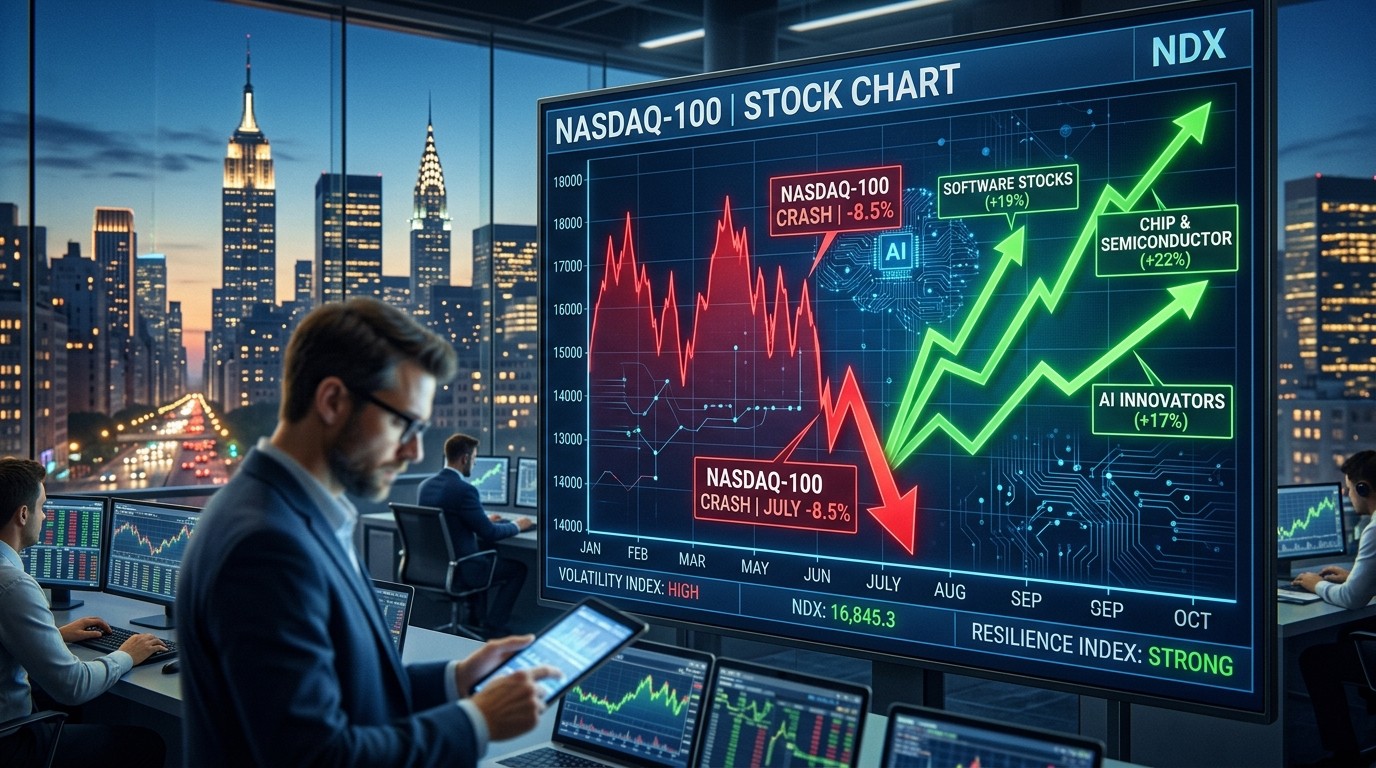
A rigorous examination of the market statistics from the October 30 close highlights the severity of the correction across major benchmarks:
| Index / Asset Class | October 2026 Return | Primary Catalytic Driver | Implied Valuation Impact |
|---|---|---|---|
| Nasdaq Composite | -8.4% (Worst Month Since Late 2025) | Semiconductor liquidation & multiple compression | P/E contraction from 38x to 31x forward earnings |
| S&P 500 Information Technology | -6.9% | Hyperscale cloud capex scrutiny | Significant reduction in speculative premium |
| CBOE Volatility Index (VIX) | +34.2% (MoM Surge) | Spike in downside put option hedging | Elevated cost of capital protection |
| U.S. 10-Year Treasury Yield | 4.38% (Avg. for Month) | Persistent inflation and resilient labor data | Increased discount rate applied to future cash flows |
Industry & Market Implications: Winners, Losers, and Systemic Ripple Effects
Every major market dislocation redistributes capital and exposes vulnerabilities. The October 30 tech selloff has created distinct battle lines across global industries:
- The Losers — High-Beta Growth & Unprofitable Tech: Venture-backed startups, pre-revenue biotechnology firms, and enterprise software companies relying on cash-burning customer acquisition models bore the brunt of the selloff. Without immediate profitability or pristine balance sheets, these entities face a severe closure of primary equity capital markets.
- The Losers — Hyperscale Infrastructure Spenders: Mega-cap cloud service providers saw billions wiped from their market valuations as analysts scrutinized the depreciation schedules of newly acquired AI hardware. The market is no longer cheering massive infrastructure spending unless accompanied by immediate margin expansion.
- The Winners — Value, Financials, and Defensive Sectors: As capital rotated out of technology, traditional value stocks, dividend-aristocrat consumer staples, and select financial institutions experienced relative outperformance. Investors seeking shelter turned to cash-flow-generative businesses with strong pricing power capable of navigating sticky inflation environments.
- Regulatory & Compliance Watchdogs: The sharp intraday price swings on October 30 reignited debates among regulators regarding algorithmic market making, dark pool liquidity, and systemic risks tied to passive indexing. Expect increased scrutiny on systemic market plumbing in the coming legislative session.
Frequently Asked Questions (People Also Ask)
Frequently Asked Questions
Q: What triggered the massive tech selloff on October 30, 2026?
A: The selloff was driven by a combination of factors, including mounting investor skepticism over enterprise ROI for artificial intelligence infrastructure, rising sovereign bond yields, aggressive institutional portfolio rebalancing, and algorithmic unwinding that accelerated selling pressure across mega-cap tech stocks.
Q: How does the October 2026 tech correction compare to historical downturns?
A: While not as severe structurally as the 2022 bear market or the 2000 dot-com bust, this correction marks the Nasdaq's worst monthly performance in over a year. It highlights a decisive shift from growth-at-all-costs mentalities to strict adherence to profitability, balance sheet health, and tangible earnings growth.
Q: Are high interest rates solely responsible for the Nasdaq's decline?
A: No. While elevated Treasury yields increased the discount rate applied to future corporate cash flows—disproportionately hurting long-duration tech assets—micro-level concerns regarding capital allocation discipline, slowing hardware demand, and compressed profit margins played an equally decisive role.
Q: What should institutional investors monitor next as November approaches?
A: Institutional portfolios should closely monitor upcoming Federal Reserve policy announcements, third-quarter earnings guidance revisions, corporate debt maturity walls, and macroeconomic indicators such as employment data and consumer price indices to gauge future market liquidity.
Future Outlook: Navigating the Post-October Landscape
As Wall Street transitions from October to the final two months of 2026, the prevailing sentiment among chief investment officers is one of cautious recalibration. The era of blind faith in hyper-growth technology narratives has officially given way to a discerning, fundamentals-driven regime. Corporate boards must now demonstrate disciplined capital allocation, verifiable enterprise ROI, and robust free cash flow generation to regain the confidence of jittery institutional shareholders.
Key milestones to watch in the coming weeks include upcoming central bank policy decisions, holiday retail spending metrics, and the final wave of fourth-quarter corporate earnings guidance. While volatility is expected to remain elevated as year-end tax-loss harvesting commences, disciplined asset managers view this market cleansing not as a structural collapse, but as a long-overdue valuation reset that restores sanity to global capital markets.